


















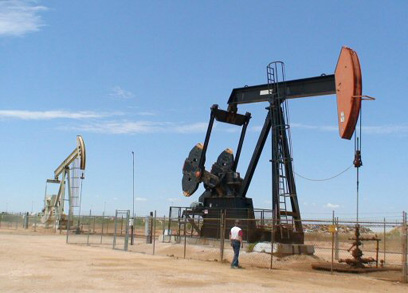


WASHINGTON, Feb 7 — America’s legacy Permian Basin, the biggest of all oil fields in the US, was hit hardest by drillers this week retrenching amid the worst price collapse in six years.
The Permian, stretching across parts of Texas and New Mexico, lost 37 rigs drilling for oil to 413, Baker Hughes Inc. said on its website Friday. The US-wide count slid 83 to 1,140, marking the ninth straight week of declines and bringing the total to the lowest since Dec. 2, 2011.
The unprecedented retreat in US oil rigs over the past four months shows how deeply the biggest collapse in global oil prices since 2008 is wounding the country’s oil industry, erasing more than 30,000 jobs and shrinking estimated exploration and production spending by more than US$116 billion (RM411.556 billion).
“The Permian was expected to be a little more resilient than the rest because companies were just starting to ramp up drilling there again,” R.T. Dukes, an oil and gas analyst at Wood Mackenzie Ltd., said by phone from Houston yesterday. “What this shows is that, in reality, no oil is immune to US$50 prices, not even the Permian, not even the best of the best.”
The total US oil count has fallen by a record 435 rigs in nine weeks, Baker Hughes data show. The decline in the Permian was larger than the retreats in any other play. It was also the field’s steepest decline since Baker Hughes began reporting basin-by-basin counts in February 2011.
“The drop this week was absolutely substantial,” James Williams, president of energy consulting company WTRG Economics, said by phone from London, Arkansas, yesterday. “I’m actually surprised it’s dropping this fast. A lot of companies are strapped for cash, their balance sheets and income statements do not look good and they’re bailing out of new projects as fast as they can.”
Weatherford Cuts
Swiss oilfield services company Weatherford International Plc became the latest energy company to announce job cuts, saying Thursday it’ll let go of 8,000 workers in the first half of this year as it faces “an unusually severe market contraction and concurrently, a once-in-a-lifetime industry change.”
“Weatherford will be efficient, will be lean and organizationally flat,” Bernard Duroc-Danner, the company’s chief executive officer, said in a call with analysts on Thursday. “This is what we need to do, and this is what we will execute.”
West Texas Intermediate for March delivery rose US$1.21 yesterday to settle at US$51.69 a barrel on the New York Mercantile Exchange, up 6.9 per cent this week and down 47 per cent from a year earlier. The CBOE Crude Oil Volatility Index, which measures price fluctuations using US Oil Fund options, ended at 63.14 on Thursday, the highest level since April 2009.
OPEC Output
The Organisation of Petroleum Exporting Countries, which accounts for about 40 per cent of the world’s oil supplies, has meanwhile resisted calls to cut output after agreeing in November to maintain production targets.
On Thursday, Saudi Arabia, the group’s biggest producer, deepened its discount for March oil sales to Asia, a sign that the kingdom is fighting for market share.
US oil production has meanwhile remained at the highest seasonal level since at last 1983 and climbed to a record 9.21 million barrels a day in the week ended Jan. 23, US Energy Information Administration data show. Drilling techniques such as horizontal drilling and hydraulic fracturing are increasing the yield from new wells and propping up total output.
“You might see growth slow, but annual production will continue to rise,” Dukes said.
Rigs targeting natural gas in the US fell by five this week to 314, Baker Hughes said.
Inventories of the heating fuel declined 115 billion cubic feet in the week ended Jan. 30 to 2.428 trillion, EIA data show. Supplies were 24 per cent above year-earlier inventories and 1.2 per cent below the five-year average.
Natural gas for March delivery slipped 2.1 cents to US$2.579 per million British thermal units on the Nymex. — Bloomberg


