


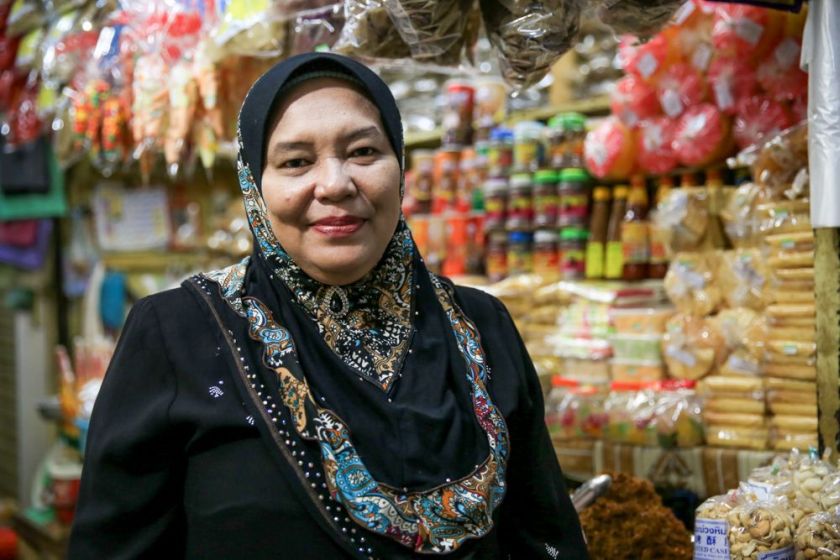


KOTA BARU, May 27 ― Despite national concern, Muslim residents in the northeast Malay heartland are taking the Kelantan PAS government's zeal to enforce hudud by 2016 with a large pinch of salt.
Long-accustomed to strict Islamic regulations that separate men and women at even the supermarket counters, Muslims in the Kelantan capital polled by The Malay Mail Online appear amused by the fevered pitch outside their home state to the state ruling party's insistence that it is merely bending to the overwhelming demand from its constituents.
“If they implement it, we support. If not, then it does not matter... We just follow the rulers, if it is a good thing, we’ll go for it,” Che Rohani Che Mat, 48, told The Malay Mail Online.
“Here in Malaysia we have so many races, it will be hard to implement such a thing. It is different with Brunei, there they are all Muslims,” the Tumpat native added.
“If they do enforce hudud we would accept it, but even if they don’t we would still accept it,” added Mohd Nor, a trader in the iconic Bazaar Siti Khadijah smack in the heart of the coastal city.
In 1993, the PAS state government passed the Kelantan Shariah Criminal Code Enactment (II), allowing it to impose the strict Islamic penal code in the state. But the laws yet to be enforced as they purportedly are in conflict with the country's constitution.
PAS is now looking for federal approval to implement hudud, through two private members’ bills it hopes to push through Parliament at its next sitting later this year.
This comes as the tiny, oil-rich nation of Brunei passed hudud laws last year and will begin enforcement from this year.
In pushing for hudud, Kelantan deputy mentri besar Datuk Mohd Amar Abdullah had claimed that Kelantan folks continued to vote for PAS since 1990 since they backed PAS’ manifesto for hudud.
PAS kept Kelantan in the general elections last year, winning 33 out of 45 state seats, down from 39 in 2008.
For residents like Mohd Nor, the Kelantan Number Two's remarks did not represent the voice of all Muslims in Kelantan.
The 38-year-old said those votes cast in favour of PAS at the last elections did not necessarily mean an explicit support for hudud.
Mohd Nor's mother, Fatimah Mohd, who was nearby, chimed in with a chuckle: “Of course he would say that, he is a politician. You know how it is with politicians; this political party will say this, but another party will say that.”
Another trader Nik Anisah, 51, said that while it might be easy for Muslims to accept hudud, they must also understand the reluctance of non-Muslims, especially the Chinese who made up around 4 per cent of the state’s population.
“Even in implementing hudud, we have to follow the times... For us, of course it is not that scary. But for those who find it scary, of course they would be against it,” she said, referring to the severe punishments prescribed in hudud, including amputations of limbs and death by stoning.
The proposed hudud law will cover crimes such as theft, robbery, illicit sex, making unproven accusations of adultery, drinking intoxicants, and apostasy, in addition to murder and causing physical hurt.
Despite that, Nik Anisah was adamant to point out that the Muslims understand that such punishments were not delivered on a whim, but through thorough deliberation.
“I support hudud, because when somebody steals my stuff, they will get their hands chopped,” claimed a trader who gave his name as Hamidi, as he chuckled and simulated his hand getting amputated.
Hamidi, 54, was originally from Jasin, Malacca and had settled here for 30 years after taking a Kelantanese for a wife. He wished his home state had followed Kelantan’s footsteps in carrying out Islamic laws.
Although he said he understood the non-Muslims’ had reservations over hudud, Hamidi claimed that if Muslims were punished by hudud, then they would escape more severe punishments in the afterlife.
“For me, hudud is good. Quran had prescribed a way that is molek,” he said, using the Kelantanese word for “beautiful”.


