


KULAI, June 6 — As far as news headlines are concerned, the 21st century has arrived in Kulai, a sleepy suburb of Johor Bharu, as the county emerges as a hub for data centres in Malaysia. Yet, in a small corner near Felda Taib Andak, time stands still.
Amidst palm oil plantation, in the middle of nowhere, is Putuo Village, containing a Buddhist temple and a 21-acre Bamboo Garden featuring various structures and artwork, most of which made with bamboo. In fact, bamboo is the main player in Putuo Village, ever-present in all aspects, even the food.
To understand the focus on bamboo, we must first go to the temple, situated a few hundred metres on the hill from the Bamboo Garden. Putuo is named after Mount Putuo, one of the four sacred mountains for Buddhists in China. It is also the mythical mountain residence of Avalokiteshvara, the Bodhisattva of Compassion and known in Chinese as Guanyin.
The temple was devoted to Guanyin, according to Chew Ah Wei, a staffer with Putuo Village. And the bamboo?
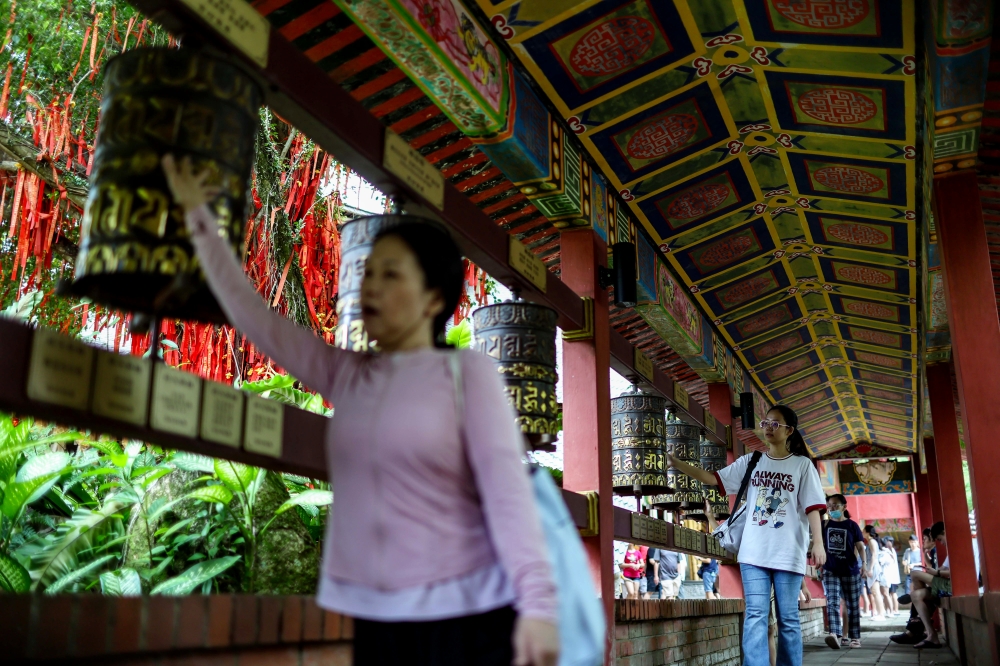
“She is the one most associated with bamboo, Bamboo is considered part of her natural surroundings,” he said, wiping the sweat from his forehead. It was noon, and the sun and heat were at their peak. The humidity was high, testament to the gathering storm clouds inching closer to the hills.
Despite the heat and humidity, the crowd at the temple was unrelenting. Today was Wesak Day after all, which meant the Buddhist Temple was full of devotees offering prayers and seeking blessings. A long line of Buddhists stretched from inside the temple to the outside, where a huge statue of a dragon floated above the heads of worshippers.
Weighing an estimated 200kg, the dragon reared its head high, its whiskers trailing in the air and its open mouth showing sharp fangs. Its front paws were flexed, claws ready to strike down any mortal foolish enough to show it anything less than admiration or respect. Made by Indonesian and Malaysian artists, the size and attention to detail made for a wondrous sight.
Like the temple, the dragon was made almost entirely out of bamboo.
“Bamboo symbolises many positive values, including prosperity, success, good health and resilience,” Chew added.
Beside the temple is a tree, laden with red ribbons. Chew said it was a wishing tree.
He also said they receive about 500,000 visitors a year, with more visitors during religious and Chinese festivals to the temple and the Bamboo Garden. The garden draws visitors from various ethnicities, and countries, mostly from Asean and East Asia, and is very popular with Instagrammers.
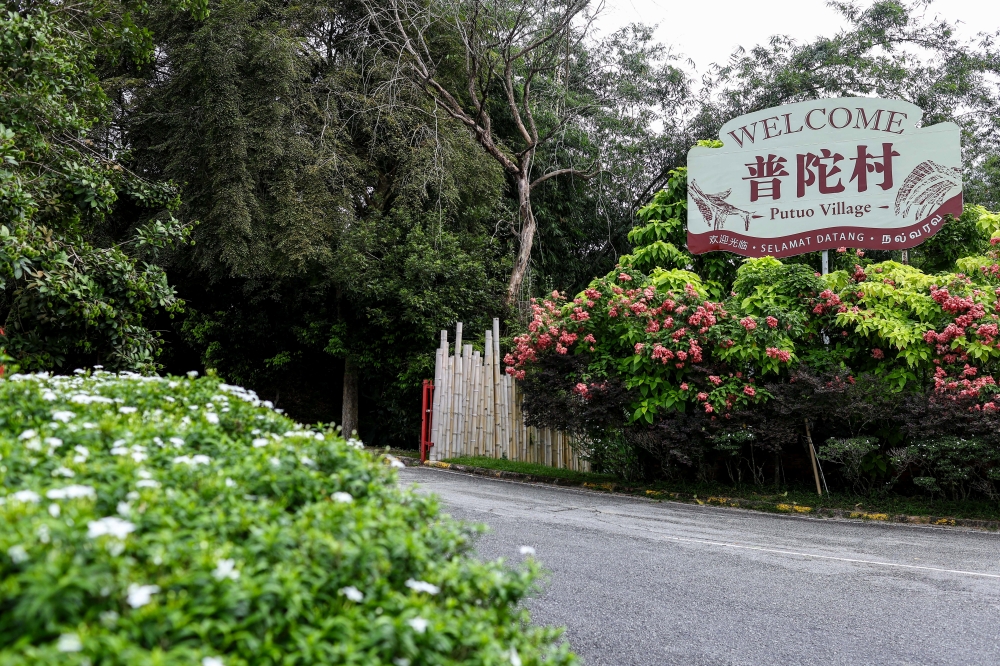
Hidden gem
Despite its popularity on Instagram, not many know of Putuo Village’s existence. Buddhists know of the temple, which started in 2005 but went significant overhaul and redesign with bamboo in 2023. But Malaysian visitors to the Bamboo Garden, including some from Johor, told Bernama that they only discovered Putuo Village via Google, or friends when looking for things to do in Kulai.
“It’s a hidden gem,” agreed Dr. Lee Yoke Lai, head of department of Landscape Architecture from Universiti Teknologi Malaysia (UTM), Johor. Although she worked nearby and despite her work with bamboo as a nature-based solution, she herself only found out about Putuo Village a few years back because her sister had visited the place before. Since then, Lee has visited Putuo Village twice.
To get to the Bamboo Garden, one can go there directly as it is the first stop in Putuo Village. From the Guanyin temple, one has to walk along a paved pathway, decorated with Confucius sayings and Buddhist symbols. What starts out as an easy stroll stroll becomes a hike uphill that is not difficult, but can be a bit of a cardio workout for the uninitiated.
At the top is a two-storey rest area made almost out of bamboo, with bamboo furniture for picnics. If one is feeling a bit overheated, not to worry, there is a drinks and ice cream stand, and the building has fans.
Off to the side is the entrance to the Bamboo Garden. Entry costs RM10 per adult and RM5 per child.
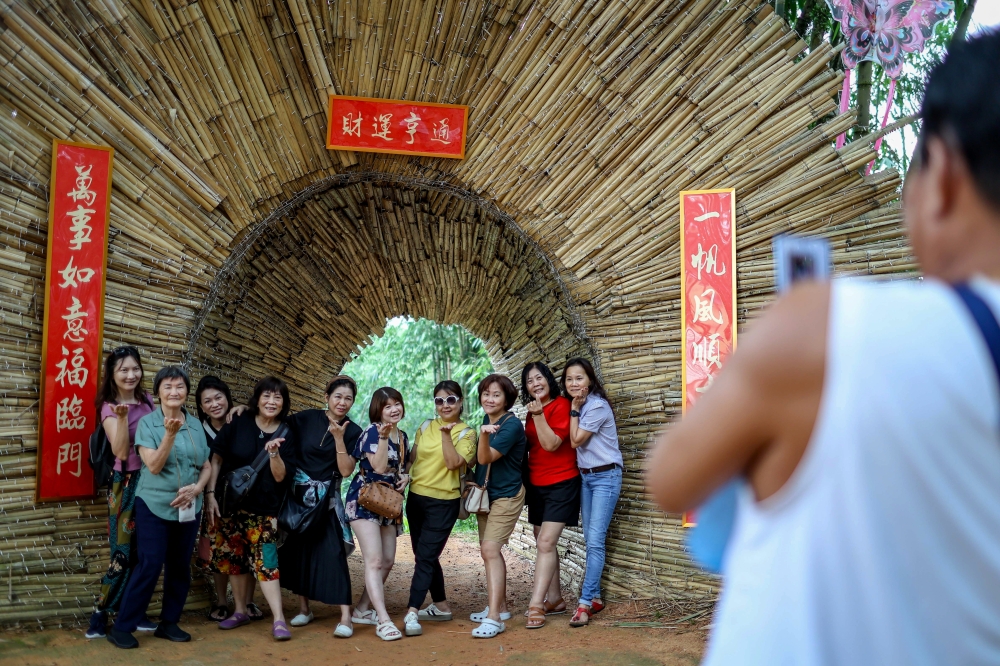
Chew said the Bamboo Garden was very popular with newlyweds and couples, and contains many Chinese cultural decorations. The Buddhism symbols are fewer here, as Putuo Village management wants the space to be open and welcoming for all.
“If we focus only on Buddhism, then only Buddhists will come,” he said.
The Bamboo Garden covers a huge expanse of land. Upon entering, the paths are clear and branches off into several directions. The most trodden path is the one in the middle, which leads uphill to the bamboo statue of the winged horse, erected in honour of the Year of the Horse. Bamboo trees and stalks grow line the pathways everywhere as far as the eye can see.
True to what many had said before, it did look like one was in China.
Here and there, tourists were taking photos by the many art installations. Other than the huge statue of the winged horse, there were other notable sights, such as the group of large pinwheel fans. It was not a windy day, unfortunately, so the pinwheels remained static. Otherwise, what a glorious sight they would make.
There is also a platform with two immense handscrolls, likely made of cement, with Chinese writing on one and a landscape on another. At first glance, it looked like a skateboarding park but the Chinese calligraphy soon disabused one of that notion.
Putuo Village Tourism Promotion ManagerLim Teck Hwee told Bernama in a statement that the Bamboo Garden has many other installations including the Fish in the Clouds installation, where “vibrant koi appear to swim through a sea of clouds (to) symbolise abundance, prosperity, and the freedom to chase one’s aspirations.”
Another is the Leisure Umbrella, which is a “giant bamboo umbrella (to) create a whimsical and relaxing corner within the bamboo forest.”
In the background, a bell keeps ringing. Chew said it was a Chinese custom to ring the bell to chase away bad luck and evil spirits.
Visitors Bernama talked to said they were attracted to the natural aethestic of the Bamboo Garden.
“I personally prefer this kind of calm enviornment. It’s like stress relief,” said Vimala Selvaraj, who hails from Tiram. She took advantage of the long holiday weekend to visit Putuo Village with her husband and two children. She added she only found out about the place via Google.
Other visitors concurred. Moon, an Indonesian national working in Singapore, was tired of big city living and decided to visit Kulai with her husband Karis. Like many Indonesians, they only have first names.
“Johor Bahru has become too crowded. I’m not interested in shopping. I prefer peace and quiet,” she said.
Balancing nature, culture
In Buddhism, bamboo is considered a sign of spiritual resilience, flexibility and enlightenment. In science, bamboo is a carbon sink and considered one of the best ways to reduce the effects of climate change from excess carbon.
Lee, who is an expert in green infrastructure, said marrying culture with green infrastructure was a great move as it serves dual purpose by attracting people through cultural appreciation while creating a healthier environment for all.
“I want to credit Putuo village with how they integrated a bamboo forest to create a nature (getaway) with culture. I think it’s a good combination,” she said.
She added Putuo Village was serving as a green lung for Kulai, which is seeing a surge in data centre investment and development.
She also hoped there would be more green infrastructure, such as bamboo forests and replanting native trees to go alongside.
“We don’t want … to see a very concrete Kulai in the future,” she said. — Bernama


