














KUALA LUMPUR, April 1 — A recent survey conducted during the ongoing Middle East crisis shows that Malaysians are more worried about food and grocery prices than fuel costs despite the global oil supply disruption dominating headlines.
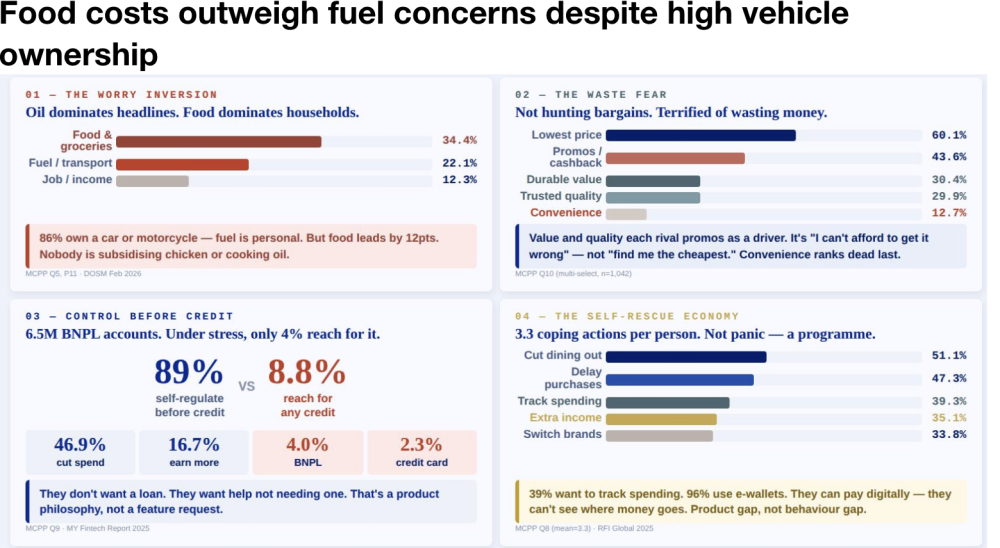
According to the Malaysia Cost Pressure Pulse (MCPP) Wave 1 by Rakuten Insight, 34.4 per cent of respondents identified food and groceries as their top concern, compared to 22.1 per cent for fuel and transport.
The study surveyed 1,042 Malaysians between 16 and 18 March 2026, during a period when Brent crude was above US$100 per barrel.
The findings suggest that while Malaysia’s fuel subsidy mechanism is cushioning petrol prices, cost pressures are being felt more acutely in daily essentials such as food.
The survey found that 86 per cent of respondents have personal access to a car or motorcycle, yet food remains the dominant concern. This indicates that even though fuel prices directly affect most households, the perceived impact of rising grocery costs is higher.
According to Rakuten Insight, while Budi95 still manages to hold RON95 petrol price at RM1.99 per litre, there’s no equivalent shield exists for everyday food prices. It added that items such as chicken, cooking oil, rice and nasi lemak packets are where Malaysians feel the squeeze most acutely.
Consumer anxiety significantly higher than official inflation
Malaysia’s official Consumer Price Index (CPI) stood at 1.4 per cent in February 2026, but respondents reported an average concern level of 7.83 out of 10 regarding rising costs.
A total of 62 per cent rated their concern at 8 or higher, while 31 per cent gave the maximum score of 10. Nearly half (48.2 per cent) expect their household financial situation to worsen over the next three months.
Min Yao Kong, who leads commercial research at Rakuten Insight Malaysia, said, “The subsidy is holding the pump price, but it’s not holding the psyche.”
He added, “Consumers are reading the same oil headlines as everyone else, seeing grocery prices creep up and drawing their own conclusions regardless of what CPI says.”
Majority of Malaysians would cut spending before using credit
The survey also highlights a strong preference among Malaysians to avoid debt during financial stress. When faced with rising expenses, 89 per cent said they would adjust spending habits before using credit.
Only 4.0 per cent would use Buy Now, Pay Later (BNPL) services first, while 2.3 per cent would use a credit cards, despite an estimated 6.5 million BNPL accounts in Malaysia.
Respondents also indicated other measures such as cutting discretionary spending (46.9 per cent), seeking extra income (16.7 per cent), delaying large purchases (15.3 per cent), and using savings (10.2 per cent) before reaching for any form of credit.
Looking at the generational breakdown, it added that it isn’t the youngest Malaysians (18-24) that rely on BNPL heavily who are under stress. Instead, the 35-44 age group (6.6 per cent) that’s more likely to carry mortgages and car loans. For the group that earns RM10,000 or more per month, the BNPL uptake under stress drops to zero.
Value overtakes convenience when money is tight
During tighter financial periods, consumers prioritise value over speed or convenience. The survey found that “lowest price” (60.1 per cent) and “promotions and cashback” (43.6 per cent) ranked highest in influencing brand choice, while “convenience and speed” came last at 12.7 per cent.
Kong noted that when money is tight, the consumer psychology shifts from “find me the fastest” to “I can’t afford to get it wrong”.
Multiple coping strategies and growing focus on income
On average, respondents are taking 3.3 simultaneous actions in the next four weeks to manage costs. The most common include reducing dining out (51.1 per cent), delaying non-essential purchases (47.3 per cent), tracking spending more closely (39.3 per cent) and stocking up on discounted essentials (36.4 per cent).
Notably, 35.1 per cent are actively seeking additional income or side gigs and 33.8 per cent says they will switch to cheaper brands.
Interest rates seen as impactful despite low awareness
The study also reveals a disconnect between awareness and perceived impact of interest rates. While only 26.6 per cent reported high exposure to interest rate news, 43.7 per cent expect borrowing costs to significantly affect their household finances.
This suggests that financial pressure from loans and mortgages is felt directly, regardless of news consumption. Malaysia’s central bank, Bank Negara Malaysia, had reduced the Overnight Policy Rate to 2.75 per cent in July 2025, but those with floating-rate obligations are carrying a latent exposure that they may not be consciously monitoring.
Dining out shows a split consumer trend
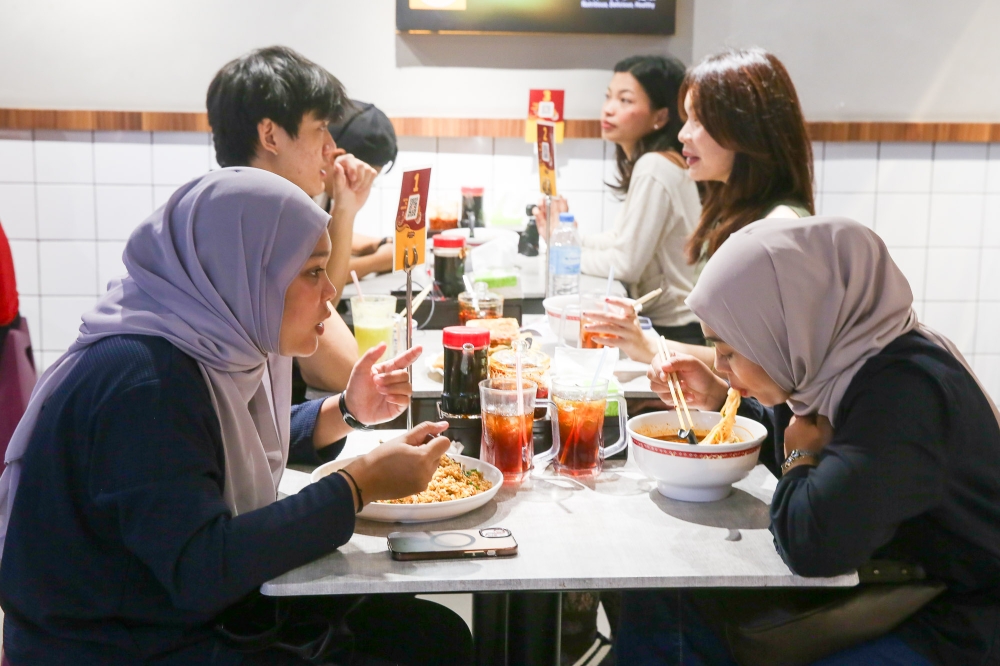
Dining out is the category under the most pressure, with 52.9 per cent saying they would cut it first if prices rise further. However, 26.6 per cent still expect to increase spending in this area, indicating a split between cost-cutting households and those maintaining eating out as a non-negotiable activity or affordable luxury.
‘Managed affordability’ instead of austerity
Rakuten Insight describes the current behaviour as “managed affordability”, where consumers are actively adjusting spending, timing purchases, tracking finances, and seeking additional income rather than entering full austerity.
The firm adds that the population is self-regulating across multiple fronts and actively refusing credit as a coping mechanism. It says that Brands that position positive themselves as affordability infrastructure with tools for control, savings visibility and predictability will outperform those that simply offer discounts or flexible payment options.
Rakuten Insights has recommended several actions for different sectors. For telco, they recommend bundling non-telco utility into their offering such as grocery cashback on bill-pay day and petrol discount codes.
Meanwhile, for FMCG and Grocery, they recommend putting cost-per-serving labels on the shelves to help consumers make decision better with value math visible. — SoyaCincau