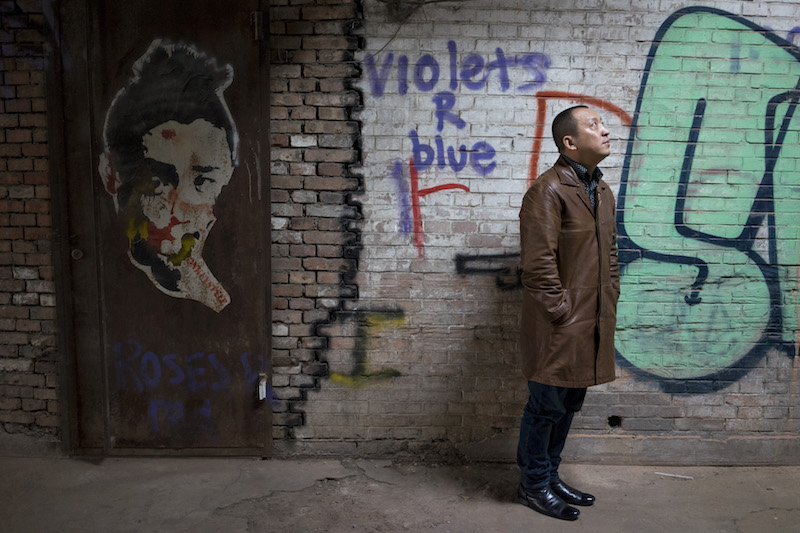
CHONGQING, Jan 2 — Zhang Xiaotao, one of China’s leading animation artists, grew up in a village in western China where the ferocity of the Cultural Revolution left indelible marks on everyone. His father, a leader of the local Red Guards, emerged with his spirit broken by what he saw and did.
But that is not what Zhang remembers from his childhood. Instead of the violence, he recalls the imposing Catholic church near his home, 30 miles north of here, built by French missionaries at the turn of the 20th century. Its broad verandas and colonnades, encrusted with moss in the clammy summer months, remained after the violence, and tall stands of bamboo provided swaths of shade.
Zhang, 45, remembers the church so vividly because he would play on the grounds there. And by the time he was 10, when his parents had abandoned him to find work far away, it had become a place of dreams where he would take his sketchbook and paint.
Nostalgia for the big whitewashed building infuses a number of Zhang’s award-winning digital animation films, which explore China’s rush to modernisation. In sometimes-surreal ways, the films try to show what the intense pressure to achieve wealth and success does to the soul.
It is not so much the church’s physical structure that appears in his work, although it does occasionally. Rather, it is the building’s sense of calm that, he says, contrasts with the almost intolerable intensity of contemporary urban China.
“I have deep memories from the church as a child,” he said in his studio at the Sichuan Fine Arts Institute, where he studied as a young man and now heads the new media department. Around him, dozens of young digital artists labored over computer screens to help complete one of his new works. “When I was playing there as a child I could see people praying, and I felt a profound sense of religion.”
Those who prayed were not organised by priests or nuns. The official church had long been expelled from China. They were men and women who were too old to be dragged into the madness of the Cultural Revolution, and who turned to the church in his village as a place of solace, much as Zhang does today.
Zhang ’s latest work, Spring in Huangjueping, is a two-hour digital animation movie that he has entered into the 2016 Berlin International Film Festival. He was elated that the film had made the jury’s first cut.
The idea of the film, he said, is to draw parallels between the Cultural Revolution and the dismal period nearly 20 years later when he sought entry to the institute. He failed the entrance exam three times, an experience that still haunts him.
The movie is cast with figures drawn in the style of a graphic novel: skinny young men and women from Zhang’s student days are dressed in basic T-shirts and pants, while Red Guards from the earlier era appear in drab olive uniforms with rifles. The landscape resembles the gritty parts of the industrial city of Chongqing, and its outskirts in Huangjueping, where the art institute and his studio are.
“The brutal college entrance exam and the frenetic beliefs of my father’s generation: How similar are they?” Very, he concludes.
As a child, Zhang showed a knack for making money to support his painting, a skill that serves him now as he plunges into animation, one of the more expensive forms of contemporary art.
“I bought comic books and rented them to classmates,” he said. “And from sixth grade, when I was living by myself because my parents went away, the business grew from renting 50 comic books to 1,000 comic books.”
When he finally conquered the exam and got into art school, he found himself in the tumult of the ’90s art scene, when Chinese artists were the newest fad in the West. At the time, the Sichuan institute’s oil painting department, whose graduates include Zhang Xiaogang, now one of China’s most sought-after contemporary painters, was a crucible of experimentation.
In the late ’90s, Meg Maggio, an American lawyer who ran a contemporary gallery in Beijing, met Zhang when he was showing his work in Beijing, Shanghai and Hong Kong.
“He was painting surreal fantasy paintings of candy-colored condoms,” said Maggio, who still represents Zhang through her gallery Pékin Fine Arts in Beijing. “Later, he became well known for painting a long series of overripe, slightly rotten, occasionally moldy strawberries.” In 2006, she sold a number of his paintings to the British collector, Charles Saatchi, including a 6-foot painting of a drowning rat.
But Zhang was moving on from oil painting. He studied photography for a while in Europe, and then in 2000 in San Francisco he fell into animation. “It changed my life,” he said. He easily adapted to the skills of animation, and though he was tempted to set up shop in New York, a city he finds exhilarating, he decided to return to China to establish his own company.
His next film, Sakya, which together with Mist was shown at the Venice Biennale in 2013, is named after a Buddhist monastery in Tibet. It uses 3-D modeling software to create a celestial mood of pilgrims and Tibetan mandalas, and won praise for its exploration on the limitations on freedom of religion.
For his next venture, Zhang plans to leave the Sichuan Fine Arts Institute and take the helm of a Beijing gallery, the Kylin Centre of Contemporary Art. There, he said, he will show art from around the world and send Chinese art abroad.
But most of all, he says, he looks forward to having more time to spend with his son, Liang-liang. “My parents did not spend much time with me,” he said. “I feel guilty that I have not seen enough of my son, and I miss him. I have promised to take him to New York to see the great art.” — The New York Times