




MADEIRA (Portugal), Jan 22 — “Where are the vineyards?” I wondered aloud on a recent visit to Madeira, the small volcanic island belonging to Portugal, perched out in the Atlantic, about 400 miles off the coast of Morocco.
Wine has been the principal product of the island for more than 400 years. Its fame is such that you might reasonably expect on arrival to be greeted with wave upon wave of vitis vinifera, rather as you do when traveling through France’s Champagne region. On the contrary, what you mostly see planted on poios, centuries-old terraces stacked steeply up from the island’s coastal fringe, are verdant banana palms, their floppy green leaves rattled by the frequent winds that gust in off the Atlantic.
Hidden vineyards
I did eventually spot some vines. The holdings are tiny and widely scattered, hanging on for dear life and threatened both by the bananas and the newly built houses and apartments that increasingly encroach on the available space. Trained in the traditional manner over wooden pergolas, the vines often have a crop of potatoes, cabbages, zucchini and beans planted at their feet to make full use of the scarce—and exceedingly fertile—ground.
Despite the near invisibility of its vineyards, Madeira’s wine remains one of the world’s leading fortified wines. Once highly fashionable and sought after, it was reputed to be George Washington’s favored tipple and was served at his presidential inauguration. The term “fortified” means the wine is bolstered by adding grape spirit, which raises its alcohol content (typically to 19% in the case of Madeira, as opposed to the usual 12% to 14% range for table wines), as well as giving it a longer life. Port, that other celebrated Portuguese fortified wine, gets a shot of grape spirit too, but there the similarity ends, because the grape varieties involved and—above all—the process employed in making Madeira differ in significant ways from those used in Port production.
A happy accident
The wine starts out life in the usual way, with the grapes picked in late summer, then crushed and fermented, and grape spirit added to arrest fermentation—so far, so familiar. From here, things start to get interesting. During its long journey to maturity, Madeira is exposed to the unlikely twin enemies of heat and air, to emerge not only unspoiled but with extraordinary added layers of flavor and complexity. As Richard Mayson puts it in his recently published book “Madeira: the Islands and Their Wines,” “Heat and air, both the sworn enemies of most wines and winemakers, conspire to turn madeira into one of the most enthralling of the world’s wines, as well as one of its most resilient.”
The discovery that wine could be heated and come to no harm—and even improved by it—was a happy accident. The island has always been strategically important for trans-Atlantic shipping, and over the centuries, countless vessels have paused here to restock with provisions before the long sea journey from Europe across the Atlantic to the Americas and beyond. Provisions always included casks of wine, which by the nature of things were exposed on board to great heat. When the ships berthed and the wine was found to be perfectly good—even better than when it departed—the shippers set about reproducing the same conditions in their cellars back home, placing the huge, wooden wine casks on the upper floors of their wineries to bask in the summer heat.
Worth the expense
Nowadays, a faster (and cheaper) way to reproduce this step is to heat the wine artificially in large containers called estufas, but the finest Madeiras are still aged in wooden casks, heated only by the island’s year-round sunshine. This process, called the canteiro method, is lengthier and more gentle and gives the wines their characteristic, slightly caramelized, faintly smoky aromas with exotic hints of honey and dried fruits.
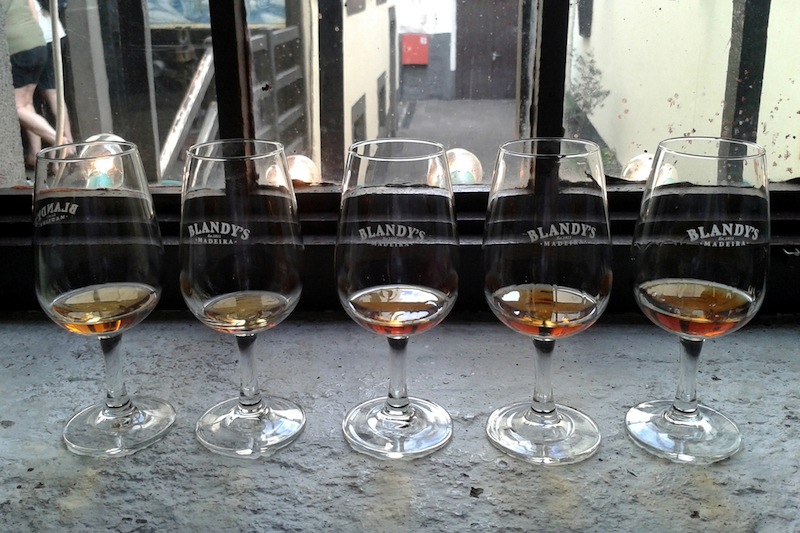
A premium bottle of Madeira is always expensive, because of the time and skill needed to nurse it to perfection. One consolation—and a considerable selling point—is that once the wines have survived the rigors of heating and oxidation, they are good to go for up to 100 years. Blandy’s, one of the top Madeira producers based in the capital, Funchal, still has a barrel of 1920 wine stored in its cellar, awaiting its moment.
Once bottled, Madeira can be opened and sampled, the cork replaced and the bottle stored upright in a dark place for weeks or months without the contents coming to any harm. “If ever there was a wine to take away with you to a desert island,” comments Mayson, “this is it.”
Today, the chief market for Madeira is France, followed by the island of Madeira itself. Portugal, surprisingly, consumes little Madeira, but the UK remains a big fan, with Japan, Germany and the US not far behind.
Check www.winesearcher.com for your nearest supplier.
Top Madeira producers (commonly known as “shippers”) include Blandy’s, Henriques & Henriques, Barbeito and H.M. Borges. — Zester Daily/Reuters


