


APRIL 14 — The Strait of Hormuz is no longer merely a chokepoint of global commerce. It has become a theatre of overlapping coercion — a place where two forms of blockade now collide, compressing the space for both trade and diplomacy.
On one side stands Iran, resolute in its determination to continue exporting crude oil despite war, sanctions, and mounting pressure.
On the other stands the US under President Donald Trump, increasingly willing to use naval power to constrain those very exports.
The result is not a single blockade, but a dual squeeze — one that is pushing the global energy system into uncharted territory.
For Tehran, the imperative is unmistakable. Oil is not just an export; it is the backbone of the state.
Revenues from crude sales finance domestic stability, sustain public spending, and anchor Iran’s regional influence.
Even under intense pressure, Iran has continued to move significant volumes of oil into global markets, with China absorbing a substantial share and India remaining a potential outlet.
To halt these exports voluntarily would not be a strategic pause. It would be economic self-strangulation.
This explains why Iran has adopted a calibrated approach in the Strait of Hormuz.
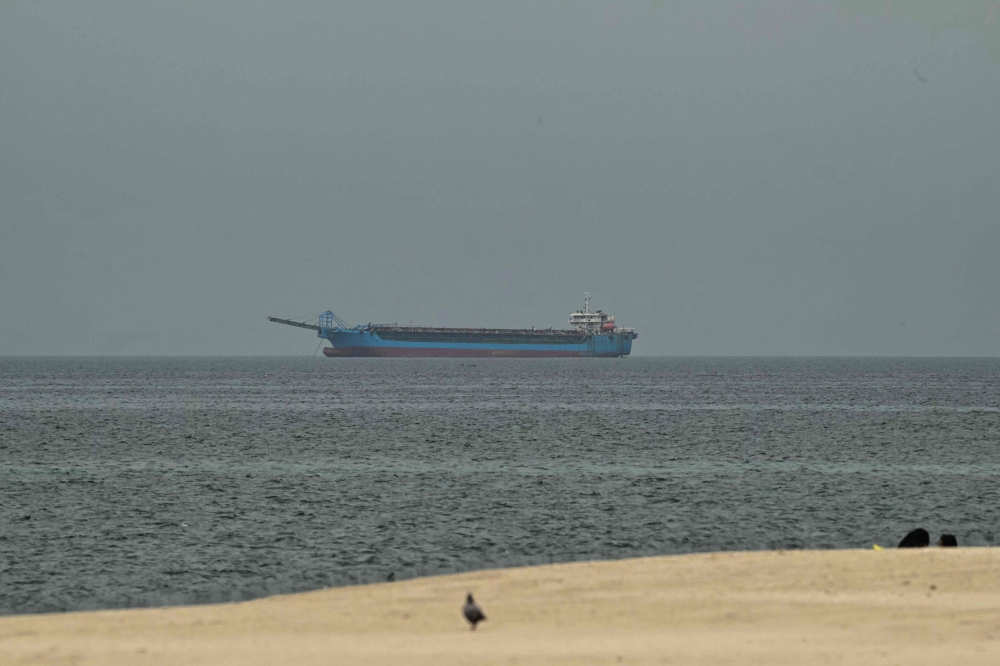
Rather than closing it outright, it has restricted passage selectively — allowing vessels from countries it considers friendly to pass while denying access to those it deems hostile.
This is not merely a tactical move; it is a signal that control over the Strait can be exercised politically, not just geographically.
Yet Iran’s determination to sell is now being systematically counter-checked.
The US has not opted for a full closure of the Strait — a move that would trigger immediate global backlash — but for something more precise and arguably more disruptive: the interdiction of Iranian oil flows at sea.
By deploying naval assets to monitor, inspect, and potentially block tankers linked to Iranian exports, Washington is targeting the very arteries through which Iran earns its lifeblood.
In effect, the US is contesting Iran’s ability not only to ship oil, but to complete the commercial transaction itself.
Cargoes that leave Iranian waters are no longer guaranteed to reach their destination. Buyers, particularly in Asia, must now weigh the risk of interception, delay, or outright seizure.
This creates a structural contradiction that defines the current crisis. Iran insists on selling. The US insists on stopping.
And the Strait of Hormuz — once governed by predictable norms of navigation — has become the contested space where these opposing imperatives collide.
What emerges is a dual chokehold.
Iran controls access by determining who may enter the Strait under its watch.
The US controls exit by policing what leaves Iranian ports. Between these two pressures, the commercial viability of Iranian oil exports is being squeezed from both ends.
For China, this presents an acute dilemma. As one of the largest buyers of Iranian crude, Beijing benefits from discounted supplies and strategic diversification.
Yet it also depends on the uninterrupted flow of energy through the Strait. Its call for stability — voiced through its foreign ministry — is less a diplomatic platitude than a reflection of hard economic necessity.
For the wider world, the implications are even more severe. Roughly one-fifth of global oil passes through the Strait of Hormuz.
Any sustained disruption will ripple across markets, driving up prices, fuelling inflation, and exacerbating what can only be described as a polycrisis — where energy, food, fertilisers, and industrial inputs are all simultaneously affected.
Southeast Asia, in particular, stands exposed.
As a region heavily dependent on imported energy and integrated supply chains, Asean cannot insulate itself from such shocks.
Rising fuel costs will cascade into higher prices for food, transport, and manufacturing, testing both economic resilience and political stability.
And yet, Asean’s voice remains muted.
This silence is increasingly untenable. If Asean is to maintain its claim to centrality, it must articulate a principled position — one that upholds freedom of navigation while urging restraint from all parties.
Medium sized powers, including Malaysia and Indonesia, have both the credibility and the interest to act as stabilising forces, whether through diplomatic engagement or quiet facilitation.
The paradox of the current crisis is that its very danger may be its only saving grace.
The dual blockade is not sustainable. Iran cannot endure prolonged revenue strangulation without risking internal instability.
The US cannot escalate indefinitely without triggering wider conflict and global economic fallout.
China cannot tolerate prolonged disruption without jeopardising its own growth trajectory.
In this convergence of constraints lies a narrow corridor for diplomacy.
Recent remarks by Turkey’s Foreign Minister, Hakan Fidan, suggesting that both Washington and Tehran remain sincere in seeking dialogue, should not be dismissed lightly.
Diplomacy often advances not in spite of crisis, but because of it. Pressure clarifies interests, exposes limits, and, at times, forces adversaries back to the negotiating table.
The failure of talks in Islamabad, therefore, should not be seen as an endpoint. It is part of a longer, more iterative process — one in which confrontation and negotiation are intertwined.
The Strait of Hormuz, in this sense, is both a warning and an opportunity. It demonstrates how quickly global systems can be destabilised when geography is weaponised.
But it also underscores a fundamental truth: no single actor can dominate such a critical artery without incurring prohibitive costs.
Between Iran’s insistence on selling and America’s determination to stop it lies a fragile equilibrium — one that cannot hold indefinitely.
The question is whether the current moment of maximum pressure will tip into open conflict, or whether it will compel all sides to recognise a simple reality: that even in an age of coercion, there is no substitute for a negotiated peace.
* Phar Kim Beng is a professor of Asean Studies and director at the Institute of International and Asean Studies, International Islamic University of Malaysia.
** This is the personal opinion of the writer or publication and does not necessarily represent the views of Malay Mail.


