APRIL 13 — Grand strategy, at its most effective, is an exercise in restraint as much as it is in power. It requires calibration, sequencing, and an acute awareness of systemic consequences.
When these elements are absent, policy risks slipping into overreach — where the pursuit of advantage produces instability far beyond its intended scope.
The evolving posture of President Donald Trump toward the Strait of Hormuz suggests precisely such a moment of strategic excess.
In March 2026, Trump adopted a position that reflected a degree of pragmatic realism.
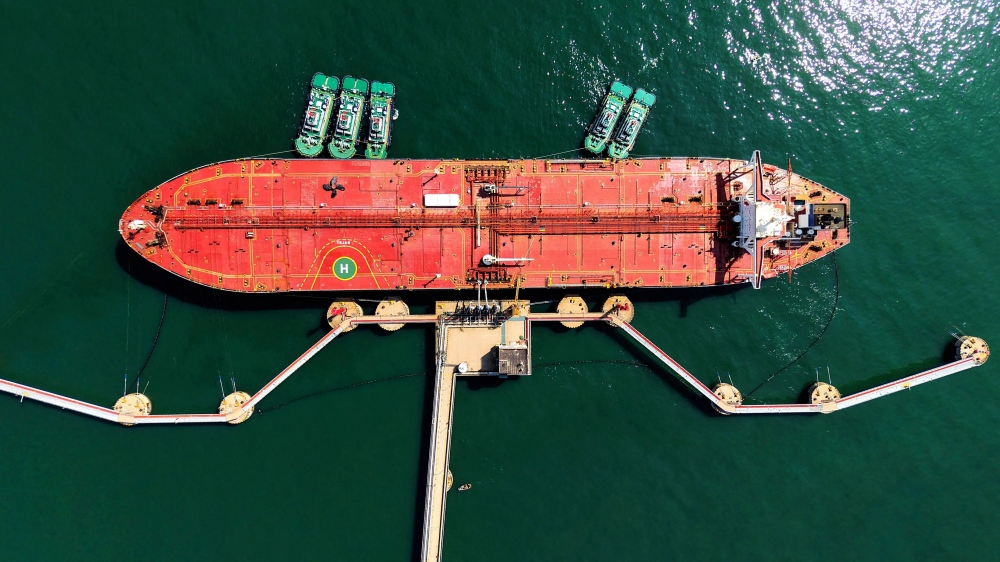
By granting a temporary license for Iran to release approximately 140 million barrels of oil that had been stranded on tankers, the United States implicitly acknowledged the structural constraints of the global energy system. Markets were tightening under the pressures of war in West Asia. Supply disruptions were no longer hypothetical.
Allowing Iranian crude — much of it destined for China and India — to re-enter circulation was not an act of concession, but one of systemic stabilisation.
Yet this carefully calibrated move now stands in sharp contrast to a far more coercive trajectory: the potential interdiction of maritime flows through the Strait of Hormuz to prevent Iran from exporting its oil altogether.
This is not merely a policy adjustment. It is a strategic inversion.
Sanctions, as instruments of statecraft, operate through layers of indirection.
They leverage financial systems, insurance regimes, and legal architectures to constrain behaviour over time.
Their effectiveness lies in their elasticity — they can be tightened, relaxed, or selectively enforced.
A blockade, by contrast, is immediate, kinetic, and inherently escalatory. It substitutes systemic pressure with physical denial.
The distinction is not trivial. It is foundational.
The Strait of Hormuz constitutes one of the most critical chokepoints in the international political economy.
Approximately one-fifth of globally traded oil transits this narrow corridor, with the overwhelming majority destined for Asia’s industrial economies.
China and India, in particular, have emerged as principal absorbers of these flows, not merely as consumers but as stabilisers of demand in an otherwise volatile market.
To interdict Iranian crude within this space is therefore to do more than constrain Tehran.
It is to disrupt a dense web of interdependence that underpins global growth.
The contradiction is immediate and profound.
A policy that recently facilitated the release of 140 million barrels of oil to alleviate price pressures now contemplates actions that would render such relief meaningless. Markets do not respond solely to supply volumes; they respond to expectations of continuity.
The mere prospect of disruption within the Strait is sufficient to trigger price volatility, insurance escalations, and logistical dislocations.
In this sense, the blockade is not simply an instrument of coercion. It is a generator of systemic uncertainty.
Moreover, the operational realities of such a strategy are fraught with ambiguity.
The global oil trade is characterised by opacity — ship-to-ship transfers, reflagging practices, and complex intermediary networks obscure the origin and destination of cargoes.
Distinguishing Iranian crude from other consignments is neither straightforward nor always feasible. A blockade risks entangling non-targeted flows, thereby amplifying its disruptive impact.
China and India, as primary recipients of Iranian oil, would inevitably bear the brunt of such disruption. For Beijing, Iranian crude represents both a cost advantage and a strategic hedge against supply concentration.
For New Delhi, it forms part of a broader diversification strategy in an increasingly constrained market. Interrupting these flows does not occur in a geopolitical vacuum; it reverberates across diplomatic, economic, and strategic domains.
The implications extend further still. South-east Asia — particularly trade-dependent economies such as Indonesia, Malaysia and Singapore — remains acutely vulnerable to energy shocks emanating from the Gulf.
The transmission mechanisms are immediate: higher fuel costs, elevated fertiliser prices, disruptions to industrial inputs, and inflationary pressures across the food-energy nexus.
Even an agricultural powerhouse such as Vietnam is affected if the fertilisers do not reach them on time by early May 2026. It cannot plant its rice fields with the right yields to be sold to the Philippines.
What unfolds in the Strait of Hormuz does not remain confined to the Gulf; it is transmitted, with remarkable ease, across the global system.
At a deeper level, the policy trajectory raises questions of strategic coherence. The oscillation between limited accommodation and maximalist coercion suggests not a linear strategy, but a reactive posture.
The release of Iranian oil acknowledged the necessity of market stability. The contemplation of a blockade appears to subordinate that necessity to the imperatives of pressure.
Yet the two objectives are not easily reconciled.
To maximise pressure on Iran is to risk constricting supply.
To stabilise markets is to ensure its flow. Attempting to pursue both simultaneously produces a condition of strategic dissonance — where policy instruments undermine one another.
This is not merely a theoretical concern. It is a practical dilemma with tangible consequences.
The global energy system, already strained by conflict, cannot absorb indefinite shocks without cascading effects.
Price spikes, demand destruction, and supply realignments are not abstract outcomes; they are lived realities for states and societies alike.
The United States, as a central architect of the post-war international order, has historically balanced coercion with stewardship.
It has recognised that the stability of the system is itself a strategic asset. To disrupt that stability in pursuit of narrower objectives risks eroding the very foundations of its influence.
The Strait of Hormuz, in this regard, is not a lever to be pulled without consequence. It is a systemic node — one whose disruption reverberates far beyond its immediate geography.
To block it is not simply to deny Iran access to markets. It is to recalibrate the entire architecture of global energy flows, with uncertain and potentially destabilising outcomes.
In the final analysis, the question is not whether Iran can be prevented from exporting its crude. It is whether the method of doing so — through the physical constriction of a global chokepoint — constitutes a form of strategic prudence or strategic excess.
History suggests that when power is exercised without sufficient regard for systemic limits, it ceases to be stabilising. It becomes, instead, a source of disorder.
And in a world already defined by polycrisis, that is a risk few can afford.
What, then, are the putative solutions ? The likes of Prime Minister Mark Carney has asked medium sized powers to rise up against the excesses of Trump; notwithstanding the fact that Canada is one of the first to support the US and Israel war against Iran, which is both expansive and getting increasingly expensive for all and sundry. Including the United States.
With Prime Minister of Australia Albanese making a visit to Malaysia soon, the likes of him and Prime Minister Datuk Seri Anwar Ibrahim of Malaysia have to think of a double pronged approach to encourage the US and Iran to go for the jugular of one another.
70 percent of Iran has already been bombed with the people denied all usage of internet over the last six weeks. Iranians themselves are cut off from the outside world.
Such developments risk turning Iran into a hermetic regime that is both wounded yet filled with the pride to keep fighting with total ferocity.
* Phar Kim Beng is a professor of Asean Studies and director at the Institute of International and Asean Studies, International Islamic University of Malaysia.
** This is the personal opinion of the writer or publication and does not necessarily represent the views of Malay Mail.