


KUALA LUMPUR, May 15 — Malaysia’s economy likely picked up pace in the first quarter, lifted by rebounding exports and underpinned by resilient domestic demand that has helped prompt the central bank to consider its first interest rate rise in three years.
First quarter gross domestic product was estimated to have risen 5.5 per cent from a year earlier, according to the median forecast of a Reuters poll, picking up from 5.1 per cent in the fourth quarter and 4.7 per cent in 2013. The forecasts ranged from 4.6 to 7.0 per cent.
Full-year growth for 2014 was seen at 4.9 per cent, up from 4.6 per cent in a February poll and compared with 4.7 per cent in 2013.
“There is an overall improvement in GDP which is supported by export growth and domestic demand,” said Jeff Ng, an economist at Standard Chartered in Singapore.
“Export growth has been positive these past few months especially in the first quarter and will continue to support the current account balance this quarter and year.”
Exports in March grew 8.4 per cent from a year earlier, supported by strengthening global demand for the Southeast Asian exporter’s key shipments of electrical and electronics products. A recovery in the advanced economies and growing domestic demand is expected to continue to benefit Malaysia’s export sector. Malaysia’s trade surplus in the first quarter surged to a record RM24.6 billion.
“Domestic demand growth seems to be stable and coupled with strong net trades, we are looking at a very stable GDP growth for 2014,” said Patricia Oh, an economist at Ambank in Malaysia.
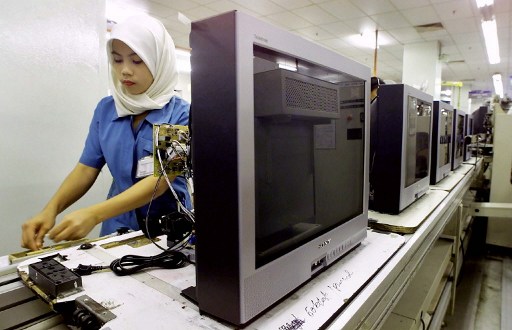
Malaysia’s March industrial production rose 4.3 per cent from a year earlier, despite a decrease in mining sector output. Malaysia’s first quarter industrial production increased by 4.8 per cent.
Buoyant consumer demand helped Malaysia’s economy weather a period of slack exports and a shrinking trade surplus last year, but it has also raised central bank concerns over possible overheating and inflationary pressure.
After its policy meeting last Thursday, the central bank appeared to pave the way for a near-term rate hike, possibly as early as its next meeting on July 10, by saying that a policy adjustment may be needed to tackle financial imbalances such as rising household debt.
The central bank, which has kept its benchmark rate at 3.0 per cent since May 2011, had said in March it was monitoring signs of financial imbalances, but did not mention the possible need for a policy adjustment.
Rising inflation has been another concern for Malaysia’s monetary authorities.
The consumer price index in March rose 3.5 per cent from a year earlier, its highest since June 2011, reflecting increases in food, transport and electricity prices following cuts in government subsidies last year. — Reuters


