


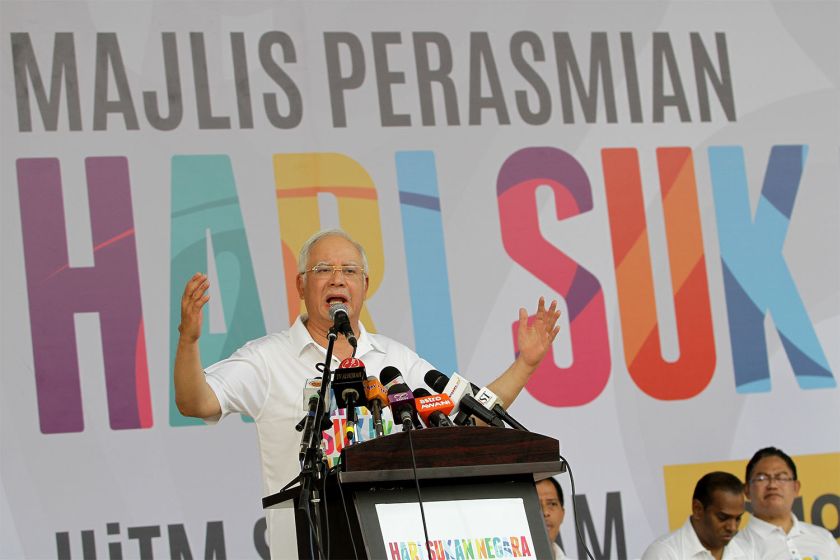


KUALA LUMPUR, Feb 21 — Datuk Seri Najib Razak has been active in sports since his early days in politics, giving it a vibrant face with his love for the great outdoors.
He has always had his finger on the pulse of developments and achievements in the field, with his busy schedule as prime minister not an impediment.
He never fails to tweet or send personal messages to athletes or teams over their achievements. A morale-boosting message on the eve of crucial competitions is also the style of the man at the top, who never misses major sporting events in the country.
Coming from a Kuala Lumpur school with a rich sports tradition — St John’s Institution — sports was part and parcel of his growing days.
It was also evident in his time as Member of Parliament for Pekan, which he took on at 22. His love for sports never left him even when he became Energy, Telecommunications and Posts deputy minister in 1976 and Education deputy minister and Finance deputy minister after that.
His stint as Pahang menteri besar from 1982 to 1986 saw him going down to the ground to attend events at village level.
It was, therefore, natural that Najib was appointed Culture, Youth and Sports minister in 1986 in a culmination of his love for sports.
It was this appointment that gave sports a timely boost to make it more vibrant and relevant.
For starters, he changed the outlook of the Sports Ministry, regarded then as a final posting prior to retirement for civil servants. With him at the helm, the ministry came alive to motivate youths to make Malaysian sports noteworthy again.
Under his stewardship, sports machinery was reinvented with innovative ideas and vision.
The notable landmarks set included the introduction of the National Sports Policy, which outlined the development of sports in the country, a gallery for past greats at the National Museum, sports scholarships, cash incentives schemes for athletes, tying up private enterprises with the National Sports Council and sports associations under the sports partnership programme and achieving international honours.
But probably the most significant landmark was the hosting of the 1989 SEA Games — the fourth to be hosted after 12 years — which gave it new meaning.
It was Najib’s vision to get the private sector involved in a big way in marketing the Games like never before.
With a marketing consultancy firm headed by Tan Sri G. Gnanalingam, he turned the Kuala Lumpur SEA Games into a money-making event with prominent sponsors.
The Games also saw Malaysians coming out in large numbers to support the proceedings, thanks to the Torch Run campaign linking the length and breadth of Malaysia.
It helped develop relationships between races, cultures and religions.
The regional Games football final on Merdeka Day at the Merdeka Stadium was packed to its 45,000 capacity, with fans braving the rain and the stands of the stadium resembling a sea of umbrellas.
The Malaysian team, coached by Englishman Trevor Hartley, went on to a 3-1 victory over arch-rival Singapore.
At that Games, Malaysia finished with a total haul of 67 gold, 58 silver and 75 bronze medals behind table-toppers Indonesia (102-78-70).
Najib’s vision and innovative ideas gave Malaysian sports a much needed lift for the future.
As deputy prime minister, he set up a high-level Cabinet Committee for Sports involving 10 ministries, which he chaired.
That is the kind of commitment he has brought to sports in the country.
He continues to support not only excellence in sports, but also programmes that make it a way of life.
Najib strongly believes Malaysia will eventually be able to churn out more world-class athletes.
Time and again, he has challenged sports associations and officials to rise to the occasion to take Malaysian sports to the next level through professional and scientific approaches.
He also believes a sporting culture could help reduce the number of Malaysians suffering from ill health and obesity.
He also aspires to see sports become a career path opportunity for trainers, coaches, sports doctors and administrators.
Without doubt, Najib wants to turn Malaysia into a sporting nation. Najib congratulates badminton legend Rashid Sidek at the 1989 Sea Games, where Malaysia finished with a total haul of 67 gold, 58 silver and 75 bronze medals behind table-toppers Indonesia.


