


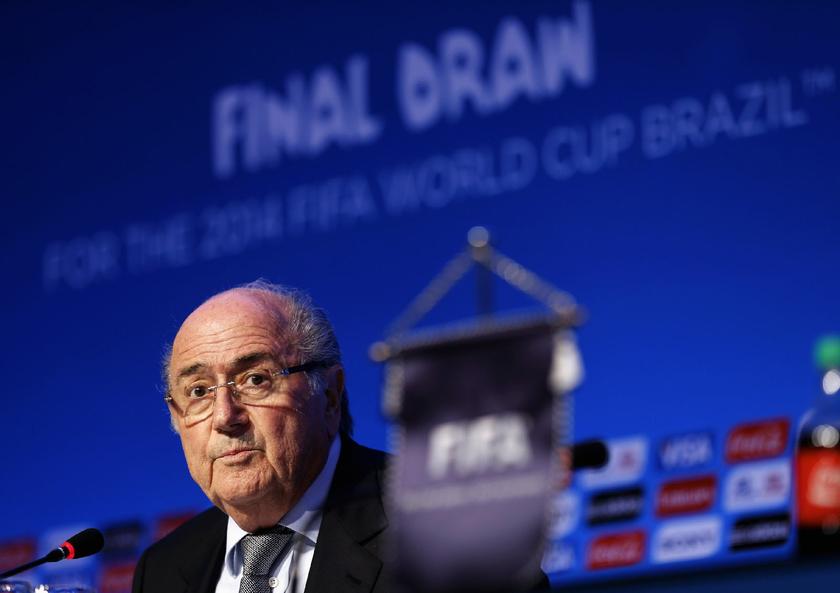


COSTA DO SAUIPE, Dec 6 — Thirty-two teams will learn their World Cup fate when the draw for Brazil’s problem-plagued 2014 showpiece takes place today as governing body FIFA plays down concerns about delays in getting stadiums ready.
The draw today will follow a ceremony starting at 1pm local time (1600 GMT) and will involve some complex juggling to separate as far as possible teams from the same continent.
But some of the eight groups will have to have two European sides facing off, with the Old Continent having 13 of the 32 qualifiers.
The presence of all eight former champions — only surprise package Bosnia will be making their debut — could produce some ultra-tough groups.
Brazil could theoretically face two European former champions in the shape of, for example, France and Italy.
England coach Roy Hodgson, meanwhile, indicated where a team played could be more important than whom they faced as the team drawn second in Brazil’s group faced a marathon travel schedule and having to play in sweltering heat in the north.
Those considerations meant European teams were likely to struggle while a South American side was likely to triumph, England legend Geoff Hurst predicted.
“There has to be some realism for the European team,” said Hurst, who scored a hat-trick in the 1966 final win over Germany and will assist in the draw today.
“Brazil must be looked upon as favourites. Anyone wanting to win will have to beat Brazil to do it.”
Despite fears over stadium delays, a host of stars insist Brazil will rise to the challenge.
“Everyone wants to come to the World Cup, where they will see the passion of Brazilians for football,” said Ronaldo, who scored both goals in Brazil’s 2002 final win over Germany.
“A month’s delay won’t jeopardise things. There is no chance an arena won’t be ready — all will be ready for the World Cup.”
Last week’s fatal accident at the Arena Corinthians in Sao Paulo, in which two workers died, forced organisers to put back the stadium’s completion date.
But FIFA president Sepp Blatter insisted he was confident the venue would still be able to host the opening match on June 12.
That would mean the stadium will have to undergo testing less than two months before the kick-off of the game, which will feature the hosts and five-times world champions.
“We have received information it should be ready in mid-April,” Blatter told reporters at the draw venue in Costa do Sauipe, north-eastern Brazil, in a final briefing before the eight groups are drawn.
“For the time being there is no Plan B,” Blatter added, though secretary general Jerome Valcke later urged caution ahead of April’s tests.
Aside from Sao Paulo, Curitiba is also running behind schedule and set for February completion while Cuiaba is on course for a late-January finish, forcing FIFA to drop an initial firm December deadline for the completion of all 12 venues.
“All FIFA can do now is ask God, Allah, whoever, that no more accidents shall arise in connection with the World Cup,” said Blatter. “That is all we can do and we hope the reconstruction can start as soon as possible.”
The fatal accident at the Arena Corinthians stadium was the third to occur at World Cup venues in Brazil.
Valcke told AFP that FIFA had resolved to look at the overall glass as half full over venue delays, particularly in the context of Sao Paulo.
“The fact (a stadium) is not ready on December 31 but on January 15 is not fundamentally a problem,” said Valcke.
“But if it’s not January but March 15 it’s more of a problem. That gives you less time to be sure things are working.”
Brazil last hosted the World Cup in 1950 but in those days there were only 13 teams and none of the mass media coverage that accompanies the modern game.
The stadium delays and a price tag of an estimated US$11 billion (RM35 billion) have fomented public unrest and pressure groups have called for public protest of the kind that accompanied the Confederations Cup rehearsal last June.
Luis Fernandes, Brazil’s deputy minister of sport, told AFP that “given the delay we shall have to accelerate preparations. It is too early to say how this will affect (Sao Paulo)”.
“Before the accident it was 97 per cent complete. According to the information we have there was no significant damage to the structure.”
Fernandes said relations with FIFA had improved since Valcke caused a storm by suggesting on an early visit that Brazil needed a “kick up the backside”.
He said Brazil did not wish to be “ordered about — but at the same time recognises society’s interest in celebrating the World Cup”.
“Once FIFA recognised the importance of the Brazilian government for the event’s success relations vastly improved.” — AFP


