

NEW YORK/LONDON, March 11 — Oil and global equity markets rebounded yesterday after the prior day’s steep losses as the world’s biggest economies moved to cushion the impact of the coronavirus, but stock gains in Europe failed to hold as investors remained skittish.
The price of Brent crude roared back as much as 10 per cent on hopes a supply cut deal could be rescued and most benchmark government bond yields rose from record lows as measures took shape to confront the epidemic’s economic and human toll.
US President Donald Trump said he will ask Congress for a payroll tax cut and other “very major” stimulus moves to ease the economic pain, but details remain unclear.
Trump was heading to Capitol Hill to discuss what action should be taken. During a White House meeting with heath executives, he said the US administration intended also to help airlines and the cruise line industry.
Japan unveiled a second package of measures worth about US$4 billion in spending, focusing on support to small and mid-sized firms.
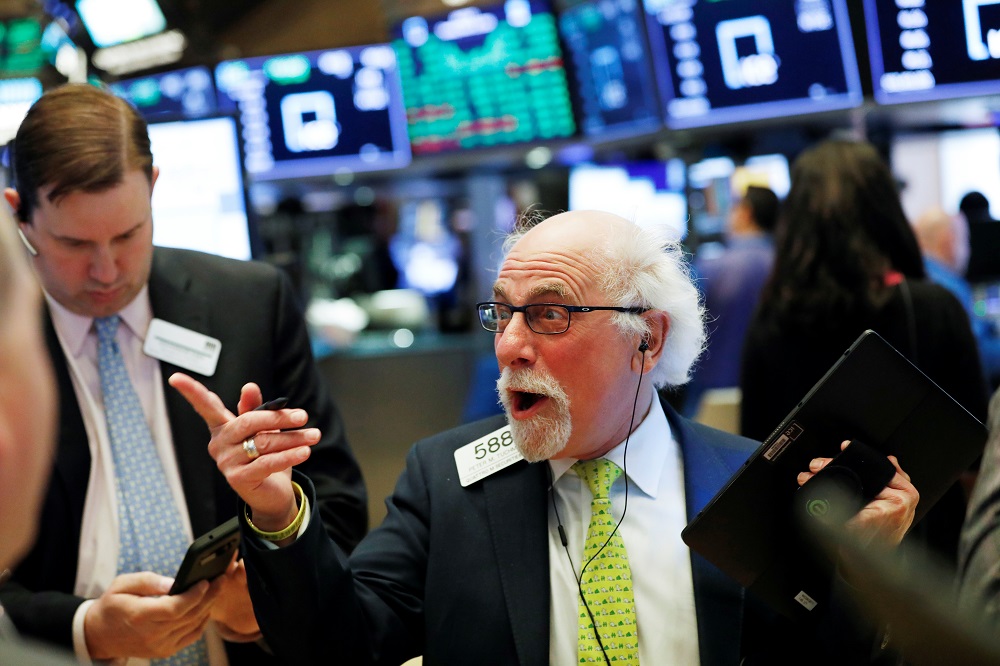
US stocks jumped more than 3 per cent at the open but pared gains in choppy trade. Investors hoped Monday’s rout marked the low of a downturn that has pushed Wall Street’s major indexes close to a bear market — defined as a decline of 20 per cent from recent peaks.
“Investors are trying put a bottom in here,” said Rick Meckler, partner at Cherry Lane Investments in New Vernon, New Jersey.
The S&P 500 forward price-earnings ratio for this year fell to 15.8 as of Monday, in line with the historic average and down from 19.3 less than a month ago, according to Refinitiv.
“It seems like that yesterday was such a collection of so much bad news, it shocked the market down. Today with fresh eyes people are picking out the names they think have dropped the most,” Meckler said.
Comments by Vice President Mike Pence that private US health insurance companies have agreed to cover coronavirus treatment and waive co-payment fees for testing helped US stocks rebound after briefly turning negative.
On Wall Street, the Dow Jones Industrial Average rose 949.48 points, or 3.98 per cent, to 24,800.5 the S&P 500 gained 113.32 points, or 4.13 per cent, to 2,859.88 and the Nasdaq Composite added 322.95 points, or 4.06 per cent, to 8,273.63.
MSCI’s gauge of stocks across the globe gained 2.03 per cent but the pan-European STOXX 600 index lost 1.14 per cent, solidly in a bear market.
The major European bourses declined after initial gains and remained in bear territory. The FTSE 100 in London almost eked out a gain but closed down 0.1 per cent as oil companies rebounded as Saudi Arabia and Russia engaged in a price war.
Oil heavyweights BP Plc and Royal Dutch Shell Plc gained 3.4 per cent and 3.7 per cent, respectively, after closing Monday with their worst session on record.
“Traders are a bit nervy, the only positive news we’ve been getting out is probably rate cuts or tax cuts,” said Michael Baker, an analyst at ETX Capital in London.
“We need news in terms of the actual control of the virus, which we don’t seem to be having right now,” he said.
Yields on benchmark US 10-year Treasury debt more than doubled to 0.70 per cent and those on German Bunds jumped around 20 basis points at one point as investors pared some safe-haven holdings, though they were beginning to ease again.
Many strategists and economists expect the Federal Reserve to cut US interest rates to zero as part of a global move to provide strength and liquidity to the financial system.
The dollar rallied after huge losses against the safe-haven Japanese yen and Swiss franc, but analysts said it was too early to predict a floor.
Stocks in Asia rebounded, with Japan’s Nikkei closing up 0.85 per cent after earlier touching its lowest level since April 2017.
China’s benchmark Shanghai Composite Index traded 2.1 per cent higher as new domestic coronavirus cases tumbled and President Xi Jinping’s visit to the epicentre of the epidemic lifted sentiment.
The oil rally had the most horsepower. About half of its massive losses from Monday were clawed back, offering hope that markets had found a floor despite still-fragile sentiment.
Russian oil minister Alexander Novak said he did not rule out joint measures with the Organisation of the Petroleum Exporting Countries to stabilise the market.
Benchmark Brent crude futures rose 8.3 per cent to settle at US$37.22 (RM158) a barrel, roughly half this year’s peak, reached in January. US crude gained 10.4 per cent to settle at US$34.36.
Gold prices fell 1 per cent, retreating from the previous session’s jump above the key US$1,700 level, as safe-haven demand waned a little amid speculation about global stimulus measures.
US gold futures settled down 0.9 per cent at US$1,660.30 an ounce.
Analysts assume policymakers will have to respond aggressively to prevent an economic crisis. The Fed on Monday sharply stepped up the size of its fund injections into markets to head off stress.
Investors are fully pricing an easing of at least 75 basis points at the next Fed meeting on March 18, while a cut to near zero was seen as likely by April.
The bond market has priced in a global recession of unknown length.
Yields on 10-year US Treasuries dipped to as little as 0.318 per cent on Monday — a level unthinkable just a week ago — but climbed back to 0.6787 per cent yesterday amid the stimulus chatter. — Reuters