


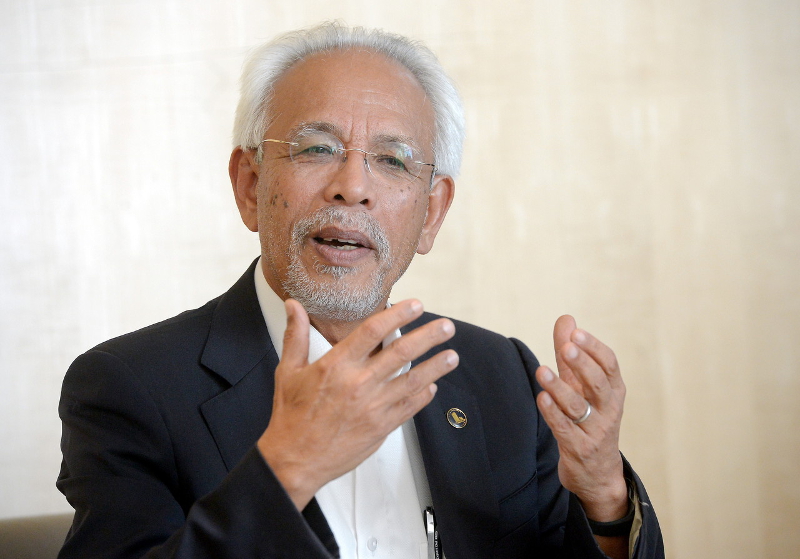


KUALA LUMPUR, Feb 2 — Newly-appointed Federal Land Development Authority (Felda) chairman Tan Sri Shahrir Abdul Samad is wasting no time in putting the 60-year-old institution back in its right track.
Just days within assuming his new position, he admitted that Felda has strayed from its original purpose of helping settlers and taking care of their well-being.
Shahrir, 68, who has vast experience in government administration and had served as minister in three ministries, said he has already made it clear to the Felda management that it has to redirect its attention to the settlers and their land schemes.
Shahrir, who is also the Member of Parliament for Johor Bahru, was appointed by the government to replace Tan Sri Isa Samad whose term as Felda chairman ended on Jan 6.
In a recent exclusive interview with Bernama, Shahrir spoke about his aspirations and directions for Felda, the housing woes faced by the second-generation settlers and its Private Funding Initiative which attracted controversy.
Here are some excerpts from the interview:
Question 1: Tan Sri, congratulations on your appointment as chairman of Felda. Call you share with us some the new directions you will be setting for this institution?
Answer: I think the first thing I have to do is to set right misconceptions about Felda and Felda Global Ventures Holdings Bhd (FGV) and explain that they are two distinct organisations. I’ve noticed that the main problem is that people have misunderstood and have a wrong perception on Felda. They can’t seem to differentiate it from FGV, which is a company listed on Bursa Malaysia. Felda, on the other hand, is a body that was established under an Act of Parliament.
Not only are the settlers themselves confused (over the two entities), even those leaders of various businesses are confused.
So, right now it’s our responsibility to explain the difference between Felda and FGV. FGV has complied with all the requirements expected of a public-listed company and is being managed as such.
Felda, meanwhile, is governed by the Felda Act. It also has a subsidiary, called Felda Investment Corporation Sdn Bhd (FIC), which is controlled and managed by the Felda board.
But as the majority shareholder (30 per cent) in FGV, Felda of course wants to see FGV succeeding and advancing in all its business ventures. (Despite Felda’s shareholding) FGV is still a separate entity and Felda cannot intervene because it (FGV) is a company with its own regulations and procedures.
You can visit FGV’s website and take a look at its profile there.
Question 2: What is Felda’s role in FGV?
Answer: Felda is merely a shareholder in FGV. But being the majority shareholder we, certainly, have vested interest in seeing the company progressing.
Being a shareholder, we are not just going to sit around with our eyes closed. We want to watch how it will endeavour to realise our dreams of seeing FGV emerging as a successful company. FGV must be run without being burdened by problems, such as those related to settlers.
Explaining the different roles played by Felda and FGV is a big responsibility that I’ve to undertake and it requires hard work.
I admit, however, that Felda has to build up its capacity to finance all its activities. In the past, Felda had estates which generated revenue. Now we are left with FIC, which was incorporated to generate additional revenue for Felda. As well as the settlers and their land schemes.
So, now our focus is only on FIC and the settlers, leaving aside FGV.
When I joined (Felda), I realised that Felda did not appear to be focusing on its core business of helping the settlers.
This is why I told the management that we have to start directing our attention to the land schemes because that is the settlers’ main source of income. And, if we were to say that Felda’s role is to help uplift the rural economy, this is it. Felda has to make itself more visible and effective for them (settlers).
Question 3: Tan Sri, does this mean that Felda has strayed from its original objective?
Answer: It is still there. But when the focus was on FGV’s listing, probably some confusion arose.
After FGV went public (FGV was incorporated in 2007 and initially operated as the commercial arm of Felda but became a separate entity in 2012 after its listing on Bursa Malaysia), it took control of Felda’s plantations. These were proper plantations which did not have settlers, and they were run like other (conventional) oil palm estates. Under the land-lease agreement signed by FGV and Felda, FGV will pay Felda RM220 million and 15 per cent of the plantation revenue every year.
So, with the exit of our plantations, we only have to take care of our settlers’ welfare.
Felda now has 112,635 settlers, who have families of their own. Some 60 years have passed since Felda’s establishment and problems and other matters have cropped up over the years.
We’ve to go back to how Felda is taking care of the settlers, that is how it is tackling issues related to them and their land schemes and the subsequent generations as well as their welfare and social well-being.
And, with new industries and entrepreneurial activities (available now), we want to look at these too and give our encouragement.
Felda does not earn any profit from the settlers. They don’t pay us anything. They get to keep all the earnings they derive from their land schemes.
Felda provides assistance to them to improve their services, cultivation, maintenance, management and so on.
For example, if they are given good fertilisers and seeds, and are able to implement good agricultural practices, they won’t have any problems at their farms or smallholdings.
Their productivity and yields will increase, and so will their incomes. Taking care of their land schemes has to be our priority as it is in their best interests.
Question 4: Can you give us your views on prevailing issues relating to the housing woes faced by the second-generation Felda settlers, and other matters? In fact, these issues have become political fodder for certain parties (opposition).
Answer: Last Wednesday (January 18) I visited Jengka, Pahang to take a look at some of the houses for the second-generation settlers. In the first phase of our pilot project, a total of 8,470 units will be built in seven locations. There are six packages for the contractors to complete. Some have been completed, but some have been abandoned.
The housing problem faced by the second-generation settlers is something that we have to tackle. Rafizi (opposition MP Rafizi Ramli) has also made an issue out of the Private Funding Initiative (PFI) as he is alleging that it will not be in the interests of the settlers. A total of 11,530 housing units to be built under the Felda New Generation Housing Project (PGBF) will be financed through PFI.
Felda has signed an agreement with Syarikat Putra Star Investment Holdings Pte Ltd to finance the project via PFI, while Terranova Builders Sdn Bhd has been appointed as the housing developer. Implementing huge projects through PFI is not something out of the ordinary. He (Rafizi) wouldn’t have spoken against it if he understood Felda’s structure and philosophy.
First and foremost, he should know that (Felda’s) land schemes come under the jurisdiction of the Land (Group Settlement Areas) Act 1960 (GSA) and under this Act, such land cannot be pledged or sold to other parties. Impossible.
So, should he (Rafizi) understand properly, the settlers will not be burdened by the PFI.
I can guarantee that the settlers’ properties will not be affected because they come under the GSA.
No collateral is required but what Felda will do is provide a corporate guarantee. Being an agency, Felda can issue such guarantees but it will not jeopardise the settlers’ assets.
(Under the GSA, land owned by settlers cannot be leased, mortgaged or transferred to other parties, except with the written approval of the state authorities. The Act also prohibits the subdivision of settlers’ land.)
Question 5: What about the US$1 billion (RM4.48 billion) PFI secured by Felda?
Answer: The financing was not meant for Felda but for the contractors involved in the (second-generation housing) project.
Terranova was not the only company that put in a bid for the (housing) project... there were bids from other companies as the market was aware that Felda wanted to build many houses.
So, after negotiations and discussions, we selected Putra Star (as financier) and Terranova (as developer).
The second phase of PGBF has not been implemented due to PFI compliance issues. Negotiations are still going on.
Question 6: If the negotiations fall through, what other initiatives will be taken to resolve the financing of the second-generation housing project?
Answer: If it (the negotiation) fails, we will look for other means of financing.
I’ve said that it’s not fair for the children of settlers (not to have access to housing) because they are Malaysian citizens too. So it’s only fair that they be given the same amenities and attention given to other Malaysians.
However, Felda is not the only one affected by the housing issue, the whole of Malaysia is facing the same problem.
We will be discussing the matter again with the federal government.
Question 7: Lastly, Tan Sri, what are your aspirations for Felda?
Answer: I am just beginning to get to know the Felda management better. As I said earlier, I told them to go back to focusing on the settlers and their land schemes because that is our main responsibility.
Secondly, we have to look at how we can get higher returns from investments made through FIC. As announced earlier, I have asked them (board of directors) to resign and I will fill the posts in the near future.
On the whole, I want the public to have a better understanding of what Felda and FGV are all about.
Going back to the settlers, I will set up a body or unit called the inspection unit. This body will report to me the various problems faced by the settlers.
I hope my visits (to the Felda schemes) and my views, as well as my advice, are well-received by them.
As for the administrative team, there’s a need to improve governance. Felda has been around for a long time and the good governance and management practices that led to its success are already there in place.
We’ve to keep an open mind. Information, or anything else, does not come from just one channel. Felda and its board members must become accustomed to today’s world. If the settlers were not smart, their children are smart. Times have changed and the whole world has changed in terms of communications. We have to adjust ourselves to the new realities presented by the world of communications. — Bernama


