


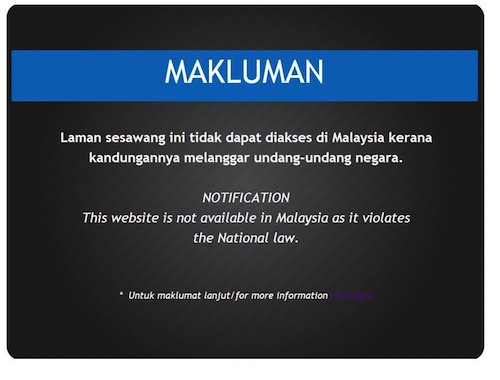


PETALING JAYA, July 21 — Several netizens have complained of new “signs” of censorship after running into an official-looking notification barring access to certain sites, but regulators insist such moves go back more than a decade.
According to the Malaysian Communications and Multimedia Commission (MCMC), censoring online porn was an old practice, as “indecent” and “obscene” content is prohibited under Section 211 of the Communications and Multimedia Act 1998.
It further maintains that the blocks do not represent censorship per se, but act to inform Internet users of possible violations.
“The Notification Page is a new addition to assist Malaysian users to practise self-regulation and also to be aware of the types of the content that they are accessing,” MCMC corporate communications head Sheikh Ahmad Raffie Sheikh Abd Rahman told The Malay Mail Online yesterday.
He also added that the barriers were put in place by the providers and not the MCMC.
“The blocking of the websites is done by the Internet Service Providers licensed by SKMM and is applicable to all users accessing the Internet through the ISPs Domain Name Server (DNS),” he added, referring to MCMC by its Malay initials.
On Thursday, Twitter user @hazri complained of being blocked from porn websites like www.pornmd.com and www.xtube.com.
“It is a step in the wrong direction!” he tweeted, posting a picture of the MCMC notification.
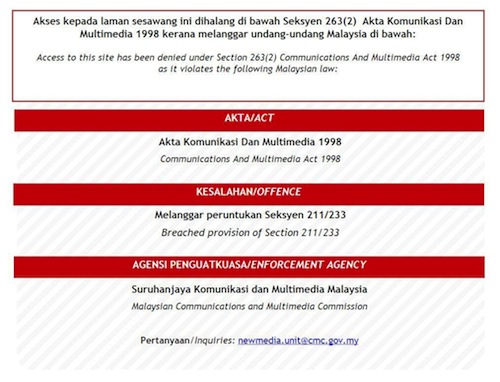
Net censorship is a controversial subject in the country due to the pervasiveness of the Internet in Malaysians’ lives. Nearly half the 28 million population are on the Facebook social network, according to monitors at socialbakers.com, and the country reportedly has the second highest Twitter usage in the world.
When former Prime Minister Tun Dr Mahathir Mohamad rolled out the Multimedia Super Corridor, a Bill of Guarantees that included a pledge “to ensure no censorship of the Internet” was also introduced.
The country’s longest-serving prime minister, however, said last year that Putrajaya needed to reconsider absolute freedom on the Internet, noting that “filth” had to be blocked.
On Friday, Sheikh Ahmad Raffie said that MCMC had requested for 2,611 websites to be blocked last year for violating local laws, while 806 websites were blocked in the first half of 2013.
“It is noted that most of the blocking are for phishing websites,” he said.


