













NEW YORK, Sept 18 — When Dallas-area realtor Katherine Schwartz went shopping for a new SUV, she test-drove several models, including a Chevy Tahoe, Land Rover LR3 and Mercedes GL550.
In the end, Schwartz, 40, decided to plunk down a US$5,000 (RM21,148) deposit for a vehicle no consumer has been able to sit in, much less take for a spin: Tesla Motors Inc.’s all-electric Model X, which starts deliveries later this month.
“You name it, I test-drove it, but when I saw the video of Elon Musk revealing the Model X online I was like ‘OK, this is it,”’ said Schwartz, who’s always hauling something: clients, real estate signs, two kids, their friends, the dog.
Plus, her husband already drives a Tesla Model S sedan. “I’m very impressed with the safety record of the Model S, and I figure that the X will be comparably rated,” she said.
Tesla designed its first sport utility vehicle in part to appeal to female drivers and is betting a lot of women will feel the same way as Schwartz. If the company is to hit an ambitious annual sales target of 500,000 vehicles by 2020, it needs to attract a whole new contingent of drivers — and women buy more than half the crossover SUVs in the US
Tesla’s initial customers — many of them tech-savvy early adopters — were overwhelmingly male. In 2012, the year the Model S hit the market, women accounted for just 13.3 per cent of the electric sedan’s US registrations, according to data from IHS Automotive.
Gender ratio
But the gender ratio is shifting as women become more comfortable with electric vehicle technology, the company’s safety record and the Tesla brand.
In 2013, women accounted for 17.8 per cent of Model S registrations; in 2014, it was 21.5 per cent, according to IHS. The National Highway Traffic Safety Administration, or NHTSA, awarded the Model S a 5-star safety rating in August 2013. While SUVs can be top-heavy, Tesla’s vehicles are designed with the electric drivetrain sitting beneath the car, which lowers the center of gravity and minimizes rollover risk.
With the X, the demographics of Tesla’s customers have the potential to flip. Though women buy just 40 per cent of cars in the US, they purchase 53 per cent of the small SUVs and 48 per cent of small premium SUVs, according to an analysis by J.D. Power & Associates.
Schwartz’s order of priorities will be familiar to many female car buyers: a third row seat, plenty of cargo space, safety, reliability, fuel economy and performance.
“With the S, we might be something like two-thirds male,” Musk said in an interview with Bloomberg earlier this year.
“With the X, I think we probably will be slightly majority female.”
Early in the design process, Tesla invited a dozen women to its Palo Alto, California, headquarters for a three-hour focus group led by chief designer Franz von Holzhausen. The participants, most of whom drove minivans and SUVs, were asked what they like and don’t like about their vehicles. Among the big issues: safety, a third row and getting kids in and out of car seats.
Jane von Holzhausen’s, Franz’s mother, lives in Connecticut and put a reservation down on the Model X when the concept was revealed in early 2012.
“My husband and I have a Model S, and I love the way it drives,” said von Holzhausen, who has seven grandchildren.
“But I like to sit up a little higher. I can’t wait to get it.”
Splashy reveal
Musk unveiled the Model X in February 2012 at a splashy Los Angeles event featuring California Governor Jerry Brown. Three and a half years later, the first Xs—a limited edition Founders Series that typically goes to board members and close friends of the company—will be handed over Sept. 29 at Tesla’s factory in Fremont, California.
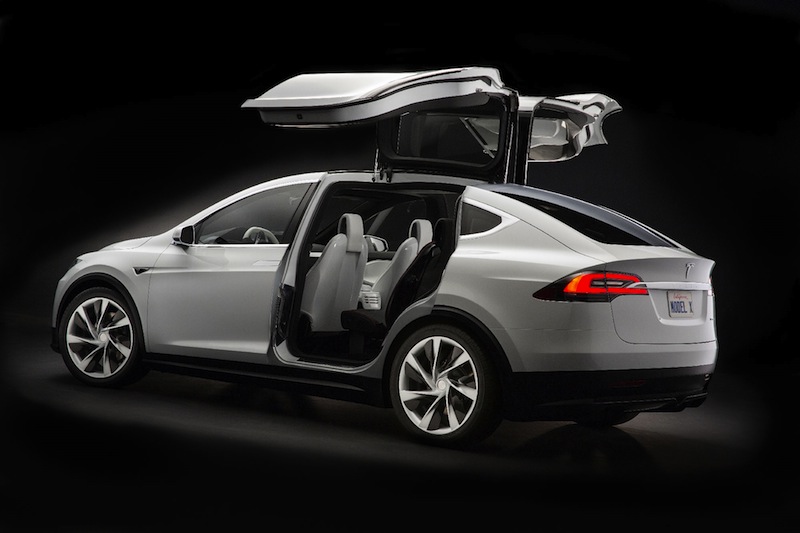
The all-wheel-drive X seats seven passengers, has “falcon wing” doors that open vertically and a 90 kilowatt-hour battery that is expected to have a range of roughly 386km per charge.
Musk recently tweeted that with the same options, the Model X will cost US$5,000 more than the S due to its greater size and complexity. The S starts at US$75,000; Tesla has not released the full specs for the Model X.
Americans will buy more than 17 million new vehicles this year, and their love affair with trucks and SUVs is accelerating. In August, more than 889,000 light trucks were sold in the US, compared to 688,000 cars. Smaller SUVs, including the BMW X5, the Audi Q5 and the Porsche Cayenne, are among the models popular among female drivers.
“Women dominate the crossover SUV segment,” said Jessica Caldwell of Edmunds.com. “Ride height gives a feeling of safety, and having a command view of the road is really important to women. Women are also pragmatic buyers, and SUVs bring flexibility. SUVs are growing in popularity, and Tesla brings an electric solution.”
Anticipation for the Model X is so high that it could eat into sales of the S. Tesla aims to deliver 50,000 to 55,000 vehicles this year, compared with a previous target of 55,000 -- partly owing to production snags with the Model X’s middle-row seats. Now Tesla is trying to stoke sales of the Model S with a customer referral program.
Ethan Shapiro got a Model S in early 2013. He sold it in May of this year so that he could afford the X, which he reserved in June 2012.
“If you have three kids, you really need a third-row seat,” said Shapiro, who lives in Miami and is an IBM project manager. “My kids are excited about the falcon wing doors. They’ve been talking about them for a year.”
Shapiro drives a 2005 Lincoln Aviator that he inherited from his father. His wife drives a hybrid, the 2007 Lexus RX400h. Who will drive the Model X most days?
It’s an “ongoing conversation”. — Bloomberg