













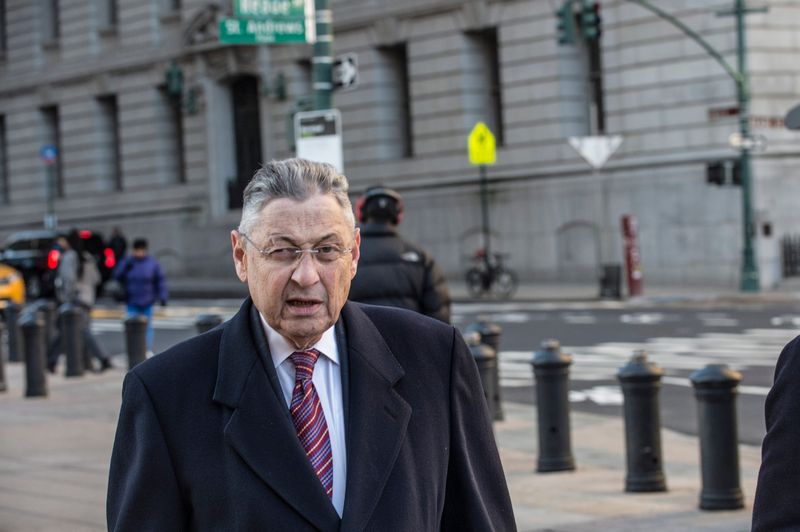


NEW YORK — Sheldon Silver, who held a seemingly intractable grip on power for decades as one of the most feared politicians in New York state, was found guilty yesterday of federal corruption charges, ending a trial that was the capstone of the government’s efforts to expose the seamy culture of influence-peddling in Albany.
The verdict was a quick and unceremonious end for Silver, who, during his more than two decades as state Assembly speaker, displayed a Teflon-like quality in deflecting questions about his outside income as well as calls for his ouster.
Silver, 71, a Manhattan Democrat, was convicted on all seven counts against him. The charges of honest services fraud, extortion and money laundering stemmed from schemes by which he obtained nearly US$4 million (RM16.94 million) in exchange for using his position to help benefit a cancer researcher and two real estate developers.
The son of a hardware store owner on the Lower East Side, Silver was known as a poker-faced negotiator who often got his way during budget negotiations, sometimes by simply holding out the longest. At the same time, he was also a fierce defender of New York City in the state Capitol. As a result of the conviction, he must automatically forfeit the Assembly seat to which he was first elected nearly 40 years ago.
The verdict came on the jury’s third day of deliberations, after a five-week trial in US District Court in Manhattan. When word came that a verdict had been reached, Silver fidgeted in his chair, clenched his jaw, shook his head, sighed and glanced toward Preet Bharara, the US attorney for the Southern District of New York, who had taken a seat at the rear of the courtroom just before the verdict was read.
After the fourth guilty pronouncement by the jury forewoman, Silver’s shoulders sagged visibly inside his baggy navy blue suit. No sentencing date was set, but he could face up to 20 years in prison on each of six of the seven counts. His lawyers indicated that they would file motions to challenge the verdict.
Steven F Molo, one of Silver’s lawyers, said the defence was “obviously disappointed in the verdict, and we intend to file vigorous post-trial motions seeking to set it aside.”
“We’ll take it from there,” he continued.
Reporters mobbed Silver as he left the courthouse. He said he was “disappointed” in the verdict. “Ultimately I believe after we file the legal challenges we will have a different result,” he added.
Asked by one reporter what he would say to constituents who had supported him over the years, he responded, “Thank you.” His lawyers then guided him through the crowd and into a waiting black sedan.
Bharara released an equally succinct statement after the verdict: “Today, Sheldon Silver got justice, and at long last, so did the people of New York.”
Silver is the most prominent in a parade of state lawmakers who have been convicted by Bharara’s office. Silver’s former counterpart, state Sen Dean G. Skelos, a Long Island Republican who served as Senate majority leader, is also being tried on federal corruption charges; his case, which also includes Skelos’ son, Adam, entered its third week yesterday.
For portions of his tenure as speaker, Silver maintained a viselike hold on the Assembly, withstanding the rare challenge from Democratic colleagues, and brushing off all criticism of his performance. He was faulted for his handling of two sexual harassment allegations; in 2013, a state ethics report criticised him for covering up accusations of sexual harassment against Assemblyman Vito J Lopez.
Silver also stood out in financial disclosure reports that showed him to be one of the largest earners of outside income among New York state politicians, reporting that he had been paid hundreds of thousands on mesothelioma, a deadly form of cancer related to asbestos exposure.
In return, Taub sent mesothelioma patients with potentially lucrative legal claims to Weitz & Luxenberg, which then shared a portion of its fees with Silver.
In the second scheme, prosecutors charged, Silver had the two developers, Glenwood Management and the Witkoff Group, move certain tax business to a law firm, Goldberg & Iryami, that secretly shared its fees with Silver.
In return, the speaker lent his support to critical rent legislation backed by Glenwood, in particular, and met with the company’s lobbyists.
Silver attended each day of his trial, often wearing a pinstripe suit. For the most part he sat quietly, chatting occasionally with his lawyers, or making notes for their review. He did not testify in his defense, and his lawyers did not call any witnesses.
Silver’s lawyers argued that in charging him, Bharara’s office had sought to criminalise the kinds of activity in which state legislators routinely engaged.
“They look at conduct which is legal,” Molo told the jury in his opening statement, “conduct which is normal, conduct which allows government to function consistent with the way that our founding fathers of the state of New York wanted it to function, and they say this is illegal.”
A federal prosecutor, Howard S Master, in a summation, cited what he called the “core principle” that “this nation shall be governed by the people and for the people.”
Silver “governed using a different model,” Master said.
“It wasn’t by the people or for the people,” he continued. “It was by Sheldon Silver for Sheldon Silver.” — Benjamin Weiser and Susanne Craig/New York Times