












NEW DELHI, July 21 — The source of poison that killed 23 school children last week in the Indian state of Bihar was the cooking oil used to prepare their lunch, an official said, citing a forensic report released late yesterday.
Monocrotophos, a highly toxic organophosphate insecticide, was found in the oil container, the food and the utensil in which it was cooked, R. Lakshmanan, who runs the mid-day meals program in the state, said in a telephone interview last night. The chemical is produced by at least 15 manufacturers in the world, according to the website of Pesticide Action Network. An Indian unit of Dow AgroSciences SAS is one of the makers of the organophosphorus insecticides, according to its website.
“This confirms our suspicion that the oil, or what was believed to be oil, was the source of poisoning,” Lakshmanan said in a telephone interview. He didn’t say if the food was cooked just using the insecticide or contaminated oil.
The deaths of the children further tarnished the reputation of an 18-year-old government meals program meant to feed the hungriest children in the poorest corners of India. The plan, part of a web of polices aimed at easing the malnourishment that afflicts almost half the country’s children, has been criticised by the Supreme Court and the comptroller and auditor general for corruption and inefficiencies.
Stolen food
Graft has plagued all three of India’s major food aid programs. A Bloomberg News investigation last year showed how $14.5 billion (RM46.3 billion) in food meant for the poor was stolen from a rationing system and sold on the black market.
The forensic report doesn’t indicate whether the poisoning was intentional, Lakshmanan said.
About 50 to 60 children were present as lunch was served on July 16 around 1pm, relatives said July 18. Most ate off metal plates sitting on the building’s concrete floor, many of which were strewn around the classroom. The meal had been cooked just outside on a makeshift stove made of bricks, which has since been destroyed during protests that followed the deaths.
The condition of three children undergoing treatment in the Intensive Care Unit of the Patna Medical College hospital had improved, the hospital said in a bulletin yesterday. All the other children and the school cook were also stable and the patients were now being fed orally, it said.
Lakhshmanan, in a separate interview on July 19, said the tragedy wouldn’t have occurred if rules had been followed and condemned the “gross negligence” of the school principal in the village of Dharmasati Gandawan. He rejected charges the deaths represented a wider government failure.
‘Gross negligence’
“There has been a very callous attitude and gross negligence on the part of the headmistress,” he said in the provincial capital of Patna. “Our principals have been given detailed training as recently as April, including instructions to taste the food before feeding the students.”
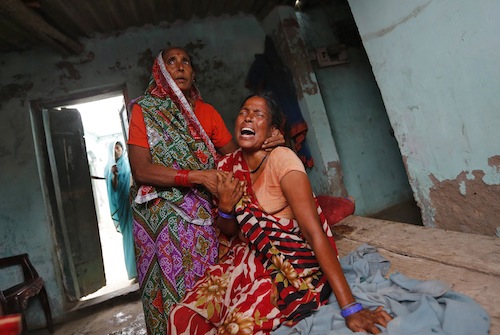
Many of the grieving families in Bihar buried their dead children in the school grounds or in nearby paddy fields to protest what they said was official indifference to their loss.
Nirmala Kumari, the sister-in-law of the school cook, said in an interview at her home in the village on July 18 that it was clear there was something wrong with some of the meal ingredients as they were being prepared. The school principal was told of a foul smell and strange colour to the food, and was told lunch shouldn’t be served to the children, Kumari said as she stared out of the window of her family’s village home. The cook was overruled.
Kitchen plans
“These kids were being fed sub-standard food. We all know that as fact in this village,” Dilip Kumar, 20, a student and resident, said. “This is going on all over Bihar and probably India.”
A case has been lodged against the principal, local magistrate in Saran district Manish Sharma said naming her as Meena Devi. She’s on the run and being sought by police, he said. A store ran by her husband provided the food for the school meals, local media reported.
In the tragedy’s wake, Bihar’s government will build a permanent kitchen at each of the 14,000 schools in the province without one, Lakshmanan said. Schools received just 3.5 rupees (6 cents) a day to feed each child below 10 years of age, he said. In Bihar alone, the lunch program feeds 12.5 million children, according to Lakshmanan.
Malnourishment rate
Rapid economic growth hasn’t dented malnourishment rates, and more people than ever don’t consume government-recommended minimums. Some 900 million Indians hover just above starvation but below well-nourished, according to the latest data available, up from 472 million in 1983.
Bihar, one of India’s poorest states, has been admonished by the Supreme Court for its management of the school meal program. In 2010, the latest data available, the central government set aside US$80 million for food and US$73 million to pay for cooking materials, including the construction of hygienic sheds and water supplies. The state government managed to spend only US$30 million of that, the planning commission report found.
As parents vowed to keep their children out of school, Lakshmanan said his government was seeking to reassure them. “The moral responsibility falls on the government,” he said. “But this cannot be treated as a systemic failure, it’s one of human error,” or a crime committed by an individual, he said. — Bloomberg