


OCTOBER 9 — Prime Minister Datuk Seri Anwar Ibrahim, popularly known as PMX, has demonstrated once again that political survival is not merely about commanding parliamentary numbers.
It is about understanding the psychology of the electorate, anticipating economic anxieties and converting fiscal instruments into political confidence.
Budget 2027, approaching the half-trillion-ringgit threshold, is a testament to Anwar’s mercurial political shrewdness.
At a time when Malaysia faces an uncertain 16th general election, the Prime Minister has reminded Malaysians that the Unity Government remains capable of delivering tangible benefits.
Madani is back.
Not merely as a slogan associated with compassion and good governance, but as a political proposition reconnecting the government with ordinary Malaysians.
The announcement of RM1,500 in special financial assistance to approximately 1.3 million civil servants in Grade Utama B and below, including contract employees, is particularly revealing.
The assistance will be disbursed in two instalments.
The first comes before Hari Raya Aidilfitri, while the second precedes Malaysia’s 70th anniversary of independence in August 2027.
Neither timing is politically insignificant.
Hari Raya is a period when household expenditure increases substantially. Families must contend with travel, food, clothing and social obligations.
The assistance therefore arrives when its immediate economic utility will be appreciated.
The second instalment carries different symbolism.
It associates the government’s recognition of public servants with seven decades of nationhood.
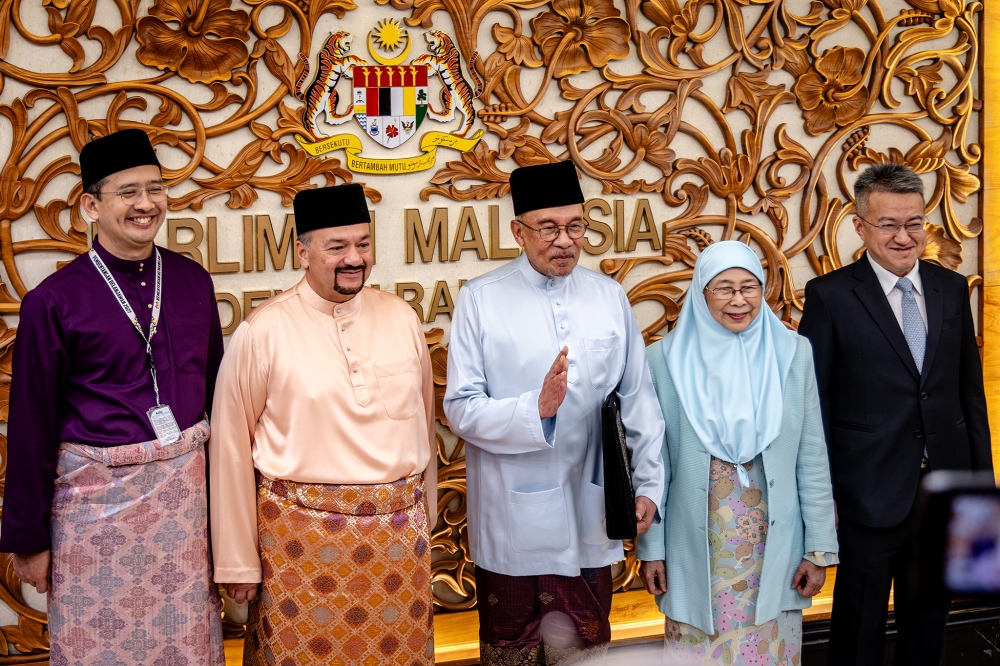
Anwar has combined economic relief with national sentiment.
This is not necessarily cynical politics. Democratic governments must balance fiscal prudence with demonstrating that public institutions remain responsive.
Yet the political sophistication of this arrangement should not be underestimated.
Malaysia’s civil service is more than an administrative apparatus.
It is an institutional network extending from Putrajaya to schools, hospitals, district offices and rural communities.
Its members are also voters, parents, consumers and opinion-makers.
When 1.3 million civil servants receive additional assistance, the effects extend beyond direct recipients.
Their households and local economies benefit from additional spending.
This does not mean financial assistance automatically translates into electoral loyalty.
Malaysian voters have repeatedly demonstrated their capacity to separate immediate economic benefits from broader judgments about governance.
Nevertheless, the announcement provides the government with an opportunity to rebuild confidence when public expectations remain high.
The larger significance of Budget 2027 lies in Anwar’s recognition that economic management and political legitimacy cannot be separated.
A government may announce impressive investments, stronger trade relations and ambitious industrial strategies.
But unless Malaysians experience improvements in their daily lives, such achievements remain distant abstractions.
The cost of living remains the central test.
Malaysia’s middle-income households, younger workers and small businesses continue facing pressures arising from housing affordability, food expenditure and uncertain external economic conditions.
Anwar understands that macroeconomic statistics alone cannot sustain political legitimacy.
National economic performance must translate into household-level improvements.
This is where his political adaptability becomes evident.
Anwar has spent decades navigating political adversity, institutional resistance and shifting alliances.
His career has been marked by reversals that would have ended the ambitions of less resilient leaders.
His present challenge, however, is fundamentally different.
As Prime Minister, he must demonstrate that political resilience can be converted into administrative competence.
Budget 2027 provides another opportunity to make that case.
Yet a budget approaching half a trillion ringgit is not automatically successful.
Its effectiveness must ultimately be judged by fiscal sustainability, expenditure quality and the government’s ability to generate durable economic growth.
Public assistance cannot substitute for productivity improvements, wage growth or institutional reform.
Indeed, the greater the scale of public expenditure, the more important transparency and accountability become.
Malaysia must ensure fiscal commitments are supported by credible revenue assumptions and development allocations produce measurable returns.
Anwar’s shrewdness will therefore be tested not merely by the reception of his announcements but by their implementation.
There is also an important electoral dimension.
With GE16 approaching next year, Malaysia does not possess an obvious government-in-waiting capable of presenting a unified alternative to the Unity Government.
Opposition fragmentation, changing party alignments and uncertainty over political leadership have complicated the electoral landscape.
Anwar appears determined to exploit this strategic opening, not simply by attacking opponents but by strengthening the government’s claim to competence.
Budget 2027 is consequently both an economic document and an instrument of political positioning.
Its message is that the Unity Government remains functional, financially capable and attentive to Malaysians’ pressures.
But Anwar should resist interpreting favourable reactions as guarantees of electoral success.
Malaysian politics remains too fluid for such certainty.
Previous administrations demonstrate that generous public spending cannot permanently compensate for weak governance or declining trust.
For Madani to become politically durable, it must evolve beyond periodic financial assistance into a coherent model of national development.
That means better public services, stronger educational outcomes, competitive industries, improved wages and greater institutional integrity.
The Prime Minister has shown the tactical intelligence to read the political moment.
His next task is demonstrating the strategic patience necessary to transform temporary goodwill into sustained confidence.
Budget 2027 may be remembered as the moment Anwar regained the political initiative.
But the ultimate measure of his leadership will not be the budget’s size.
It will be whether Malaysians emerge more economically secure, institutionally confident and optimistic about their future.
Madani is back. Whether it stays back depends on delivery, not declarations.
* Phar Kim Beng, PhD is the Professor of Asean Studies at International Islamic University of Malaysia and Director of Institute of International and Asean Studies (IINTAS).
** This is the personal opinion of the writer or publication and does not necessarily represent the views of v


