


OCTOBER 9 — When the International Monetary Fund and World Bank gather in Bangkok for their Annual Meetings on October 12-18, recent flooding will pose a question central to their discussions: how can a country protect the households, businesses and infrastructure on which its prosperity depends?
The contrast with 1991, when Thailand last hosted the meetings, is instructive. Then, the country appeared to embody the promise of rapid industrialization, expanding foreign investment and Southeast Asia’s economic ascent. This time, the challenge is not simply to generate growth, but to protect its foundations against costly disruptions.
Early assessments suggest losses from interrupted economic activity of around 0.1-0.2 per cent of GDP, even though damage to assets could be substantial. A modest hit to national GDP does not necessarily mean a modest economic shock.
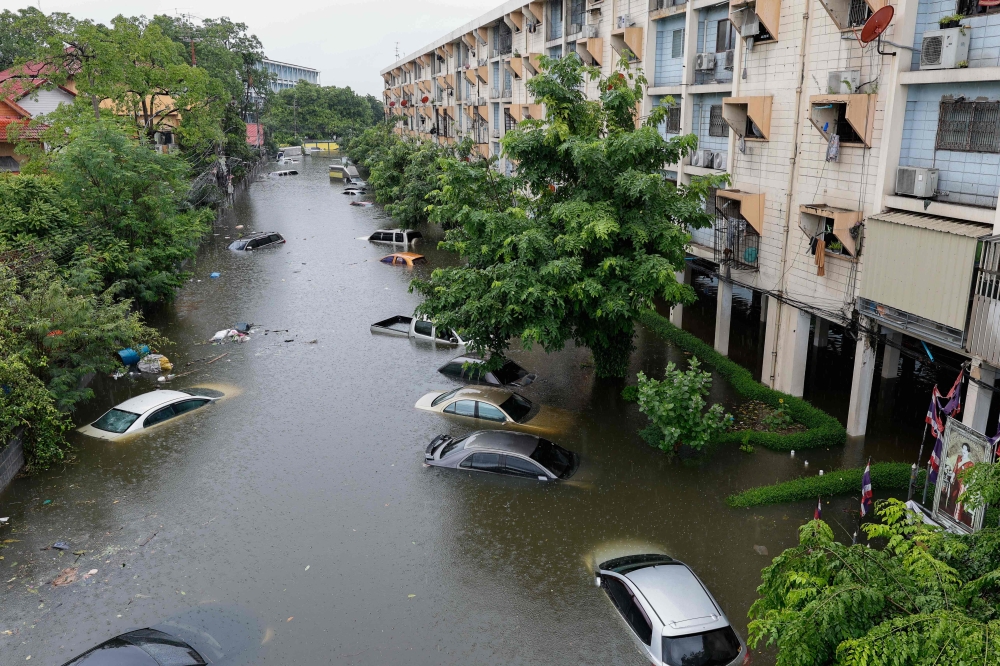
Floods destroy household and business wealth as well as interrupt production. Homes, vehicles, shops, inventories and machinery must be repaired or replaced. Businesses lose income while facing unexpected expenses. Workers struggle to reach workplaces, and families must replace essential possessions before their finances have recovered.
Economic activity can resume well before those losses have been absorbed. Reopening a shop does not replenish its owner’s savings. Returning to work does not repay the money borrowed to repair a home. A recovery measured through production and spending can therefore coexist with persistent financial insecurity.
In an economy burdened by household debt of 85-87 per cent of GDP, weak productivity growth and demographic ageing, these losses compound existing vulnerabilities. For families servicing mortgages, vehicle loans and consumer debt, recovery may require another loan, depleted savings or postponed spending. Restoring normal activity is only the first stage of recovery.
The disruption has already reached beyond flooded neighborhoods. Thailand’s Commerce Ministry has asked producers to curb egg exports through year-end after floodwaters damaged poultry farms, showing how losses that look contained in GDP terms can cascade into food supply chains and trade policy.
Thailand should judge recovery not only by how quickly transport and production return to normal, but also by whether households and small businesses can rebuild without becoming more financially fragile. Otherwise, the disappearance of floodwater risks being mistaken for the disappearance of economic damage.
This broader understanding should shape the government’s fiscal response. Immediate assistance is essential, but emergency relief and longer-term prevention should not become competing priorities, with one funded only by postponing the other.
The IMF’s February assessment offers a more useful framework than a simple choice between stimulus and restraint. It supports targeted assistance alongside a credible medium-term fiscal strategy and measures to rebuild fiscal buffers. The floods make that balance more urgent.
The issue is not whether Thailand should spend on recovery, but how to target assistance, protect vulnerable households and prevent repeated emergencies from displacing investment that could reduce future losses.
That requires distinguishing three tasks: repairing current damage, strengthening households’ ability to recover, and reducing exposure to the next disaster. They operate on different timescales but belong within the same strategy. Funding repairs while repeatedly postponing prevention may restore activity without making the economy safer.
Prevention requires treating Bangkok’s drainage systems, pumping stations, canals, retention areas and transport networks as economic infrastructure, not merely municipal services. Bangkok city alone accounts for roughly 34 per cent of Thailand’s GDP. Disruption in the capital carries consequences far beyond the neighborhoods under water.
Thailand’s manufacturing networks, tourism industry and central position in mainland Southeast Asia remain considerable advantages. Yet they depend on the reliable movement of workers, goods and visitors. Resilience is not an alternative to competitiveness. It preserves the conditions that make productive activity possible.
Infrastructure should therefore be judged by more than scale or expenditure. The test is whether it reduces losses, keeps essential networks functioning and protects exposed communities. Announcing a large project is easier than demonstrating that it will deliver those outcomes.
The Bangkok meetings offer an opportunity to move from commitments to a credible delivery plan, explaining what will be built, how it will be funded and what protection communities can expect in the meantime.
The cabinet’s approval of the 160-billion-baht Chai Nat-Pa Sak-Gulf of Thailand flood-diversion canal provides a concrete starting point. Intended to reduce flooding across 3.48 million rai (5,568 square kilometres), construction is scheduled to begin in 2027 and finish in 2034. This is a long-term commitment, not protection that will arrive next year.
Approval should open a discussion about delivery rather than close one. The government should set implementation milestones, assign responsibilities and report progress publicly. It must also explain how communities will be protected before construction is complete. Credibility depends on commitments that survive beyond the conference.
International support can strengthen that programme, but the IMF and World Bank have distinct roles. With the IMF, Thailand can address how targeted recovery assistance and preventive investment fit within a credible medium-term fiscal framework. With the World Bank, it can explore support for adaptation alongside arrangements that make disaster response faster and more predictable.
Financing a canal seeks to reduce physical exposure. Contingent credit and insurance help manage the financial consequences when disasters still occur. Thailand needs prevention and financial protection; neither substitutes for the other.
A useful outcome would be a programme connecting targeted recovery support, accountable infrastructure delivery and financing for future emergencies. Its purpose should be to close gaps in Thailand’s capacity to prevent damage and respond when prevention fails, not merely attach an international financing label to an existing project.
The significance would extend beyond Thailand. Jakarta, Manila and Ho Chi Minh City confront variations of the same challenge: economically important urban areas must reconcile concentrated development with exposure to flooding. Climate resilience cannot remain separate from decisions about transport, investment and urban growth.
Thailand can make that connection tangible in Bangkok. Not every flood signals an impending economic crisis, but reassuring national output estimates can obscure losses that leave households and businesses less able to withstand the next shock. In 1991, Thailand offered its visitors a story of expanding economic opportunity. In 2026, it can show how that opportunity will be protected.
Success will not be measured by the size of an announcement or the speed with which floodwater disappears. It will be measured by whether the next flood causes fewer losses, and whether affected households and businesses recover without becoming poorer or more indebted.
* Phar Kim Beng is professor of Asean Studies, and director at the Institute of International and Asean Studies, International Islamic University Malaysia. Dr Vic Li is a lecturer in East Asian Studies at University of Sheffield, United Kingdom
** This is the personal opinion of the writer or publication and does not necessarily represent the views of Malay Mail.


