


AUGUST 21 — If Umno behaves as a rational political party determined to restore its position at the centre of Malay politics, indeed a confident one, the strategic course in Melaka is increasingly clear: it should go solo.
This is not an argument against cooperation for its own sake. Nor is it a rejection of Malay-Muslim political cooperation as a principle.
It is an argument about leverage, institutional survival and the longer-term balance of power between Umno and PAS.
Victories in Johor and Negeri Sembilan have already demonstrated something that many had considered improbable only a few years ago. Umno, and by extension Barisan Nasional (BN), is capable of climbing back from the abyss of political irrelevance.
That recovery does not necessarily require PAS.
Indeed, Melaka may be the state where Umno has the strongest incentive to prove precisely this point.
If Umno concludes that it once again requires PAS to secure Melaka, it risks surrendering some of the political leverage it has painstakingly recovered.
Worse, it could inadvertently strengthen a PAS led by Tan Sri Abdul Hadi Awang just as negotiations over the shape of GE16 begin to intensify.
The strategic calculation is straightforward. A stronger PAS entering GE16 negotiations can demand more seats, greater influence over policy and a larger role in determining the political direction of the Malay electorate.
Umno would therefore be helping to manufacture the very competitor that threatens its historical position.
The performances of BN in Johor and Negeri Sembilan suggest that the so-called Blue Wave has acquired momentum of its own. Resources undoubtedly matter in elections. So do organisational machinery, candidate selection and turnout.
But Umno possesses another advantage that PAS cannot easily reproduce: its historical identity as the legacy party of the Malays combined with BN’s longstanding ability to reach beyond an exclusively Malay-Muslim electorate.
In Johor, the standing of Menteri Besar Onn Hafiz Ghazi also appears to have strengthened this equation. Political personalities still matter. State leadership matters. Administrative performance matters.
Melaka provides Umno with another opportunity to demonstrate that BN can govern and win on these credentials rather than borrowing religious legitimacy from PAS.
The alternative carries substantial risks.
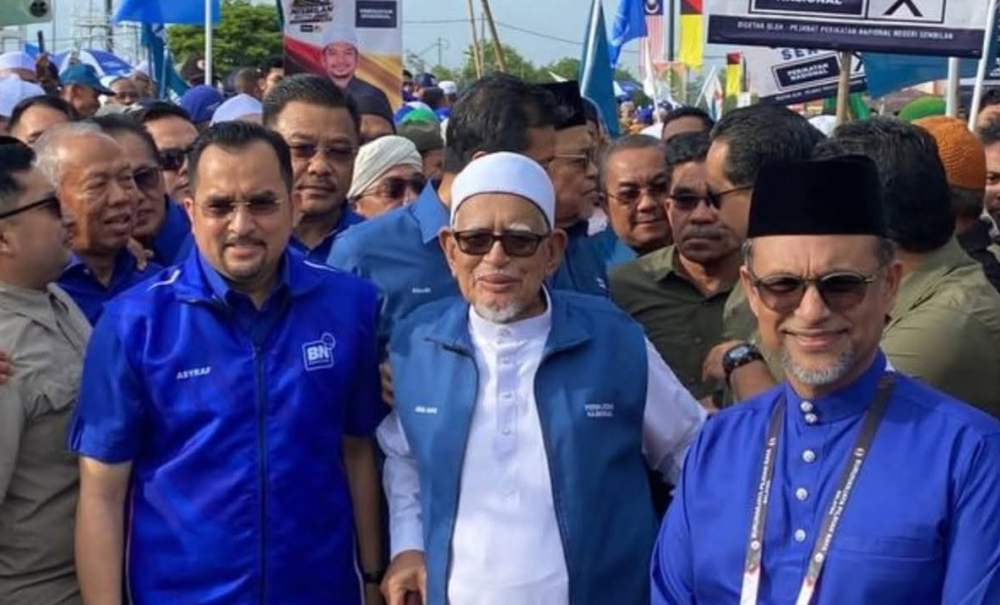
Hadi’s recurring invocation of Malay-Muslim unity may appear electorally attractive, particularly when translated into simple electoral numbers.
Yet Umno must consider what happens if the strategy succeeds too well.
Every seat that PAS gains with Umno’s assistance enlarges PAS’s bargaining power for the next election.
Every election in which Umno becomes dependent on PAS makes separation at the subsequent election more difficult.
GE16 can consequently shape GE17, which in turn can shape GE18.
This is how tactical cooperation can gradually become strategic dependence.
There is another danger. Umno and BN cannot rebuild themselves exclusively through conservative Malay votes.
Their historical advantage has been their capacity to assemble a broader electoral coalition encompassing moderate Malays, Chinese, Indians and the politics of Sabah and Sarawak.
The closer Umno becomes identified with PAS, the greater the possibility that moderate Malays and non-Malays will begin questioning whether voting BN merely facilitates the expansion of PAS.
That would be strategically debilitating.
Umno would then find itself trapped in an electoral cycle in which the loss of moderate voters makes it increasingly dependent on PAS, while its growing dependence on PAS causes it to lose even more moderate voters.
Wawasan, or any other intermediary political formation, does not fundamentally resolve this structural problem. Umno’s objective should be to recover enough political strength that it does not permanently require another Malay party to top up its numbers.
The circumstances facing Umno today are also different from those between 2008 and 2018.
Pakatan Harapan is no longer the insurgent political force it once was.
It has governed federally and therefore carries the unavoidable burdens of incumbency. Its weaknesses give Umno greater room to rebuild its own identity rather than rushing into an electoral arrangement with PAS.
Nor does cooperation with Pakatan Harapan at the federal level necessarily prevent Umno from strengthening itself independently.
Prime Minister Anwar Ibrahim’s pursuit of a second term can theoretically coexist with a stronger Umno and BN.
Indeed, another period of PH-BN cooperation could provide the political stability required for an orderly transition during a second term, should Anwar eventually make way for a new prime ministerial aspirant.
Umno therefore does not have to choose between annihilating PH and surrendering itself to PAS.
There is a strategic middle ground: compete where necessary, cooperate where useful and preserve organisational autonomy at all times.
Melaka is precisely where this doctrine can be tested.
Going solo would allow Umno President Datuk Seri Ahmad Zahid Hamidi to demonstrate that the party’s resurgence is substantive rather than borrowed.
If BN succeeds in retaining the Melaka government through its own electoral strength, Zahid would also possess considerably greater freedom in determining the composition and direction of the state administration.
Most importantly, Umno would not enter the post-election period owing PAS a political debt.
Any additional positions or appointments created within the state political structure would remain BN’s political prerogative.
Zahid would be under no coalition obligation to allocate them to PAS simply because PAS had supplied the votes required for victory.
That distinction is crucial.
Politics is not merely about assembling enough numbers to win the next election.
It is about understanding how today’s alliances redistribute tomorrow’s power.
For PAS, cooperation with Umno potentially offers access to constituencies, legitimacy and political influence that it might otherwise struggle to obtain.
For Umno, however, the same arrangement could progressively dilute the very advantage it is attempting to recover.
A rational Umno should therefore regard Melaka as more than another state election.
It is an opportunity to demonstrate that the Blue Wave belongs to BN rather than to an electoral combination constructed with PAS.
If Umno believes it has genuinely returned from the political wilderness, Melaka is where it should prove it.
Go solo, win on its own merits, helm the state government and negotiate future alliances from strength.
Anything less risks turning Umno’s recovery into PAS’s opportunity.
* Phar Kim Beng is a professor of Asean Studies and a director at the Institute of International and Asean Studies, International Islamic University Malaysia.
** This is the personal opinion of the writer or publication and does not necessarily represent the views of Malay Mail.


