















SAN FRANCISCO, Oct 31 — Facebook Inc yesterday posted strong growth in its mobile advertising business but rattled investors after saying that it did not plan to boost the frequency of ads shown to users.
Shares of the world’s No. 1 online social network soared as much as 15 per cent in extended trading before suddenly falling to US$47.40, down 3 per cent from its US$49.10 close. The stock settled at US$49.16.
In July, Facebook said it was showing one ad per 20 stories in the newsfeed, but chief financial officer David Ebersman told analysts yesterday that the current ratio, although slightly higher than 5 per cent, would not increase much more.
Ebersman’s comments, combined with remarks suggesting that young teenage users in the US were beginning to use Facebook less frequently, soured the mood abruptly on an afternoon when the company topped Wall Street’s targets with a whopping 60 per cent increase in revenue, driven by its accelerating mobile business.
“There seems to be concern about the ad load not going up,” said BTIG analyst Richard Greenfield.
But Greenfield said he believed investors were over-reacting, noting that increasing advertising prices, rather than the volume of ads, was more important for growth in Facebook’s topline.
Facebook’s newsfeed ads, which inject paid marketing messages straight into a user’s stream of news and content, have boosted Facebook’s revenue and its stock price in recent months. The ads are ideally suited for the smaller-sized screens of smartphones and other mobile devices, from which nearly half of Facebook’s monthly users now access the service.
But the company has had to balance showing more ads inside its users’ newsfeed with the fear that too many of them would irritate fickle users and drive them elsewhere.
That’s a reality that some investors may have overlooked, after Facebook reported strong third-quarter financial results today, with advertising revenue up 66 per cent.
“There’s some degree to which you can expand, but there’s an optimal level after which you risk losing your audience,” said Pivotal Research Group analyst Brian Wieser, referring to the portion of ads that Facebook shows on its service.
Still, he said the stock’s “reaction and counter-reaction was probably a little extreme. This was under any estimation a good quarter.”
Ad engagement
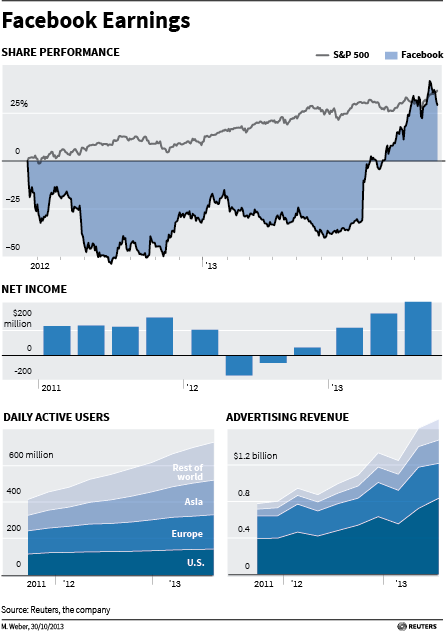 Revenue from mobile ads, which appear on smartphones, represented 49 per cent of Facebook’s total advertising revenue in the third quarter, or roughly US$880 million (RM2.8 billion). Mobile ads generated roughly US$150 million in the year-ago period, when Facebook was just beginning to develop its mobile ad business.
And Facebook said that its ads were getting noticed: The average daily user of Facebook was “engaging” with more than one ad per week, chief executive Mark Zuckerberg said during the conference call.
“It looks like they’re firing on all cylinders,” said JMP Securities analyst Ronald Josey.
He said that Facebook’s strong mobile advertising revenue in particular had put to rest the worries that many investors had at the time of the company’s 2012 IPO.
“They clearly have the product, they have the traffic and now they have the advertising solution,” said Josey.
Facebook shares have doubled in the past three months, as Wall Street has warmed to the Internet company’s ability to thrive as consumers increasingly access the Web on smartphones and other mobile devices.
Facebook said the number of its monthly active users increased to 1.19 billion as of the end of September, up from 1.15 billion at the end of June. Facebook said it counted roughly 507 million daily active mobile users.
Facebook said it earned net income of US$425 million, or 17 cents a share, in the three months ended September 30, compared with a net loss of US$59 million, or 2 cents a share, in the year-ago period.
Excluding certain items, Facebook said it earned 25 cents per share, above the average analyst expectation of 19 cents.
Facebook’s total revenue in the third quarter was US$2.016 billion, ahead of the average analyst expectation of US$1.911 billion, according to Thomson Reuters I/B/E/S. — Reuters