










MOSCOW, July 4 — “A vegetating catastrophe” would make an apt description of present-day Russia.
The phrase — by the French writer Louis-Ferdinand Celine in the 1930s — came to mind as I read “Fragile Empire: How Russia Fell In and Out of Love with Vladimir Putin” by Ben Judah, a former Reuters correspondent in Moscow who is currently a fellow at the European Stability Initiative.
It is doom-laden — and also a vivid and enthralling picture of the country.
Its post-communist history reads like a three-part tragedy.
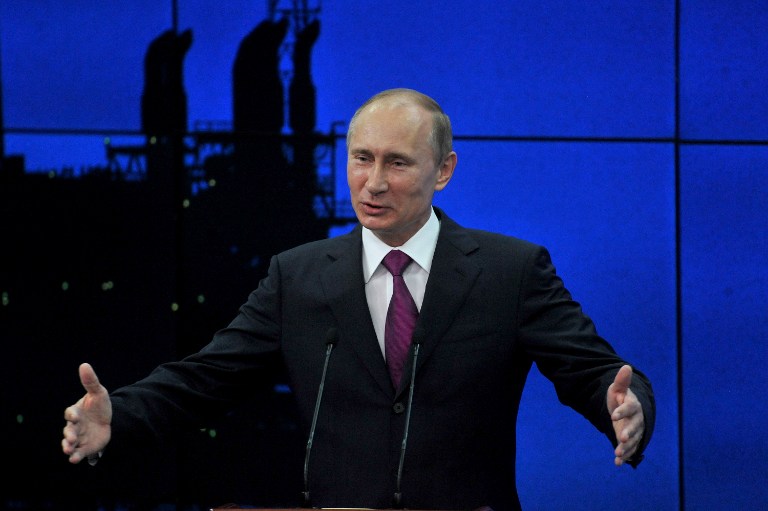
Between 1992 and 2007, 30 per cent of Russian males acquired a criminal record. To help bring order after the chaotic days of Boris Yeltsin’s presidency, the oligarch Boris Berezovsky persuaded him to make Putin (picture) his successor — and ended up a Russian exile in London for his pains.
Putin warned the oligarchs that to do business they should stay out of politics. The oil magnate Mikhail Khodorkovsky, too smart and too powerful for his own good, declined to play the game, and to this day languishes in prison.
After that, private ownership of oil fell from 90 per cent to 45 per cent in four years, creating a cash machine for the Kremlin.
Judah’s portrait of Putin is devastating.
For this “second-rate spy” cynicism, he says, is a world view. Putin is convinced that he combines the best of Czarist and Soviet Russia, and his self-image was boosted by the Russian Patriarch Kirill, who called him “a miracle of God.”
Kremlin Court
Under Putin, the Kremlin has become a court, where favourites strain to please, and the price of a minister’s post is US$10 million (RM31 million). Meanwhile, with 350,000 employees, the FSB, successor of the KGB, has grown bigger than some European armies.
In part two of the tragedy, as oil revenues soared, materially things improved. Life expectancy grew from 59 to 64 and — thanks to Central Asian immigrants — the collapsing population stabilised. Wages and pensions were paid, a flat tax boosted growth, and a booming middle class emerged.
Yet while Russia was modernised as a society, Judah writes, it degenerated as a state, plagued by obscene and ubiquitous Mafia corruption and tight media control. Discontent swelled but resistance remained marginal until the Internet took hold. Protests broke out after semi-rigged elections, where liberals rubbed shoulders with neo-communists and far-right skinheads.
Dissident Scourge
“Who’s your leader?” Putin mockingly asked — a good question. As Judah shows, certainly not Alexei Navalny, a dissident currently facing trial. Though a master of the Internet, a mesmerising speaker and scourge of the Kremlin “crooks and thieves,” he is also a nationalist and paranoid Islamophobe.
With no appetite for revolution, and the economy recovering, protests petered out. As Muscovites grumbled in fashionable cafes, Putin toured the country, where 53 per cent were dependent on state jobs or benefits, buying off opposition. In 2010-11, police pay soared and pensions rose by 60 per cent.
Part three of the tragedy is the status quo, with Putin and his court destined to stay in power for another decade and emigration increasing. Another spectre hanging over the country is China.
“The good news in 2050,” runs a Russian joke, “is that the Ukrainian euro and the Russian yuan are trading one to one.”
Chinese Power
That kind of thinking is a symptom of Russia’s insecurity — there are a mere 500,000 Chinese in the country — yet at international, power-politics level the paranoia has substance.
As China rises, Russia stagnates or declines.
“When we think of Russia,” shrugs a Chinese scholar, “we think of Putin, vodka, guns and prostitutes.”
A glimpse of life on the Far Eastern frontier with China rounds off the book starkly. On the Russian side, endemically corrupt police battle murderous gangs for control of the drug market, while chronically drunken men and women hawk berries and mushrooms, when they are not picking soya at US$2 a day on land leased by Chinese farmers.
Across the Amur River there are wind farms, a pushy, entrepreneurial culture, and hope.
Judah’s book is the opposite of dry Kremlinology. Interviews with senior politicians, oligarchs’ daughters, louts and petty criminals include revealing cameos, as when a politician throws down US$30 to cover the US$10 bill in a cafe — just for show.
So where is Russia heading?
“Russia is not yet unstable,” Judah concludes, “but its future has become uncertain. Something medieval hangs over Moscow…”
Publication of this powerful book in Moscow — if anyone dared — would certainly spice up the debate. — Bloomberg