


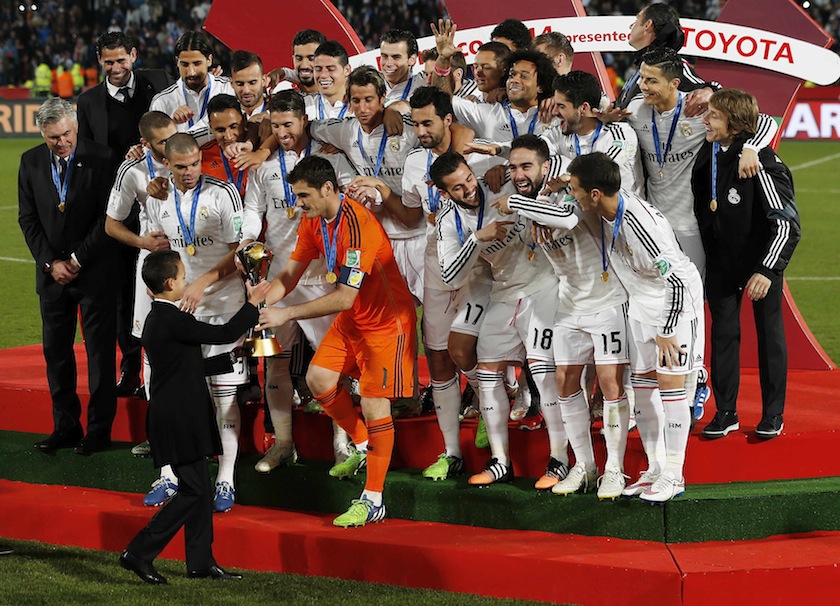
DECEMBER 23 ― Real Madrid's triumph in the FIFA Club World Cup last weekend ― comfortably defeating Argentine side San Lorenzo 2-0 in the final ― merely confirmed what we already knew: the Spanish giants are currently the best team in the world.
In fact, the Club World Cup as a serious tournament has little genuine meaning these days, because European club football is so far ahead of its counterparts throughout the rest of the world that any failure by the UEFA representatives, such as Chelsea's defeat to Brazilian side Corinthians two years ago, can be regarded as nothing more than an exceptional aberration.
When it comes to club football, in my opinion, European fare is so far superior to the other continents that realistically the Champions League Final should be regarded as the true “World Final” rather any other event FIFA may wish to stage.
The pre-eminence of European clubs is only maintained, however, because they routinely fill their squads with a healthy supply of players from the rest of the world ― notably from Africa and, in particular, South America.
Real, for example, enjoy the services of Colombian midfielder James Rodriguez, Brazilian defender Marcelo, Mexican striker Javier Hernandez and Costa Rican goalkeeper Keylor Navas; Barcelona's famous front three is exclusively South American, with Argentine Lionel Messi joined by Brazilian Neymar and Uruguayan Luis Suarez.
Elsewhere in Europe, roughly half of the expensively assembled Paris St Germain squad hails from South America, with Thiago Silva (Brazil), Javier Pastore (Argentina) and Edinson Cavani (Uruguay) among those playing a key role in the French club's bid to join the continent's elite, while Manchester United's attempts at rejuvenating their squad last summer featured the enlistment of a Colombian (Radamel Falcao) and two Argentinians (Angel Di Maria and Marcos Rojo).
When it comes to the development of players, then, it is clear that South America remains every bit as strong as Europe. But that state of parity is not maintained at senior club level because the likes of San Lorenzo ― supposedly the strongest team South America can muster ― desperately lack the resources required to keep hold of their best players, instead acting as a nursery for more financially powerful European organisations.
It wasn't always that way. Throughout the 1960s and 1970s, South American heavyweights such as Santos, River Plate and Boca Juniors were just as good as their leading European peers on the field of play and just as capable of attracting and retaining star players.
One obvious example is Pele, arguably the greatest player who has ever lived. Having started his career in 1956 with Santos, the Brazilian forward stayed there for nearly his entire career, only moving to the United States for a lucrative late-career pay day at the age of 35 and never playing for a European club.
That simply would not happen now, as demonstrated most recently by the career path of Pele's modern-day successor, Neymar, who left Santos at the age of 21 to pursue fame and fortune with Barcelona.
In fact, Pele was among the last of the stay-at-home South American heroes, because the onset of satellite television in the 1980s ― just after his career came to a close ― was the key factor in allowing European football's more advanced commercial infrastructure to take advantage of the vast new revenue-raising opportunities, and South America lost ground in terms of financial firepower which it has never since come even close to regaining.
This state of affairs cannot, in the long-term, be a good thing for the future of football. Before too long, talented kids in South America will surely grow disenchanted by the lack of opportunities in their home nations and the fact that the only realistic way to make a good living in the game is by moving thousands of miles away from home.
Gradually, interest in the game at grass roots level could dwindle, with clubs lacking the finances to provide facilities or opportunities, leading to a vicious circle of ever-decreasing standards.
A warning is provided from the world of cricket and the sad decline of the West Indies national team, which initially withstood economic underdevelopment to maintain their position as the number one team in the world, but then suffered a gradual and irreversible deterioration to the extent that they are now among the weakest of the major test playing nations.
The same, if we are not careful, could happen with football. Many decades ago, meetings between the best European and best South American club sides would be closely contested and unpredictable affairs. That is no longer the case.
Even though, for now, the international teams of South America are more than capable of competing with Europe's elite, that won't necessarily remain the case forever. If we want football to remain a truly global game, the growing gap between Europe and the rest is an issue which should be addressed.
*This is the personal opinion of the columnist.


