










MAY 12 — Starting from the Fifties, science has had a progressive fate in India. It was like Harry Potter’s magic wand. Everybody wanted to have one. No state felt complete unless it had a science policy document.
In India, we remember Jawaharlal Nehru fantasizing about his vision of modern science. Nehru’s tryst with destiny was an engagement of modern science and the future which he proclaimed “belongs to those who made friends with science.”
Back in the Seventies and Eighties, dams and laboratories became the temples of India. We produced Nobel Laureates like Subramanian Chandrasekhar and Hargobind Khorana but both emphasised the amateurism of the rest.
Today the discoveries of science and technology have changed the world dramatically. With the uncertainties and risks involved in scientific discoveries, we live in the realm of risk society, where no one really knows what science and its consequences hold.
The Bhopal gas disaster was a perfect example of uncertainty. Still after 30 years of the disaster, no one knows whether it is hundreds or millions of people who have been affected by the gas plant fall-out.
In fact, even the British science journal Nature claimed that the consequence of the Bhopal gas disaster increased the understanding of methyl isocyanate. Moreover, the long-term effects of such chemicals in any case are difficult to chart, because even if they exist they are likely to diffuse. One has to remember that with science there are no direct lines to certainties, only a plurality of future scenarios.
Relatedly, the recent debates on climate change, environment degradation, genetically modified crops, iatrogenicity and the effects of nuclear energy on the ecosystem have raised concerns about the nature of science as a knowledge system in society. All these debates reflect the idea of humans living in anthropocene – where we risk heading into a hostile condition from which we cannot return.
One such instance was seen when the Intergovernmental Panel on Climate Change’s (IPCC) fifth assessment report outlined the current state of scientific knowledge relevant to climate change. The report induced an anxiety of science at two levels. Given the range of calamities, which occurred in India last year, it made citizens wonder whether climate change was something which was only understood by scientists. At one level, it made them ask -- what do scientists know? And at another level, can science guarantee the certainty of knowing something?
What German sociologist Ulrich Beck argues is that it is not science but the misuse of science, which has created problems. Risk analysis is not just an enquiry of sociology and political economy but of epistemology – which deals with the theory of knowledge, its methods, validity, scope, and the distinction between justified belief and opinion.
Today, India is facing an emergence of risk society where the uncertainties about Bt. Brinjal (biotechnology), Kudankulam/Jaitapur nuclear power plant (nuclear technology) and modern health system (nanotechnology) are immense. What one has to understand is that risk demands a new term in the language of democracy and vocabulary of politics where it can go beyond the domain of just a mentioning in the political manifesto.
The arrival of risk into society implies a need to rethink the scope of political agenda in India and the vision to develop a politics of science and risks. Presently, not a single political party in India has an idea of what risks climate change has on society. Be it for the BJP or Congress or even for the regional parties, no one really understands the significance of scientific and ecological debates in political sphere.
In the socialist notion of a welfare state, which was formed in the backdrop of a society where Nature was still Nature and tradition was still tradition. Ecological debates reflect a world living after nature and after traditions. In other words, Indian politics has not been futuristic enough to incorporate the idea of long-term planning and assessment of alternative scenarios into its politik.
One can talk about its relevance in the ongoing Indian general election where a few Lok Sabha candidates like Uday Kumar, Medha Patkar are actively trying to come to terms with the profound changes affecting local life and the global order. Yet their party – AAP – in its manifesto completely sweeps away its ideas on science and technology.
Then there is INC which merely states these two lines - the Indian National Congress will increase the annual expenditure on science and technology to at least 2 per cent of GDP. This has to come from both government and industry. Steps will be taken to encourage the corporate sector to invest in Research and Development.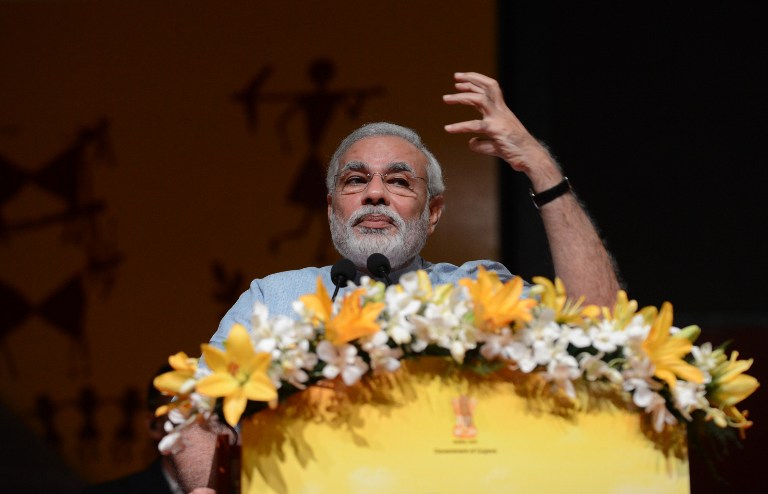
Likewise the arrival of risk society means that the idea of modernization, which is central to BJP’s Narendra Modi, needs to be rethought. “Development” as he uses the term citing “Gujarat Model” becomes problematic because development, which involves scholarship, needs conversation.
Modi who loosely uses the term “good governance” and “development” fails to understand that governance of science and technology requires conversation from multiple sources of knowledge, which is not just dictated by the scientist but rather with the people of different epistemological beliefs. Hence in risk society, modernization cannot simply be more of the same.
Today our relationship with science and technology is totally different from the characteristic of ideas, which Nehru proclaimed in the Fifties. Political parties still have a long way to go to assure citizens that such a risk analysis is not unscientific, or anti-development but a realistic part of a new understanding of science. What India now needs is a modern Nehru who can redefine and proclaim, “future belongs to those who can understand science.”
This is the personal opinion of the columnist.