














KUALA LUMPUR, Oct 7 — Datuk Seri Anwar Ibrahim’s candidacy in the Port Dickson by-election continues to garner controversy that likely will not end unless in court, a former chief justice suggested today.
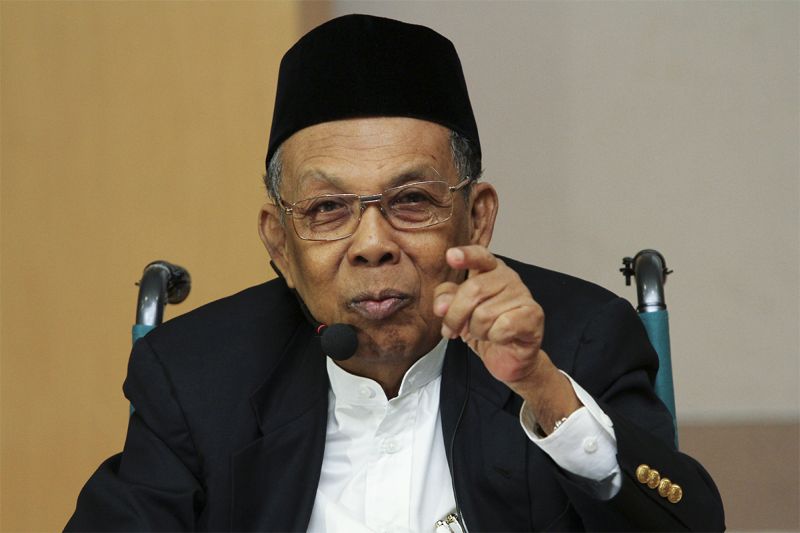
Tun Abdul Hamid Mohamad sought to explain the different types of pardons in law, after the PKR president-elect’s eligibility to contest an election was disputed despite a royal pardon for his sodomy conviction by the Yang di-Pertuan Agong earlier year.
“The Pardons Board is under Article 42 for the purpose of the matter only. It is not mentioned either in Article 42 or 48 that it applies to Article 48. Furthermore, the cancellation of one’s disqualification is not meant as a pardon, under Article 42. Therefore, I do not think that His Royal Highness has to do so (cancelling one’s ineligibility to contest) on the advice of the Pardons Board.
“Whether His Royal Highness should do it on the advice of the Prime Minister, is another matter.
“Therefore, a person who loses eligibility to become a member of Parliament under Article 48 (1) (e), and who has no free pardon may apply for cancellation of disqualification in accordance with Article 48 (3),” Abdul Hamid wrote.
Article 48(1)(e) of the Federal Constitution states that an MP is disqualified if sentenced to jail for a term of not less than one year or is fined not less than RM2 000 and has not received a pardon.
“Note that Article 42 does not even mention the link between a pardon with eligibility (to contest) or the cancellation of an MP’s disqualification. However, it is attributed to Article 48 (1) (e), he added.
The ex-judge however said that the Constitution is silent on the meaning of “free pardon” and does not even mention “full pardon” either, as other political observers following Anwar’s career and by-election campaigning have commented.
“Article 48(1) (e) mentions about how one loses their eligibility. It also mentions about exemptions, that is if a person gets a free pardon. Weirdly, the word free pardon is not used in Article 42,” he said.
“What does ‘free pardon’ mean? This is not interpreted. Can it be equated to a ‘full pardon’? This is for the courts to interpret,” Hamid said.
Abdul Hamid also explained that under the law, one can also contest in any public elections, without a free pardon, if they apply for a cancellation of their disqualification under Article 48(3), and succeed.
The former chief justice, who served from November 2007 to October 2008, also said that under the law, anyone can contest an election even from prison and can go on to become prime minister if his party wins.
“How he would attend parliamentary sittings is another matter. Prison officers should facilitate the person,” he added.
Hamid did not name Anwar in his statement, which came after PAS secretary-general Datuk Takiyuddin Hassan issued one of his own, saying Anwar did not have a “free pardon” that allowed the latter to contest the October 13 Port Dickson by-election.
Anwar last week challenged those questioning his eligibility to face him at the ballot box instead of taking the matter to court.
A Port Dickson voter had previously filed an application at the High Court here to stop Anwar from running in the parliamentary poll, claiming the pardon was defective as the Pardons Board had not convened before it was granted. The court later dismissed his bid.