












SUNGAI RAMBAI, April 26 — Will Pakatan Harapan (PH) grab some seats in Melaka in the upcoming polls, or will Barisan Nasional (BN) extend its 2013 win? In Melaka, it seems as if the locals do not care much either way.
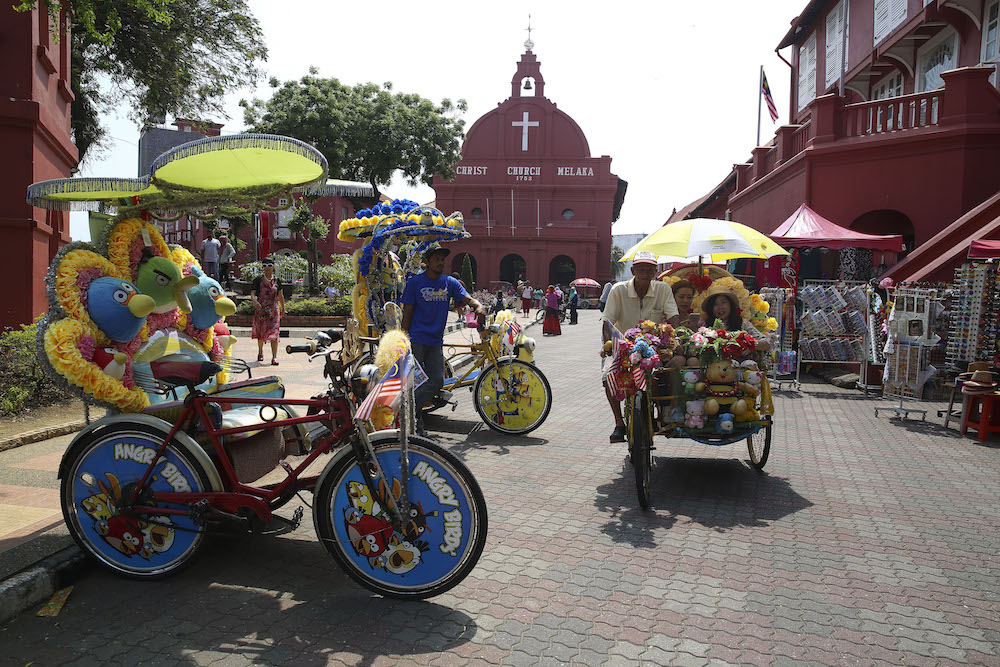
During Malay Mail’s visit to the state recently, the city centre was barely adorned with blue, red or green party flags.
Locals polled said they lack enthusiasm for the 14th general election, citing resignation over BN’s administration and fear of change.
“It is nothing new. Every five years or so, we vote because we have to. This area has been a BN area for as long as I can remember so I guess we will vote for BN again,” mechanic Teh Yil Seng, 68, said, referring to the state seat of Sungai Rambai.
Where he resides, BN’s Datuk Hasan Abdul Rahman has been the state assemblyman since 2008. In 2013, the incumbent won by a 2,363-vote majority.
Sungai Rambai sits in Jasin, some 15km from the Melaka-Johor border, with approximately 20,000 residents, made up mostly of folks in the lower- and middle-income bracket.
In 2015, a Rural Transformation Centre was built there to help its residents generate income via small business endeavours.
Now, the area is being developed for tourism, including a Kota Budaya (Malay for “Culture City”) project which will have kiosks illustrating the evolving architectural style from the Melaka Sultanate era all the way to the present-day.
Despite that, Teh, who is the third generation of his family to live here, said Hasan has brought little development to the area, although he was not completely unhappy about the fact.
“I like this slow-paced life where you have all your mom-and-pop shops, and people here know their neighbours by face and name. Some changes are okay, but nothing too drastic. I don’t see any reason not to vote him again,” he said.
His 80-year-old neighbour, who only wanted to be known as Fook, said locals would still need to struggle to put food on the table, whichever way the election goes.
“Regardless of who wins, all of us who are in the lower income bracket would still have to work hard to put food on the table. Probably the impact would be felt more by people working in the civil sector or the urbanites.
“Even if a miracle happens and the Opposition wins, can they guarantee that our quality of life will improve significantly?” Fook asked.
In Melaka, the state assembly seats have been dominated by BN representatives for the last three terms. But the trend now skews towards the Opposition.
In the 2004 state election, BN won 26 out of the 28 state seats. But that number dwindled to 23 four years later, and by 2013, BN only won 21 seats.
The others are currently held by three DAP assemblymen, three Independents and one PAS representative.
Some who spoke to Malay Mail also said they are still on the fence — growing disenchanted by BN, but still reluctant to make the shift to PH or PAS.
Business owner Siti Rohana Ahmad Affandi, 26, a resident of Kampung Parit Penghulu here, said the youths living in rural areas have long felt disconnected with the federal government.
Despite that, she said some would still support the coalition that has ruled since 1973 rather than vote for “the unknown”.
“We always seem like an after-thought. The focus is on land development, multi-million ringgit projects and community programmes for city kids. Villagers come last on the agenda.
“But we are used to it. It is better to stick to what we know. At least we still get BR1M,” she said, referring to the 1Malaysia People’s Aid.
Kampung Parit Penghulu is a Malay-dominated village which thrives mostly on agriculture, where most families rely on paddy farming as their main source of income.
Oil palm and rubber plantations line the roads leading to the village, where the houses are still modest and traditional.
Due to its close proximity to both Jasin, Melaka and Muar, Johor, some of its residents also offer short-term lodging on websites like Airbnb for tourists.
Student Y. Yoghesini, 23, said it is likely that residents are not excited by the elections due to an absence of charismatic figures.
“I don’t care much about politics but only because I have not seen one leader with good character that can bring about actual change. Everyone is the same to me, with their own scandals,” she said.
Political analyst from National Defence University Prof Aruna Gopinath said the apathy shown by the voters there was not shocking, claiming it would likely subside as the election date draws ever closer.
She said while people may not be as excited this year compared to the previous two elections, they would still exercise their right to vote, perhaps out of habit.
“It has become a routine for most registered voters to vote during the elections. There are also a big group of new voters — I am not sure how what the percentage is in Melaka — who would want to cast their first-ever ballot papers.
“Turnout would still be more or less the same compared to the previous elections, no worries there,” Aruna said.
In Melaka, the number of voters in the state elections increased from 295,207 in 2008 to 376,763 in 2013.
For the general election, a hike was also seen between 2008 and 2018 with 296,977 and 377,056 voters respectively.
“The reality is everyone wants a slice of the pie and it is a known fact that BN has a larger one. Of course, people would say they want more, but BN is in a position where they can afford to give more.
“Although some might complain about BR1M not being enough, for instance, they would not think twice about accept it when offered by the government,” Aruna said.