













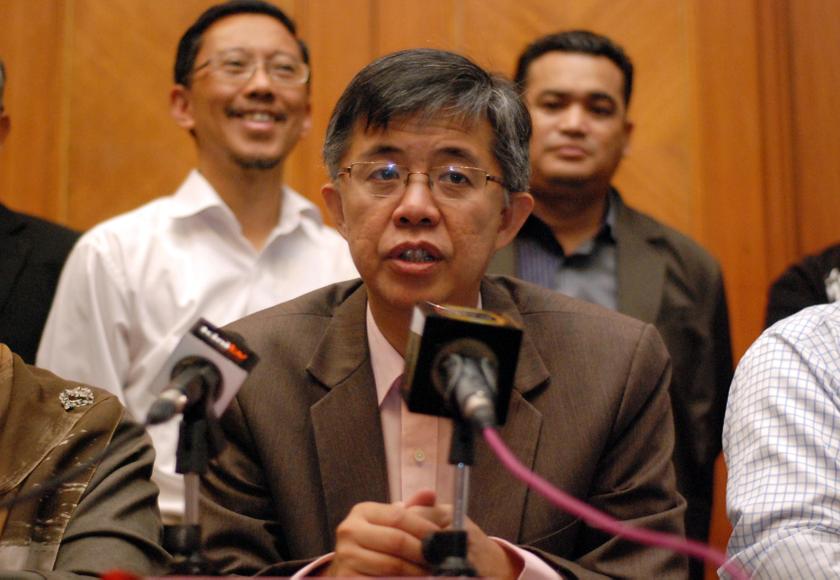


KUALA LUMPUR, March 2 ― PKR's Chua Tian Chang said today that he felt vindicated by the court’s decision to acquit him of sedition, and expressed hope this would put an end to claims that he had undermined national security.
Chua also said he felt relieved and thankful that the Kuala Lumpur High Court decided this morning to uphold his previous acquittal over allegations that he had linked the “Umno government” to the 2013 Sulu intrusion of Lahad Datu, Sabah.
“Of course I feel vindicated and that has been the position that I maintained from day one, that I have never said anything to defame anyone as well as to undermine national security,” the PKR vice-president told reporters immediately the Kuala Lumpur High Court's ruling in his favour.
Chua said the controversy over his alleged remarks in a news report on the Lahad Datu incident had been “emotionally charged”, with no less than 500 police reports lodged against him.
He added that at the time, there were large mobs that followed him to his events, with some attempting to assault him physically or using verbal threats against organisers of political ceramahs where he was present.
Umno had also filed a civil suit against him over the incident but later withdrew it, he noted, claiming that it was likely because the party knew it had insufficient grounds to say that he had defamed it through the news report.
“Today (with) the High Court's reaffirmation of decision of acquittal, I hope there will be no more wild accusations that I have undermined national security or insulted the security forces who have sacrificed their lives in the Lahad Datu intrusion,” he also said.
Latheefa Koya, one of the lawyers who represented Chua, said the High Court judge had acted “fairly” in looking into the case's evidence and affirming the acquittal.
“So we are glad to see justice done today. Nevertheless the fight against the draconian Act still continues, we still have many cases where the situation may differ and we still have to look into repealing the whole Sedition Act,” she told reporters.
Earlier today, Kuala Lumpur High Court's Judicial commissioner Datuk Nordin Hassan rejected the prosecution's appeal against a 2014 acquittal of Chua, after finding no collaborating evidence to prove that the PKR leader had uttered the alleged seditious words.
The judge said the prosecution's star witness Siti Nooraishah Geoffrey could not be the one supporting her own testimony, also pointing out that the then Keadilan Daily reporter's handwritten notes was not a verbatim record of her phone interview with Chua and was illegible.
He highlighted Section 6(1) of the Sedition Act, which said that no person shall be convicted of a sedition offence on the uncorroborated testimony of one witness.
On November 14, 2014, Kuala Lumpur Sessions Court judge Norsharidah Awang ruled that the prosecution had failed to prove a prima facie case against Chua, and had said that he was discharged and there was no need to call him to enter his defence.
Chua was charged on March 14, 2013 over his alleged remarks in an article titled “Insiden tembakan di Lahad Datu konspirasi terancang Umno ― Tian” (Shooting incident at Lahad Datu an orchestrated conspiracy by Umno ― Tian), which was published in Keadilan Daily on March 1 the same year.
Among other things, the politician popularly known as Tian Chua allegedly said the Umno government had a conspiracy to divert the attention of Sabahans, particularly over the issuing of identity cards to foreigners.
The penalty for first-time offenders under Section 4 (1) (b) of the Sedition Act 1948 is a maximum three-year jail term or a maximum fine of RM5,000 or both.
A conviction could have caused Chua to lose his Batu parliamentary seat, as a fine of RM2,000 or a one-year jail term is enough to disqualify the 53-year-old as a member of Parliament.