
















KUALA LUMPUR, July 14 — The board of directors of CIMB today announced the resignation of Badlisyah Abdul Ghani, the chief executive of their Islamic banking arm who recently disputed documents cited by Wall Street Journal (WSJ) in its exposé on 1Malaysia Development Berhad (1MDB).
In an announcement on Bursa Malaysia, the country’s second-largest bank said Badlisyah’s resignation will take effect on August 15, after having headed CIMB Islamic Bank since 2006.
“We respect Badlisyah’s decision. Since his appointment in 2006, Badlisyah has strengthened our global Islamic banking franchise and we are now well positioned globally to tackle the challenges and opportunities ahead of us,” CIMB Islamic Bank board of directors Chairman Datuk Dr Syed Muhammad Syed A. Kadir said in the announcement.
“The Board and I are grateful to Badlisyah for his leadership, integrity and contribution to the Group. We wish him well for the future and the next stage in his career,” Syed Muhammad added.
The bank’s board has since elected Mohd Shafri Shahul Hamid as Person-in-Charge of the Bank and has agreed for the Group Nomination and Remuneration Committee to start the process to identify the next CEO for the Bank, according to the announcement.
Last week, Badlisyah was subjected to an internal inquiry after admitting to making an error in his analysis of documents cited by WSJ in its exposé on US$700 million (RM2.6 billion) in funds allegedly funnelled into the personal bank accounts of Prime Minister Datuk Seri Najib Razak through 1MDB and other government agencies.
Badlisyah had — in a post on his closed-circuit Facebook page — initially accused WSJ of being duped by doctored documents cited in its story.
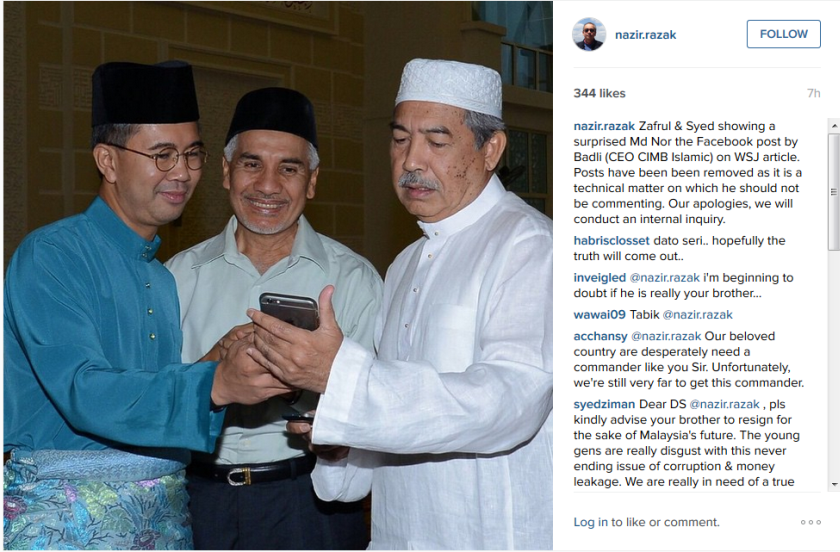
CIMB Group chairman Datuk Seri Nazir Razak later announced on his Instagram account that Badlisyah’s posts “have been removed as it is a technical matter on which he should not be commenting”.
In a report last month, US-based daily WSJ, citing documents from Malaysian investigators currently scrutinising the troubled 1MDB’s financials, claimed that a money trail showed that US$700 million were moved among government agencies, banks and companies before it ended up in Najib’s accounts.
Najib has repeatedly denied taking funds from 1MDB or any other public entity for “personal gain” and his lawyers have since asked the WSJ to state if it is accusing the prime minister of misappropriating funds.
A special task force — comprising the police, Attorney-General’s Chambers, Bank Negara Malaysia and the Malaysian Anti Corruption Commission — has since been set up to investigate the claims.
Last week, the task force said that two bank accounts held by Najib in AmBank were already closed long before an investigation was launched against the misappropriation.