











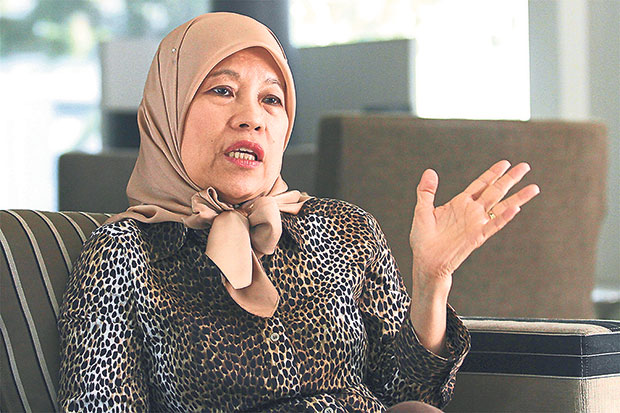


KUALA LUMPUR, April 26 — OrphanCARE Foundation chairman Tan Sri Faizah Tahir was often accused of encouraging premarital sex because she was involved in rescuing abandoned infants through baby hatches.
But the former Women, Family and Community Development Ministry secretary-general — who served in the ministry for almost nine years before heading OrphanCARE in 2011 — ignored the brickbats and the non-governmental organisation has gone on to save 114 babies born mostly to unmarried mothers, since the first baby hatch was launched in 2010. All of the 114 babies have been successfully adopted.
According to statistics that the Health Ministry sent to Malay Mail Online, 16,528 teen pregnancies were recorded last year based on data collected from teenagers who registered at government clinics, a drop from 18,652 cases in 2011. On average, 50 teen pregnancies are recorded every day, out of which almost three quarters involve married teenagers.
OrphanCARE has three baby hatches in Petaling Jaya, Johor Baru and Kota Baru, with a fourth scheduled to be launched in Sungai Petani, Kedah, in June. OrphanCARE has also collaborated with KPJ Healthcare Berhad to provide baby hatches at eight KPJ hospitals throughout peninsular Malaysia, and one each in Sabah and Sarawak.
Faizah says that OrphanCARE is now focusing on the deinstitutionalisation of children project, where they aim to get children out of orphanages and to either unite them with their biological families, or to place them for fostering or adoption.
According to Faizah who cited Social Welfare Department (JKM) statistics, 85 per cent of children in orphanages have family, and are placed there mainly because of poverty.
OrphanCARE is working on the project with Lumos, an international children’s non-profit organisation founded by Harry Potter author JK Rowling that works to end the institutionalisation of children.
The work has been tiring, Faizah says, but seeing the joy of the children and their adoptive parents is very fulfilling and spurs her on to do even more.
Here, Faizah talks about the struggles of setting up baby hatches, sex education and why children should be removed from orphanages.
In her own words:
- From the religious authorities, it’s as though we’re encouraging sex outside marriage, but we don’t care. Our responsibility and our objective is to save lives, to save babies already born. But now, I think more and more are with us now. They say it’s a good thing because we’re saving lives… they’re on our side now. They don’t criticise anymore.
- The unwed mother can’t afford, financially, emotionally, physically; that’s why they want to give up for adoption. They love the child. Who doesn’t love a baby? You conceived for nine months and you give birth, you will love the child. But circumstances force them to give up. To me, I don’t judge them.
- We work with LPPKN (the National Population and Family Development Board) to give talks on reproductive health...To me, more important is abstinence. This is what all religions tell you to do. Not just Islam, Christians, all religions will tell you abstinence. I think these young kids, they must know, they must be made aware of this. They don’t get that much in school — being taught sex education or reproductive health education. So I think it’s good. The feedback that I got, they’re quite excited learning about this.
- One difficult case was a baby placed in a hatch. She has a cleft lip and one arm missing. When we contacted our database, nobody wants. They want a perfect baby, a normal baby. That’s the only baby they’re going to have, so they want a normal baby. When we told them she has a cleft lip and one arm missing, they don’t want. The court gave us one month temporary custody to find a family. So we frantically went around. We managed to get a family who already has three kids and they’re so big-hearted, they took this baby in.
- If you look at their faces, they look like their parents. God is great. Once you take care of the child, you bring the child up in love, somehow, sama. When they walk around, I don’t think you can tell — that’s adopted. You cannot tell because they look like their parents.
- You are helping the kids. That’s the most rewarding for us, most fulfilling. When you see at the tea party, they’re happy, everyone is happy, the parents, the kids… From the tea party, you know they’ve been cared for by the adoptive parents. That makes us want to do more and more to help the kids. They have a bright future. That’s why we don’t feel tired. Tired also, tak apa, just go on.
- We want to bring children out of institutions. They cannot be languishing in orphanages. That’s not the best place for them to be brought up. There are so many studies that show children brought up in orphanages, when they come out at age 18, they have to come out at age 18 into society, they become misfits. They cannot adapt themselves. Intellectually, they’re not there because being in an institution, somehow there is an effect on their brain development, physical, emotional, everything.
- When they are small, age zero to three, very important for you to cuddle them, sayang them, but in an institution, who does that for them? Nobody, because the caretakers have to look after so many.
- Orphanages use children to raise funds. They don’t want to release the kids because every kid will attract some money. These companies are very well-meaning; CSR, they give funds to these orphanages. Actually, you’re maintaining the kids to remain there. That’s a source of funding for the orphanage.
- Our dream is one day, there’ll be no OrphanCare. There’ll be no more abandoned babies and no more children in orphanages.