











GEORGE TOWN, April 12 — Though he now considers himself a full-time street artist in Tehran, Iran, his real identity is kept secret and he only goes by his artist name — Nafir.
The eloquent street artist admits to having a double life — one as a common Iranian with a normal day job and another, at night, as an illegal street artist who goes around showcasing his artistic masterpieces in public spaces.
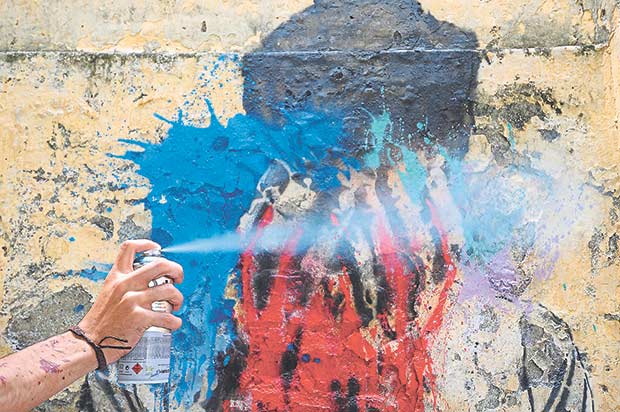
Barely a day goes by without him spray-painting a piece of art and these are not graffitti but pieces that express his feelings about certain incidents in Tehran.
Even though his works are usually erased by the Iranian authorities within a 24-hour period, Nafir continues on with what he calls his fight against oppression.
Nafir started a collaboration with Graffiti Prints about a year back where the England-based print house prints and sells some of his works online for him.
The artist now has a huge online following so he is extremely careful about keeping his identity secret, he has never granted any interviews with any media nearer to home and his self portrait is a stencil man with a large X on the face.
Through Graffiti Prints, Nafir travelled to Penang for the first time to participate in Different Strokes, a street art exhibition held by Graffiti Prints and Hin Bus Depot.
It is his first time being part of an art exhibition outside his country with about 14 other street artists from all around the world.
Here, Nafir shares on what it’s like to be an illegal street artist in Iran, how he evaded the authorities and why he continued doing it despite the risks.
In his own words:
- I started by doing tagging... after two to three years, I started to understand better about stencilling and about street art and its meanings. I started doing in a more professional way in 2009 or 2010… it’s when art becomes important to me, like a career for me. Before that, I started with only tagging my name but I always like vandalism. Anarchy, you know. You can still see a little bit of it in my works. There in Iran, I think every single man and woman, they have some kind of anarchy in them. You know when people drive very bad, they try to cheat the law, so for me, everybody is doing some kind of vandalism... in art, in everything. Because within the government, money stealing happens a lot. Many people think that if they are stealing the money, so why don’t we do this?
- Some guys, Icy and Sot, they are Iranians too... they escaped from Iran. We’ve been friends for two to three years. We did some pieces in Iran and we do shows together. And one day they went to the US to work on big murals, they travelled all around the world, so there is a focus on Iranian artists. Giancarlo of Graffiti Prints prints for Icy and Sot, so I emailed him and he really liked my work so he started printing my works. Icy and Sot… their art is more international. My art is focused on local problems, local social problems, local political problems and because of that I have more fans inside of Iran, while Icy and Sot have a more international fan base.
- When I paint something on a wall, it will be removed within 12 to 24 hours... it will disappear. I think I did 1,000 pieces in Tehran and all of it have been buffed and removed. The only way for us is social media, through the internet, like Facebook, Pinterest, Instagram… we don’t have real fans, we have some would call Internet fans. I don’t show my face to anyone, no one knows who I am. Already in Iran, I have 12,000 fans and no one knows my name or my face. Sometimes something bothers me and I would do a piece or a reaction to it. I try to do international meaningful pieces too. I hope one day I can show my face but now is not a good time to do so.
- You know, it’s very dangerous there. They’ve never caught me. I think if they had caught me, I would disappear from six months to a year and no one would know about it. They don’t put you in prison, the police don’t catch you. It’s the special intelligence unit, they do this kind of stuff. The hardest part is that we are not just facing the police. We have the sepah, basij, undercover, intelligence, police intelligence, so this means half the people are some kind of undercover intelligence. Even normal people, if they see you painting, they might even call the authorities.
- Basij is some kind of army of the government, they have many musketeers in their organisation. The government, they go to cities and teach the people religious things, about the army and defending yourself against people who are anti-Islam. They brainwash them and these people become basij. They are protected by the government. The police are more kind to the people. For example, drinking alcohol is illegal in Iran, if police caught us drinking, maybe we give money, they will let you go. But if it’s sepah or basij, they will never let you go because it’s not just a law to them, it’s religion for them.
- Because of these things, we have to do it very fast or we have to go to abandoned places but that doesn’t work for me. I have to do it in a street where more people can see it. It has to be seen by 10,000 people in 12 to 24 hours. Normally, I don’t go alone, some of my friends come to help and we go at midnight. Midnight is a little dangerous in Tehran but we have to take the risk. For my friends, right now, 10 people are now refugees, they campaign outside of Iran like Icy and Sot. Icy and Sot left the country to be refugees because they wanted to do large pieces, they wanted to do colourful pieces and after they travel to the US, their art is completely changed and they got better rates.
- The funniest part is that we have murals in Iran. These are professional government murals. The murals you see in Iran is not freedom of speech or art. People outside Iran don’t understand because they don’t see the details. Iran, like China and North Korea, has the highest censorship.
- We have many Iranian televisions outside of Iran like BBC about Iran news without censorship. But I don’t speak with them. They messaged me asking for interviews, I turned them down because they might have these undercover government people inside their organisation and if we talk to them about anything beyond the red line, I think after three hours, they will find you. For example, my friend who’s like me, he doesn’t show his face or use his real name but he does interviews everywhere. One day, he gets a call from the intelligence, they know his full name and they told him to go in for “a talk” about why he’s doing what he was doing.
- Fame attracts the special government intelligence. If you are famous, they come for you. If they see you do dangerous things — doing things that cross the red line — they will go after you.They find you from the Internet or from research. It won’t stop me. For me, it’s not just art. It’s for change too. We want to change something to be better. We don’t want to destroy and start a revolution. That’s not going to work in Iran. I will stay in Iran until the day they stop me from spraying. My base is in Iran but I want to paint everywhere.
- For the many days I’m here, it has given me a very different personality. I can do big pieces, colourful pieces but there, only fast works. This is the first time I’ve painted outside of Iran. Six months ago, Giancarlo told me to come to Penang and I told him no, it was difficult for me. But he told me I have to come to meet other street artists to see how they work. He was right. I know many things right now about international street art. It changed many things for me, such as the way I work in future. I would like to paint in other countries. I have six pieces here ( in Hin Bus Depot)… outside of the depot, I do many pieces everywhere. Giancarlo told me to stop but many of them are in the abandoned place, five or six pieces. I did two pieces near Ernest Zacharevic’s studio (Nagore Square).