











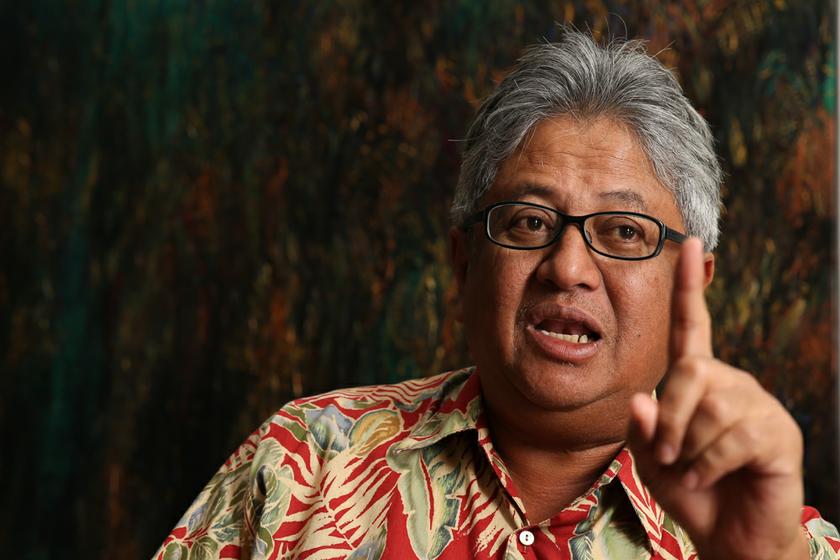


KUALA LUMPUR, Oct 14 ― Datuk Zaid Ibrahim lashed out at Putrajaya today for barring Indonesian scholar Dr Ulil Abshar Abdalla from entering Malaysia, calling the order a primitive show of power by the government.
The former de facto law minister pointed out that Ulil was scheduled speak about combatting the jihadist menace at a local forum here, a topic he said was neither a threat to public order nor a potential cause for street riots.
“It’s a subject everyone is talking about — not just in Malaysia, but the world,” he said in a blog post today.
Stopping Ulil from speaking is not just shameful, he added, it also “reveals the low and pathetic quality of our leaders’ mentality”.
Zaid also took a swipe at the quality of the country’s education, pointing out that Ulil would have likely spoken in English, which the former minister said at least half the country’s Malay population could not understand.
The other half, the former Umno man continued, would have been Umno-linked groups and bloggers who would have worked hard to tear Ulil’s arguments to pieces online with the help of abusive words.
“So what was there to fear?” Zaid asked.
“The home minister was just trying to display his power, in a primitive sort of way, for there was no real good reason at all to ban this Indonesian speaker.”
Ulil, who is the founder of the Indonesian Liberal Islam Network, was originally scheduled to speak at a conference here Wednesday about combating the growing threat of Islamic State (IS) jihadist militant group.
Earlier today, Minister Datuk Seri Dr Jamil Khir Baharom defended Putrajaya’s decision to block Ulil’s entry into Malaysia, claiming that the scholar was trying to dictate the country’s practice of Islam.
The minister in charge of Islamic affairs argued that Ulil was trying to sway Malaysian Muslims from their Sunni teachings with his “liberal” ideas of Islam.
“Here in Malaysia, we hold to the Sunni teaching. [Then] others come in, and restrict us from the Sunni teaching. One man cannot come in to obstruct the faith of the whole government,” Jamil Khir told reporters here, referring to Ulil.
The minister said that even in Indonesia, the authorities had stopped Ulil from spreading his ideas, and stressed that Malaysia should do likewise.
Disagreeing with Jamil Khir’s reasoning, Zaid said limiting free speech in Malaysia would stunt the growth of critical thinking among the country’s Muslim majority.
At present, he asserted, Muslims here only know to blindly accept the rituals and rules propagated by local religious authorities like the Islamic Development Department (Jakim).
“But this will not trigger the active mind that’s needed to make Muslims clever and creative,” Zaid said.
“We cannot be importing clever people from overseas all the time. There is a limit to how far we can rely on McKinsey and other expensive consultants,” he added, referring to US-based American consultancy McKinsey & Co.
The former minister said the Bar Council and the forum’s organisers should have challenged the ban on Ulil by seeking a court order, insisting it was a clear case of power abuse by the government.
He urged Malaysia’s Commonwealth partners to take a “hard, long look at this fundamentalist country called Malaysia” when they hold the Commonwealth Heads of Government meeting in Malta next year.
Malaysia’s alleged transgressions against the fight for free speech must be highlighted in the international arena, Zaid said, and one way is for foreign leaders to seek answers from Putrajaya about the country’s state of democratic freedom.
“It will be too late when the country becomes a full-fledged member of the Islamic state.
“Then these western leaders have to use bombs and tanks to fight the fundamentalists like they are doing in Iraq and Syria. It will be too late,” he said.