










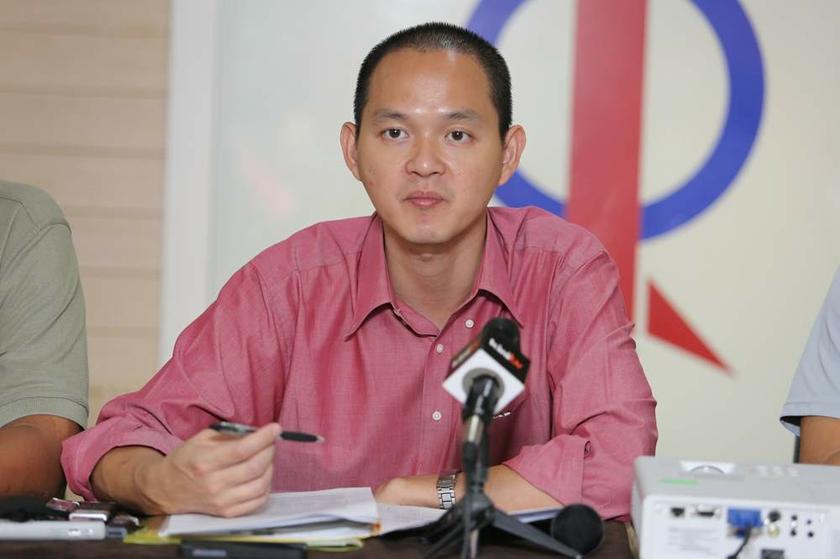


KUALA LUMPUR, July 7 — Parents are fretting over their children’s education after complaining of a slapdash rollout of the new lower secondary assessment that they fear may leave Form Three students struggling to adapt, a DAP lawmaker said today
Serdang MP Ong Kian Ming said he has received several complaints by parents and students that the change of system was too drastic and sudden, with some alleging of faults and defects in its introduction.
He added that these have left students confused and concerned about their future as their grades might suffer from the insufficient time they have to prepare for the new test format.
“The Ministry of Education had known, as far back as February 2011, that the PMR (Lower Secondary Assessment) exam will be abolished and replaced by the PBS (School-Based Assessment).
“But PT3 (Form 3 Assessment) was only announced and confirmed in March 31, 2014, leaving very little time to brief the 63,000 Form 3 teachers in 2,376 secondary schools as well as the students and parents about this change,” Ong pointed out in a press conference here.
Ong also said parents had in their complaints to him raised concerns of possible bias as there is no standardised grading benchmark for the PT3.
Previously with the PMR exams, gradings were conducted by the Examination Board in accordance with uniformed standards.
But that system is now replaced with one that allows schools to independently set questions and grade students, which the Serdang MP said could create bias as teachers are given free rein to decide what is deemed as good performance.
“As a result, this has left teachers, parents and students utterly confused about PT3 — how it differs from PMR, how it will be used to stream students after Form 3, how it will avoid bias in terms of the setting questions and the marking of papers at the school level, just to name a few important items,” he said.
The PT3 assessment for geography and history officially started on July 1, just three months after it was announced in March.
Some of the complaints compiled by Ong showed that parents felt that their children have been made into “guinea pigs” to test out the new system.
One of them, Kevin YN Ho, lamented that his son had prepared long for the PMR exams only to be told that all of his preparation would be inapplicable with the introduction of PT3.
“My son is confused as to what is required to prepare for the exams. I have met with his teachers who are equally confused.
“They don’t know what to expect and I asked them how can I help my son to prepare, they just told me to do lots of work books,” he said.
Another complainant, Afiq Omar, is a teacher himself:
“I’m one of the teacher (sic) to handle this PT3 history. The students need to have high level of thinking. Most of them were shocked because they never done such things before. Seventy per cent of them were lost,” he said.
Other parents said in their complaints that the MoE and school must better prepare them and the students on what to expect from the new assessment system.
Ong said Putrajaya should set up an emergency task force at the MoE with a dedicated hotline to look into complaints on PT3, noting that parents are finding it hard to seek explanation as the Examination Board’s website has been down for a week now.
He also said there should be oversight to prevent bias by possibly streamlining the grading benchmark as well as the setting up of a special committee to ensure proper implementation of PT3 next year to prevent a repeat of this year’s mistakes.
Education Minister Tan Sri Muhyiddin Yassin said in March that the PT3 would be used as the basis to determine the entry of students into Form 4 in fully residential schools, Sekolah Menengah Kebangsaan Agama, Mara Junior Science Colleges (MRSM), including Sekolah Menengah Teknik (SMT), and vocational colleges.
Prime Minister Datuk Seri Najib Razak said in his Facebook posting on July 1 that the new assessment system was designed to nurture “world class, all-rounders”.
Critics of PT3 had previously raised concerns that the new exam system was flawed and could be subject to bias.