


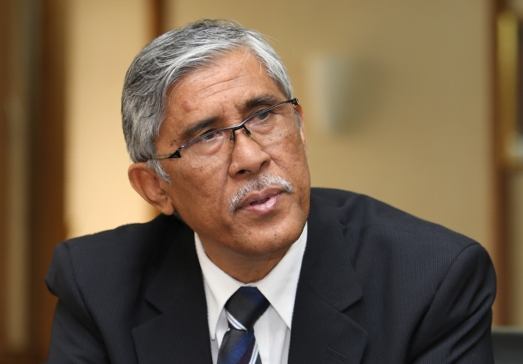


PUTRAJAYA, July 22 ― The “reality” that is just three per cent of Malaysian respondents admitting to paying bribes in a global survey belies the “perception” of rampant corruption in the country, according to Malaysian Anti-Corruption Commission (MACC) chief commissioner Tan Sri Abu Kassim Mohamed.
Despite the seemingly low figure vis-à-vis the respondents’ view on the extent of corruption in Malaysian institutions, the head of the country’s graft-busters said the number corresponds with his own findings from informal surveys at the lectures he conducts.
“I’m very proud that a lot of Malaysians ― they don’t pay bribes,” Abu Kassim said in an interview with The Malay Mail Online and Guang Ming Daily recently.
Although the country slid to new lows in Transparency International’s Global Corruption Barometer (GCB) 2013, Abu Kassim pointed to the bright spot that showed Malaysians to be at the lowest end on the scale ― which ranges from below five per cent and above 75 per cent ― when were asked if they had paid bribes in the past year.
“In Malaysia, in reality only three per cent saying they have to pay bribes. In Malaysia, paying bribe is a choice, either you decide to pay or not,” he said, contrasting Malaysia’s situation with other countries where people are forced to pay bribes to get medical attention and go to universities.
“In this country, you have a choice, you can pay or you don’t pay. But people don’t recognise, I don’t understand,” he said.
Abu Kassim further pointed out that Malaysia fared better on the level of admitted bribery in the GCB survey, in comparison to countries such as the United Kingdom and Switzerland, saying that this was despite Switzerland’s place among the top 10 countries seen to be least corrupt.
In this country, you have a choice, you can pay or you don’t pay. But people don’t recognise, I don’t understand. — MACC chief commissioner Tan Sri Abu Kassim Mohamed
In Transparency International’s Corruption Perception Index for 2012, Switzerland and Malaysia were respectively sixth and 54th out of 176 countries surveyed for perceived corruption in the public sector.
When asked if grand corruption had contributed to the dent in the country’s image, Abu Kassim agreed that high-profile graft cases may have “created the perception” that there was a lack of action by the MACC.
He said that MACC does not speak to the media when it is conducting an investigation for fear of alerting those suspected of corruption, using an analogy of bird-catchers on the hunt for prey.
“When there is a big case, we just do investigation, we keep quiet, people thought we do not investigate, that creates a perception that MACC do not investigate
“In real fact, we are like mad investigating the case,” said Abu Kassim, who has been with the MACC for about 30 years.
“When we keep quiet for the sake of investigation and people thought we don’t investigate, that creates the perception. Especially big cases, we just keep quiet,” he later repeated.
During the same interview, Abu Kassim was also asked to comment on the GCB 2013 results that showed Malaysians considering the police force to be the most corrupt institution in the country.
Malaysian respondents had given the police a score of four on a one-to-five scale, with one being “Not at all corrupt” and five, “Extremely corrupt”. Politicians followed closely behind with a 3.8 score.
He said that this result was reflected in many countries throughout the world, but also said that the majority of MACC’s probes on the civil servants had involved the police force.
When asked if the proposed Independent Police Complaints and Misconduct Commission (IPCMC) could tackle the corruption issue within the police force, Abu Kassim stressed the need to first strengthen its internal disciplinary body.
“IPCMC is not necessarily the only way. From my opinion, I’m not saying IPCMC is not important, what’s more important is the internal mechanism must be really enhanced,” he said.
He compared Malaysia’s police force with New York’s, saying that the former only has a disciplinary branch of about 300 people against 120,000 officers, while the latter had around 725 internal affairs officers for just 40,000 regular police.
“Why don’t you look at that one first and make sure that they have a good system, [the officers only can be disciplined internally].
“External body is good but it will be better if the organisation takes effort internally. They must have a clear policy, they must have a very strong investigation team to investigate,” he added.
Earlier he regarded the police’s “internal initiative” as the most important thing in tackling corruption within the force.
“Because to discipline your family is the role of the family. To create a culture is the role of the family,” he said, likening organisations to families when speaking about the anti-corruption culture.
“We are an external body. We only know when people come and report but their family knows what actually transpired in the organisation, so the culture, the processes, all that must be looked at seriously,” he said, referring to the MACC as an external body when asked to comment on the commission’s role in handling the alleged corruption within the police force.


