


MUNICH, June 23 — The 2026 World Cup has exposed an unlikely weakness — not in a team’s defence or attack, but in the shirts on their backs.
Four players have already had their Puma jerseys ripped during matches, with three forced to leave the field for replacements.
In a tournament dominated by debates over late goals, red cards and evolving tactics, the German sportswear giant has found itself at the centre of an entirely different conversation: whether football’s pursuit of ever-lighter performance gear has come at the expense of durability.
Physical grappling is hardly unusual at a World Cup, particularly during corners, set pieces and battles for possession.
Shirt-pulling has long been part of football’s grey area, often resulting in little more than a warning from the referee.
Yet while players wearing kits from other manufacturers have navigated similar challenges, Puma’s jerseys have repeatedly failed under comparable stress.
The first incident came on the tournament’s opening night when Czech Republic midfielder Pavel Sulc’s shirt was left with several large tears after being tugged by a South Korea defender.
Since then, Paraguay captain Gustavo Gomez, Egypt winger Mustafa Zico and Morocco midfielder Neil El Aynaoui have all seen their shirts split during challenges, with El Aynaoui even appealing unsuccessfully for a penalty after noticing the damage while jostling with Scotland defender Jack Hendry at a corner.
All four were wearing Puma kits.
The recurring incidents have inevitably prompted questions about the company’s Ultraweave fabric, the lightweight material used in its authentic match jerseys.
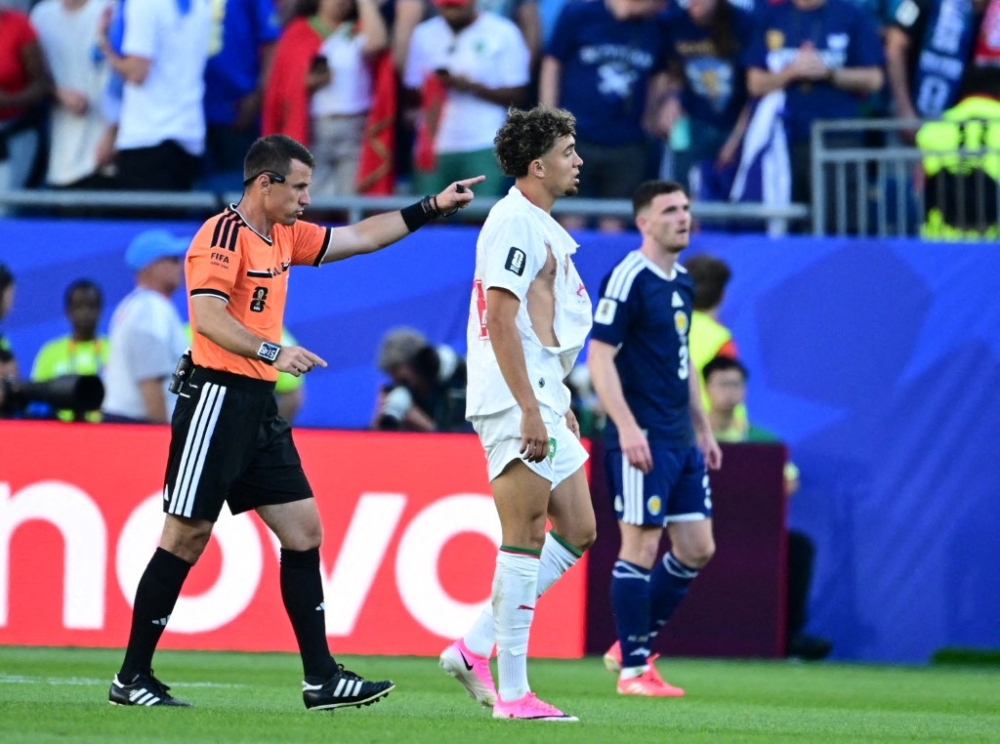
Designed to maximise speed, movement and breathability, the shirts weigh just 72 grams, according to Puma, and are made primarily from recycled polyester with four-way stretch technology.
The company says the material underwent extensive testing before being introduced at elite level.
“As football is a high-contact sport, garments can be affected when jerseys are subject to severe force or extreme physical stress,” Puma said in a statement.
“Importantly, these instances do not impact player performance.
“Player feedback has shown that they prefer lighter materials in their jerseys to achieve a better performance at the highest level. That’s why during the development of jerseys, we prioritised lightweight in combination with movement, breathability, and comfort.”
The explanation reflects a broader trend across elite sport, where manufacturers continue to shave weight from equipment in search of marginal gains. Football boots have become lighter, balls more aerodynamic and kits increasingly minimalist, all with the aim of enhancing speed and comfort.
The question raised by the World Cup, however, is whether those gains come with trade-offs.
To the touch, Ultraweave has a noticeably thinner, almost paper-like feel compared with more traditional football shirts. Consumer reviews have generally praised the fabric’s comfort and breathability, but durability has also emerged as a recurring criticism.
The issue may remain in focus as the tournament enters its decisive stages.
Puma also supplies kits for Austria, Ivory Coast, the Netherlands, New Zealand, Portugal, Senegal and Switzerland, meaning several teams still in contention are wearing the same fabric.
Whether the torn shirts are simply an inevitable consequence of football’s physical nature or evidence that performance has overtaken practicality, Puma’s jerseys have become one of the World Cup’s most unexpected storylines.
At a tournament where success is often decided by the finest of margins, an unusual debate has emerged off the ball: just how light is too light?


