AUGUST 15 — How to tell if your tyres are correctly inflated?
Most of us know how to check our tyre pressures – we go to a petrol station, set the desired tyre pressure, then place the air nozzle to the tyre valve, and wait for the buzzer to sound when the tyre pressure reaches the desired pressure.
However, in my experience, I have found that the air pump pressures are often not calibrated properly, sometimes running out by up to 5 psi (pounds per square inch). Of course one can go buy a good tyre pressure gauge, but even then, how would we know if the one we buy is accurate or not? Besides, the correct tyre pressure for your vehicle would be dependent on the types of loads you are carrying, and different types of tyres with different sidewall and tread construction may require tyre pressures that may be different from what the car makers recommend. As for recommended tyre pressures (which you can usually find on the inner door panel or inside the petrol tank cover, they are, as the terminology suggests, only recommendations.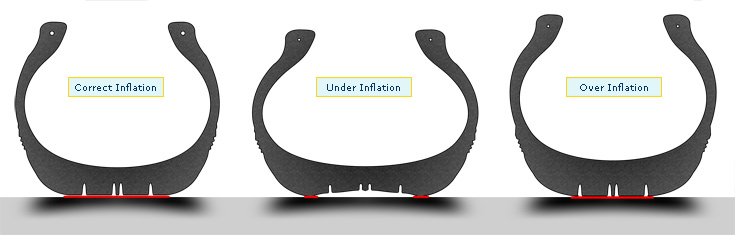
Here is a useful tip on how to ‘visually’ check if your tyre pressures are correct. The visual check is best done after you have covered around 50 to 100 kilometres of driving. Pull over to one side of the road (where it is safe and there is no loose gravel which can stick to the tyre tread), and take a look at each tyre from the front or the back.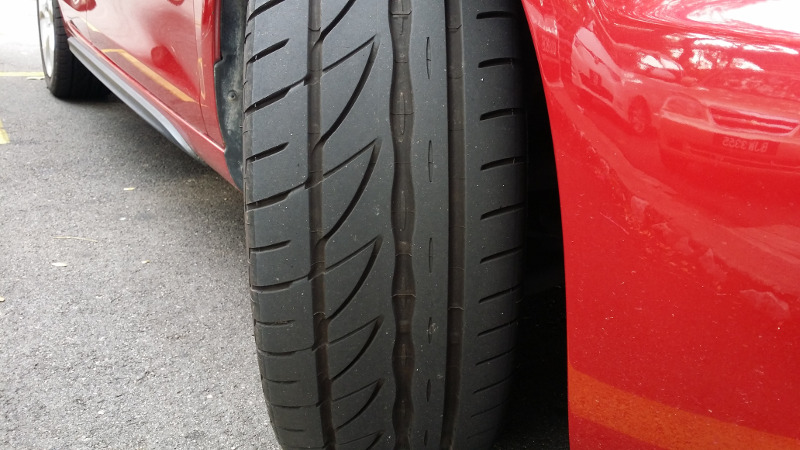
A tyre that is correctly inflated will have the entire width of its tread evenly ‘pressed’ onto the road surface. If this is the case, then you will note that across the entire tread, the colour of the tyre is exactly the same shade of black (unless you have a yellow or blue tyre – joke). An even shade indicates that the contact with the road (across the tyre tread) is even.
Conversely, if the tyre is under-inflated, then you are likely to see that the outer and inner edges of the tyre are of a darker shade than the centre of the tread. The outer edges have to bear a higher load, resulting in a higher wear rate. Depending on the contrast between the hues of the edges versus the centre, you will need to increase the tyre pressure of that tyre. Use 2psi increments if the difference is mild, recheck after driving for some distance and add on tyre pressure in 2 psi increments until you get an even wear pattern. Try to use the same gas station pump, or go get a reliable tyre pressure gauge, and use that gauge reading as your baseline.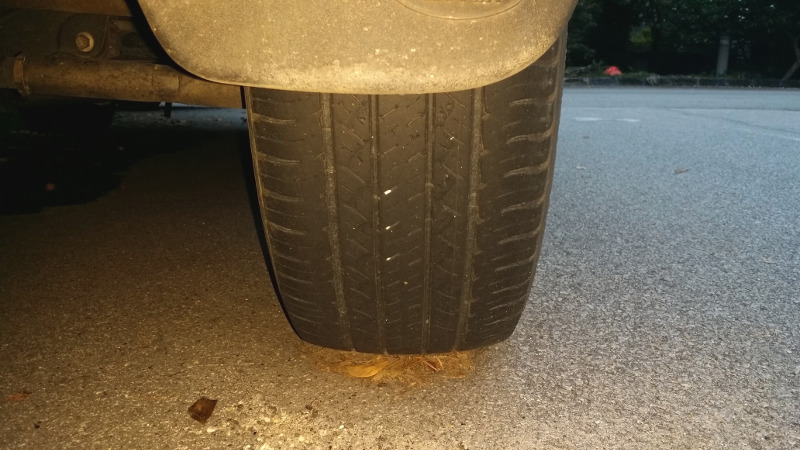
Prolonged under-inflation will result in the edges (or shoulders) of the tyre to wear out prematurely, which means earlier replacement, and makes your car less safe due to it not only having less grip on the road, but also increase the likelihood of a blow-out.
Over-inflation is also not good for your tyres – it causes the centre of the tread to ‘bulge’ downwards, causing the wear to be heavier along the centre of the tyre. If you happen to see the centre of the tread indicating a higher rate of wear (i.e. it is darker), then you need to reduce your tyre pressures.