


SEPTEMBER 17 — The opening of the Pinglu Canal on September 16, 2026 should be understood as more than the completion of another impressive Chinese infrastructure project.
It is potentially a pivotal moment in Asean — China relations because it begins to alter the economic geography connecting southwestern China with Southeast Asia.
Geography does not change. But the strategic meaning of geography can.
For decades, China's extraordinary economic ascent has been associated overwhelmingly with its eastern seaboard.
Guangdong, Fujian, Zhejiang, Jiangsu and the great ports facing the Pacific became gateways through which China entered the global economy. Pinglu introduces a different vector.
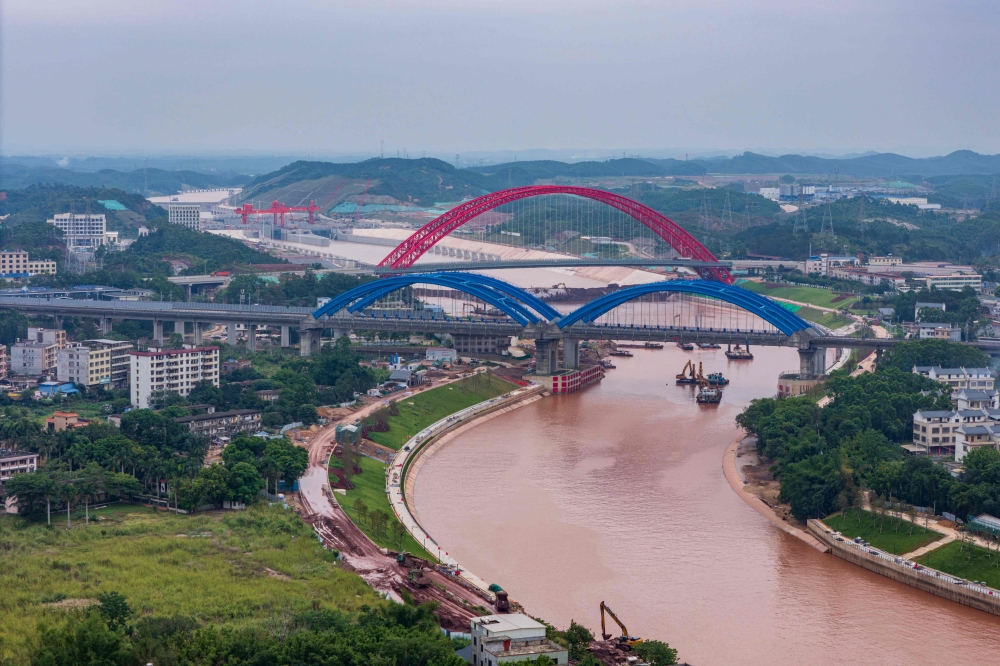
The 134.2-kilometre canal in Guangxi connects the Xijiang river system with the Beibu Gulf, providing southwestern China with a considerably shorter route to the sea.
The canal can accommodate vessels of up to 5,000 tonnes and is expected to shorten the inland shipping distance between southwestern China and Southeast Asian markets by more than 560 kilometres.
Estimates cited by Guangxi authorities suggest logistics costs could decline by 18 to 30 per cent.
These numbers matter. But geography matters even more.
The Beibu Gulf sits immediately adjacent to Vietnam and opens towards the maritime spaces of Southeast Asia.
Once goods from Guangxi and China's broader southwestern hinterland enter these waters, they are already facing Asean.
Thus Pinglu is not simply another Chinese canal.
It is China's new southern economic artery.
The importance becomes clearer when Pinglu is viewed together with the New International Land-Sea Trade Corridor.
Railways reaching Chongqing, Sichuan, Guizhou and Yunnan can increasingly feed cargo towards Guangxi, from where the canal and Beibu Gulf ports provide access to Southeast Asia and the wider maritime economy.
This could gradually transform the orientation of parts of western and southwestern China.
Regions historically constrained by their distance from China's eastern ports can increasingly look south.
And when China looks south from Guangxi, it sees Asean.
Indeed, the first day of Pinglu's operation carried considerable symbolism. New freight services included an international route connecting Nanning with Can Tho in Vietnam.
Cargo moving through the canal included building materials, minerals, steel, fertiliser and other commodities. The economic implications could therefore extend well beyond transportation.
Cheaper logistics can influence where factories are located, where companies source raw materials, where warehouses and industrial parks are constructed and how supply chains are organised. Over time, transport infrastructure can become industrial infrastructure.
This is why Asean should pay close attention.
China — Asean relations are often discussed primarily through the South China Sea, strategic competition between China and the United States, or negotiations over regional security architecture.
These issues remain important. Yet Asean — China relations are simultaneously being transformed from below by trade, investment, logistics, tourism, technology and infrastructure. The Pinglu Canal strengthens this second layer.
Trade between China and Asean reached approximately 4.34 trillion yuan in the first half of 2026, according to Chinese customs data, an increase of 18.2 per cent year-on-year.
Meanwhile, container throughput at Beibu Gulf Port increased from 2.28 million TEUs in 2017 to 10.06 million in 2025.
Physical connectivity is therefore being constructed on top of an already enormous commercial relationship.
Malaysia should take particular notice.
Qinzhou is not an unfamiliar name in Malaysia — China relations.
The China-Malaysia Qinzhou Industrial Park already represents an important experiment in cross-border industrial cooperation.
Improved connectivity through Pinglu could strengthen Qinzhou's position as a gateway linking Malaysian businesses not merely with coastal China but increasingly with China's western economic hinterland.
This potentially changes how Malaysia should think about its economic relationship with China.
The question should no longer be simply how Malaysian products can reach Shanghai, Shenzhen or Guangzhou. Malaysia must increasingly examine how its companies can reach Chongqing, Chengdu, Guizhou, Yunnan and the enormous economic spaces beyond China's traditional coastal centres. Pinglu potentially provides part of that answer.
Other Asean members should think similarly.
Vietnam is geographically closest to the emerging corridor and already has extensive production networks connected to southern China.
Thailand can examine how its own transport networks can interface with the emerging land-sea architecture.
Singapore will naturally study the implications for shipping, logistics and financial services. Indonesia, Malaysia and Brunei should consider what greater traffic through the Beibu Gulf could mean for their ports and maritime economies.
Asean, however, should not approach Pinglu passively. Connectivity must work in both directions.
If Pinglu merely makes it easier for Chinese products to enter Southeast Asian markets, its economic benefits will be uneven.
The greater opportunity lies in making the canal a genuinely two-way artery through which Asean agricultural products, commodities, manufactured goods and increasingly sophisticated intermediate products can penetrate deeper into China's western markets.
This is where Asean agency becomes important.
The region should examine customs harmonisation, port connectivity, multimodal transport, digital trade documentation and industrial cooperation surrounding the emerging corridor.
Asean companies must understand the new geography before their competitors do.
There is also a strategic dimension. Infrastructure creates relationships that diplomacy alone cannot manufacture.
Railways, ports, industrial parks and canals create commercial constituencies with material interests in stability.
The more deeply China and Asean become connected through physical infrastructure, the greater their mutual interest in maintaining predictable relations.
This does not erase strategic disagreements.
Nor should economic interdependence be mistaken for geopolitical alignment.
Asean's traditional strength lies precisely in avoiding such binary choices.
Its member states can deepen economic engagement with China while maintaining strategic relationships with Japan, South Korea, India, the European Union, the United States and other partners.
Asean does not have to choose one corridor over another. It can connect them.
That is the essence of being polytropous: widening and deepening strategic options rather than allowing the region to become trapped within the architecture of any single major power.
Pinglu should therefore be approached neither with anxiety nor excessive celebration. It should be approached strategically.
China has constructed the canal because it understands a fundamental principle of statecraft: infrastructure can reorganise economic geography.
Asean must understand the same principle.
The pivotal significance of the Pinglu Canal is therefore not merely that China has built a 134.2-kilometre waterway.
It is that China's vast western and southwestern hinterland now has a more direct maritime orientation towards Southeast Asia.
A new economic geography is taking shape.
The Pinglu Canal does not merely bring China closer to Asean. It potentially brings a huge part of China that was historically inland closer to Asean than ever before.
The challenge for Asean is to ensure that this new geography works both ways.
If it does, September 16, 2026 may eventually be remembered not simply as the day China opened another canal, but as the moment when Asean — China connectivity entered a fundamentally new phase.
* Phar Kim Beng is a professor of Asean Studies, and director at the Institute of International and Asean Studies, International Islamic University Malaysia.
** This is the personal opinion of the writers or publication and does not necessarily represent the views of Malay Mail.


