


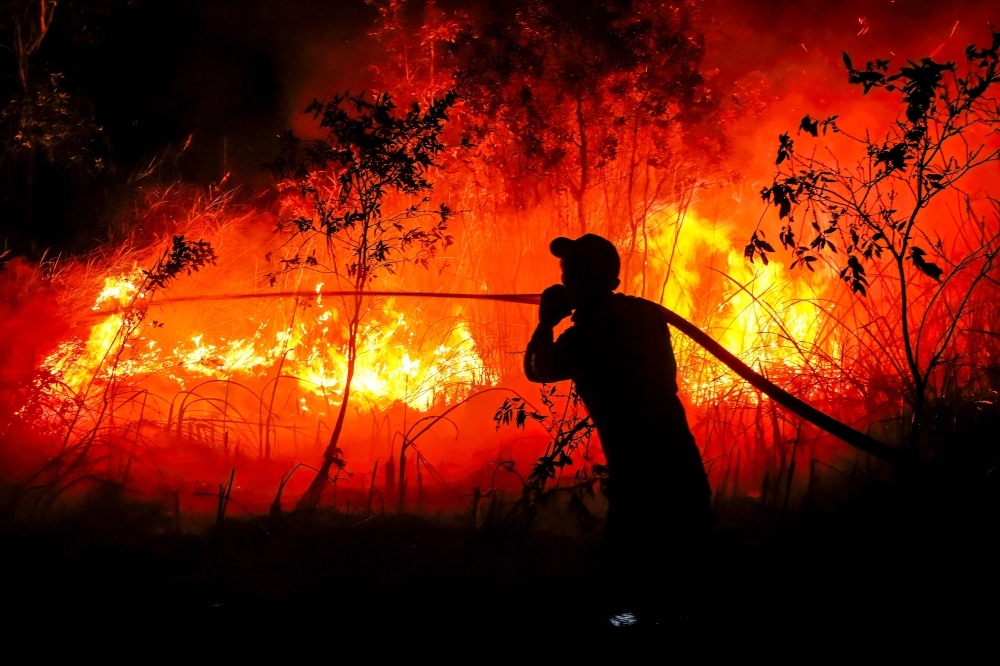
SEPTEMBER 16 — Earlier this month, Serian in Sarawak recorded an Air Pollutant Index (API) reading of 518 and an emergency was declared. Once again, Malaysians were reminded that a fire burning somewhere else can very quickly become our problem. We have been here before. Every serious haze episode produces the same questions: why is this happening again, and why, after so many years, has it still not been solved? We already have an Asean agreement, ministers meet, satellite monitoring has improved, Indonesia deploys resources to fight the fires, and Malaysia and Singapore offer assistance when conditions become serious. Yet once the fires are brought under control, the problem does not really disappear. It waits.
That is why I think we may be asking the wrong question. Instead of asking only who started the fire or who failed to enforce the law, perhaps we should ask something more uncomfortable: if almost everyone loses from the haze, why does no one want to move first? Prime Minister Datuk Seri Anwar Ibrahim has said that Asean’s existing mechanism for dealing with transboundary haze needs to be strengthened and that Malaysia would not shield Malaysian companies if Indonesian authorities found them involved in forest fires. That is important, but it also points to a deeper problem. The haze is not simply a problem of enforcement. It is a problem of incentives.
Start with business. Companies calculate costs. Mechanical land clearing, fire prevention, water management and tighter supervision all cost money. Imagine a company facing two choices. One is more expensive today but reduces environmental risk. The other is cheaper today, while the environmental cost may appear later, may be difficult to prove and may partly be borne by people hundreds of kilometres away. Which option does the current system make more attractive? This does not mean every company near a hotspot started a fire. A hotspot inside a concession does not automatically tell us who lit it. But corporate responsibility is wider than the question of who struck the match. How was the land managed? Were contractors controlled? Was enough invested in prevention? If prevention is expensive for the company while the consequences of failure are largely transferred to society, then the incentive is already wrong.
Smallholders face a different calculation. A large company may be thinking about margins, while a small farmer may be thinking about whether the family can continue farming. Illegal burning should still be dealt with, but if government simply tells a farmer, “You cannot burn”, the next question must be: what should the farmer use instead? Where does the machinery come from? Who pays for it? Can the farmer actually afford the alternative? This is why I do not think the answer is to reward people for not breaking the law. The real issue is to reduce the cost of legal transition through shared machinery, cooperative equipment, affordable financing and technical support. Different actors face different constraints. A large company that has the capacity to prevent harm should face a higher cost for failing to do so, while a smallholder who lacks that capacity should face a lower cost of moving towards a legal alternative.
Government adds another layer. Indonesia’s local authorities do not want fires, but they also want investment, jobs, agriculture and local revenue. A strict policy from Jakarta may look clear nationally, while local governments are the ones expected to enforce it and deal with the economic and political consequences. Jakarta itself must suppress fires and protect its governing credibility while also managing domestic industries, local interests and something Malaysia and Singapore cannot simply wish away: sovereignty. We can complain, request cooperation and offer aircraft, personnel, technology and expertise, but Malaysia cannot simply cross the border and enforce Indonesian law. This is why the haze is not only an environmental problem. It is also a governance, economic and sovereignty problem.
Malaysia and Singapore are in perhaps the most frustrating position. The fire may not be on our land, but the smoke comes here. We do not control the source of the pollution, yet we may still pay through health costs, school disruptions, tourism losses, lower productivity and public resources spent managing the consequences. Then, when the fires become severe enough, we may spend even more resources helping to contain them. Naturally, some people ask: why should the victim have to help? The answer is not sentimental. It is strategic. If helping Indonesia contain the fires costs Malaysia less than allowing the haze to worsen, then assistance is not charity. It is loss reduction. We help because refusing to help may cost us even more.
Asean sits above all these actors. It would be wrong to say Asean has no mechanism, because it does. The Asean Agreement on Transboundary Haze Pollution provides a framework for monitoring, information-sharing, cooperation and assistance. The problem is that coordination is not the same thing as accountability. Asean can bring governments around the same table, but the harder questions are who pays, who is responsible and what happens when the same failures keep repeating. Asean is built around sovereignty, consensus and non-interference, and those principles help very different governments continue working together. But they also reveal a limit when pollution crosses borders. Smoke crosses borders very easily; enforcement power does not.
Put all these players together and a very stable bad outcome appears. Everyone dislikes the haze, but the player who moves first may also be the player who pays first. A company spends more on prevention. A farmer pays more for legal land clearing. A local government enforces harder and worries about investment. Jakarta accepts more outside pressure and worries about sovereignty. Malaysia and Singapore continue paying for damage they did not create. Asean pushes harder and risks member-state resistance. In game theory, this resembles a bad equilibrium: each actor makes a decision that appears rational from its own position, yet together those decisions produce an outcome almost everyone dislikes.
But if the analysis stops there, game theory becomes an excuse for doing nothing. The answer cannot be that everyone has their own interests, so we wait for the next fire. This is where mechanism design becomes more useful. The idea is simple: if the same rules keep producing the same bad outcome, stop asking the players to suddenly become better people. Change the rules of the game. Good policy accepts that companies, farmers and governments will continue calculating their own interests, and then changes the calculation.
Singapore’s Transboundary Haze Pollution Act is worth examining for this reason. It has not solved the haze, but the principle behind it matters: pollution may cross a border, but responsibility does not automatically have to stop there. Malaysia therefore needs to ask what it can control on its own side of the border. If Malaysian companies operate on environmentally high-risk land overseas, should they face stronger disclosure and due-diligence requirements at home? If Malaysian banks finance such activities, should fire and land-management risks be considered more explicitly in lending decisions? If a supply chain repeatedly shows serious environmental risks, should that affect procurement, financing or certification? I am not suggesting that Malaysia accuse companies without evidence. I am asking something more basic: if capital crosses borders, why should responsibility suddenly become completely domestic?
Malaysia should also think more seriously about Sabah and Sarawak. Sarawak faces West Kalimantan, while Sabah borders North Kalimantan. Politically, there is a border, but ecologically Borneo remains one connected space. So why should cooperation become urgent only after the smoke has already crossed the border? Malaysia and Indonesia could build a more operational Borneo-focused protocol under existing national and Asean arrangements. If hotspot numbers, peat dryness, fire-weather conditions and wind direction cross agreed thresholds, higher risk could trigger faster information-sharing, joint assessment and the pre-positioning of firefighting resources. The point is not to allow Sabah or Sarawak to enforce law inside Indonesia. The point is to move cooperation earlier.
The deeper problem is that every player has something it cannot easily afford to lose. Companies do not want to lose margins, smallholders cannot lose livelihoods, local governments do not want to lose development, central governments do not want to lose control or sovereignty, Malaysia and Singapore cannot absorb unlimited health and economic losses, and Asean does not want regional cooperation to collapse into confrontation. But if everyone has something they cannot afford to lose, policy should not keep asking one player to volunteer to lose first. It should change the calculation.
Make prevention cheaper than repeated damage. Make poor environmental management more expensive than compliance. Make legal transition realistic for smallholders. Make cross-border capital carry cross-border responsibility. And make regional cooperation begin before the smoke reaches our cities.
Game theory helps explain why the haze keeps returning. However, if the same system continues to produce the same undesirable outcome, relying on all parties to behave differently next time is not an effective policy.
The solution is to change the rules and incentives that shape the game.
* Dr Low Kah Choon is affiliated with the School of Government (SoG) and Institute of Local Government Studies (iLGS), Universiti Utara Malaysia (UUM), Malaysia.
** This is the personal opinion of the writer or publication and does not necessarily represent the views of Malay Mail.


