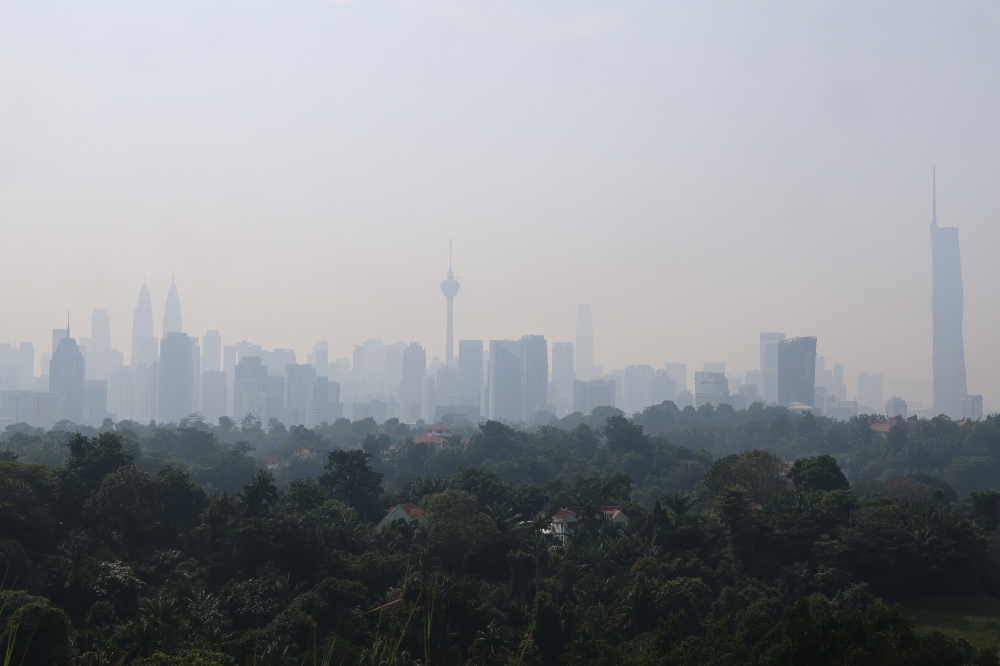
SEPTEMBER 15 — The haze is back and with it comes a familiar Malaysian routine: grey skies, masks, school closures and anxious checks of the Air Pollution Index.
This time, however, the scale has been difficult to ignore. An emergency was declared in Serian, Sarawak, on Sept 4 after the API reached 519. Although the emergency was lifted three days later as conditions improved, air quality remained poor. The haze affecting Sarawak has been linked to smoke from forest and land fires across the border in Indonesia’s Kalimantan region.
The crisis is also escalating within Indonesia. As of Sept 9, more than 113,000 people had suffered respiratory illnesses associated with the fires, according to Indonesian Health Ministry data reported by Reuters. More than 12.5 million people across seven provinces had been exposed to smoke and haze.
Yet beyond the immediate questions of air quality and public health lies a larger one that deserves our attention: Who should be accountable when environmental harm crosses corporate and national boundaries?
This is where the haze becomes more than an environmental crisis. It is also a test of environmental, social and governance (ESG) commitments.
The corporate dimension
Extreme heat and drought associated with the current El Niño have greatly intensified Indonesia’s fire season. But weather is not the entire story. Indonesian authorities have also turned their attention to companies operating in affected areas. Reuters reported on Aug 31 that the government was inspecting 19 companies after fires were detected within their concession areas, covering approximately 11,047 hectares. Satellite imagery had identified 42 companies considered at high risk of fire. Importantly, investigations were being undertaken to establish the circumstances surrounding individual fires.
Subsequent action makes the governance dimension even more significant. On Sept 4, Indonesia’s Ministry of Forestry announced administrative sanctions against five forestry concession holders in West Kalimantan following suspected forest and land fires within their respective concession areas.
These developments should not be interpreted as evidence that corporations are responsible for every fire. But they raise a much broader corporate governance question.
What responsibility does a company have for preventing environmental damage within the land, operations and supply chains under its influence?
That question matters increasingly in an era when companies proudly proclaim their ESG credentials.
ESG is more than the “E”
The haze demonstrates why ESG should not be reduced simply to carbon emissions or climate targets.
The environmental consequences are obvious: forest and peatland fires, greenhouse gas emissions, biodiversity loss and severe air pollution. Indonesia’s wildfire emissions surged dramatically in early September, according to data from the European Union’s Copernicus Atmosphere Monitoring Service.
But there is an equally important social dimension. People who may have nothing to do with the activities causing the pollution ultimately bear its costs. Children miss school. Outdoor workers breathe unhealthy air. Businesses are disrupted. Families change their routines, while vulnerable groups face increased health risks.
Then comes the often-overlooked “G” — governance
Who within a company oversees environmental risks? What information reaches the board? Are zero-burning and environmental commitments translated into effective controls on the ground? Are contractors and suppliers adequately monitored? Are warning signals acted upon? And when controls fail, who is held accountable?
The haze is therefore not merely an environmental problem. It is also a governance, risk-management and accountability problem.
From sustainability reporting to sustainability responsibility
This is particularly relevant lesson for corporate operating not only Indonesia but also in Malaysia. The Securities Commission of Malaysia has also specifically guided boards to consider governance, sustainability data boundaries, financial impacts and the integration of sustainability risks into enterprise risk management. In addition, Malaysia’s National Sustainability Reporting Framework uses IFRS S1 and IFRS S2 as its baseline sustainability disclosure standards. Its stated objective includes providing consistent, comparable and reliable sustainability information, while implementation is being phased across companies.
These are important developments. But the haze reminds us that ESG must ultimately be judged by corporate behaviour, not by the quality of a sustainability report.
A company can publish impressive commitments to zero burning, zero deforestation, responsible sourcing and climate action. But those commitments mean little unless they are supported by effective governance, controls and monitoring.
Boards should therefore be asking difficult questions
Where are our greatest environmental exposures? What is happening within our concessions and those of key suppliers? Can we identify emerging hotspots? Are contractors complying with environmental requirements? How quickly are incidents escalated to management and the board?
Technology makes these questions increasingly difficult to avoid. Satellite monitoring and geospatial data can identify hotspots and changing environmental conditions with unprecedented speed.
In such an environment, “we did not know” is becoming a less convincing governance defence.
Accountability cannot stop at the company gate
There is another important lesson. Modern companies rarely operate as isolated organisations. Their activities stretch across subsidiaries, contractors, suppliers, concession holders and complex commodity supply chains. Corporate responsibility therefore cannot automatically end at the legal boundary of the parent company.
This is particularly important for plantation, forestry, commodity and land-intensive businesses. Companies claiming responsible sourcing should know where important commodities originate and whether material environmental risks exist within their supply chains.
The same question should extend to those providing the money
Banks, asset managers and institutional investors increasingly make ESG commitments of their own. Where they finance businesses exposed to high-risk land use, environmental due diligence should consider fire-prevention systems, historical hotspots, concession management and environmental compliance.
In other words, accountability increasingly follows a chain: Land → concession → company → board → supply chain → financier → regulator.
Following that chain may tell us far more about genuine ESG performance than counting the number of sustainability reports published each year.
Regulators must move beyond disclosure
There is also a lesson for regulators. Better sustainability disclosure is necessary, but disclosure alone does not create accountability.
Claims about zero burning, responsible sourcing, deforestation-free operations or environmental stewardship need credible evidence behind them. Malaysia’s proposed sustainability assurance framework recognises precisely this broader concern: external assurance is intended to strengthen the reliability of sustainability disclosures and address greenwashing risks.
Regional cooperation also needs to evolve
Asean has become increasingly capable of monitoring hotspots and transboundary smoke. The next step should be to strengthen the connection between environmental information and accountability.
Imagine being able to trace systematically: Hotspot → concession → corporate ownership → supply chain → financier → accountable party.
Such transparency could transform satellite monitoring from primarily an environmental warning system into a powerful governance mechanism.
Malaysia should also continue examining whether existing mechanisms are sufficient to address serious transboundary environmental harm.
Singapore provides an important regional example. Its Transboundary Haze Pollution Act 2014 expressly extends to conduct outside Singapore that causes or contributes to haze pollution within the country, and provides mechanisms for both criminal and civil liability.
That does not mean Malaysia should simply replicate Singapore’s legislation. Transboundary environmental regulation involves difficult questions of jurisdiction, evidence, enforcement and regional diplomacy. But recurring haze makes the discussion increasingly difficult to postpone.
When the skies clear
Eventually, the haze will subside. Rain will fall, winds will change and blue skies will return.
The danger is that our concern will disappear with it. The recurring haze reminds us of what ESG should ultimately mean. It is not merely another reporting requirement or another glossy section of an annual report.
It is about whether organisations understand their environmental and social impacts, establish effective controls, manage risks throughout their operations and supply chains, and accept accountability when things go wrong.
The question for companies, boards, investors and regulators is therefore not simply whether they have an ESG policy.
It is whether those policies work when they matter. Good governance is not measured by what organisations promise when the skies are clear. It is measured by how responsibly they act and how willingly they accept accountability when the air turns grey.
*The author is an Associate Professor at the Department of Accounting, Faculty of Business and Economics, Universiti Malaya, and can be reached at [email protected]
** This is the personal opinion of the writers or publication and does not necessarily represent the views of Malay Mail.