















NEW YORK, Oct 23 — As an aviation writer I frequently ask flight crews for tips on what to see and do when I go somewhere new because they are among the most experienced travellers. And while some airlines capitalise on the knowledge — with guidebooks or crews who point out the landmarks they fly over — no airline seems more committed to having its employees act as travel ambassadors than Icelandair.
Because so many of its customers are passing through Iceland on flights between North America and Europe, this year the airline started a first-of-its-kind programme called Stopover Buddy, encouraging them to explore the country. Passengers who stop for a visit of up to a week, en route to another destination, can be paired with airline employees eager to show off the places they love. Travellers who participate get a buddy who is guide, driver and local expert. For the most part, the programme is free to passengers. Travellers pay for their own meals and admission to sites and events, and Icelandair picks up the expenses of the buddy, who is also being paid for the day by the airline.
On my fifth trip to the country, I signed up for buddy excursions, even though I had already been to the “must-do” sites. My guides approached the challenge of showing me something new as if it was their job. Which of course it was.
Day 1 — Plane talk
Flight attendant Margret Halldorsdottir greeted me with a hug and an introduction to her husband, Gunnar Magnusson, who would be our driver for the day. The country has 300,000 residents but no shortage of land so going anywhere outside the city centre requires a car. This explains how the wreckage of a US military plane can sit on a beach virtually untouched for 43 years. I first heard about this unusual sight from my niece, who hiked to it during a 2013 visit. Halldorsdottir, who has been a flight attendant for more than 30 years, agreed that a trip to the wreck was a great idea.
On November 21, 1973, the plane was being flown by pilots on a mail delivery flight to Keflavk. After the engines froze in a sub-zero fog, the pilots made an emergency landing on the ice-covered sand. Miraculously, all five men onboard walked away.
We examined the wreck. And lest we get the wrong idea about what we were seeing, our guide explained the bullet holes in the fuselage. “That’s not from World War II,” he said. “It’s only a lonely farmer’s weekend here in Iceland.”

Day 2 — Sea air
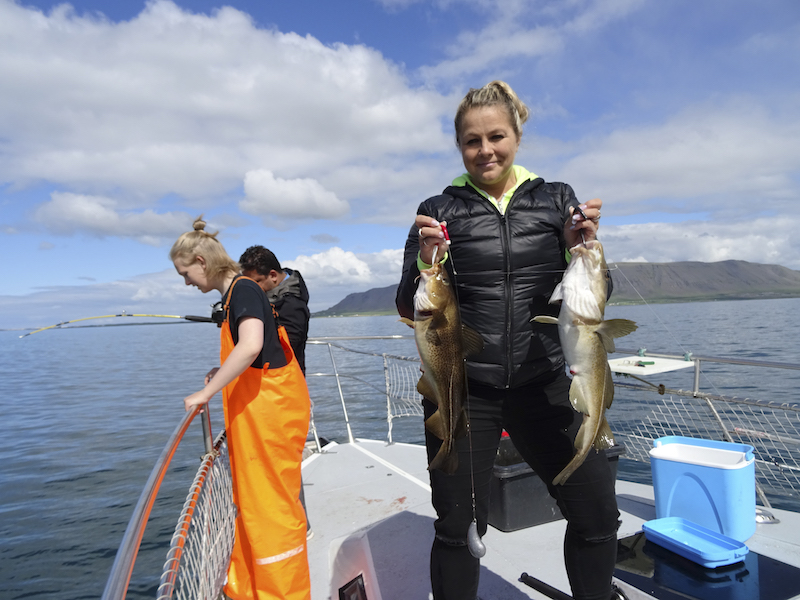
On the next day, Inga Osk Olafsdottir, a specialist in the airline’s network control centre, which handles route planning, took me fishing. She too, arrived with her companion, Sigurvin Bjarnason, who would drive us around. Bjarnason deposited us at the dock in Reykjavik’s old harbour and said he would meet us on our return that afternoon. He promised to buy us hot dogs from Reykjavik’s famous Baejarins Beztu stand if we failed to land any fish.
It was windy on the 45-foot yacht, especially topside where we would be throwing out our lines, so I donned a thermal suit. Olafsdottir was having none of that. Chic in her fashionably torn black jeans and ankle-high boots she was unfazed by the cold breeze coming off the sea.
She was, however, taken aback when she saw our captain, Bjorn Fridbjornsson. At first I thought it was his rugged, movie-star looks. I was wrong; he actually is a movie star and singer with five Icelandic films to his credit. Once Olafsdottir clued me in I was star-struck. But Olafsdottir quickly turned her attention to reeling in our lunch.
The cod were so plentiful that we were catching them two at a time. One was so big that the 16-year-old mate, Jakob Freyr Sveinsson, got a scale out to weigh it. Soon I had so many I gave up and let Jakob educate me about what the fish on my line had eaten before they foolishly took my bait. He was pulling starfish large and small out of their bellies.
This did not negatively affect my appetite. The smell from the grill on the fantail was enticing and we dug in as soon as the fish were cooked. Fed from the sea and warmed by the sun, I asked Fridbjornsson if he would sing for us, and he agreed.
He raised his voice over the roar of the engine and sang, Eg er Komin Heim, a well-known Icelandic tune that means, “I’m coming home.” — The New York Times