


MARCH 25 — Three of Singapore’s most distinctive and iconic buildings — People’s Park, Pearl Bank and Golden Mile — are set to be sold and likely demolished in the near future.
It appears that all three of the Brutalist Sixties- and Seventies-era towers will be sold to a private developer shortly, paving the way for their demise.
People’s Park was among the first residential and shopping complexes in the country.
It was built by local architects according to the principles laid down by the “father” of modern architecture — Le Corbusier.
Golden Mile, integrating office space, apartments, restaurants and shopping, was lauded in its heyday as the embodiment of a fully-functional vertical city.
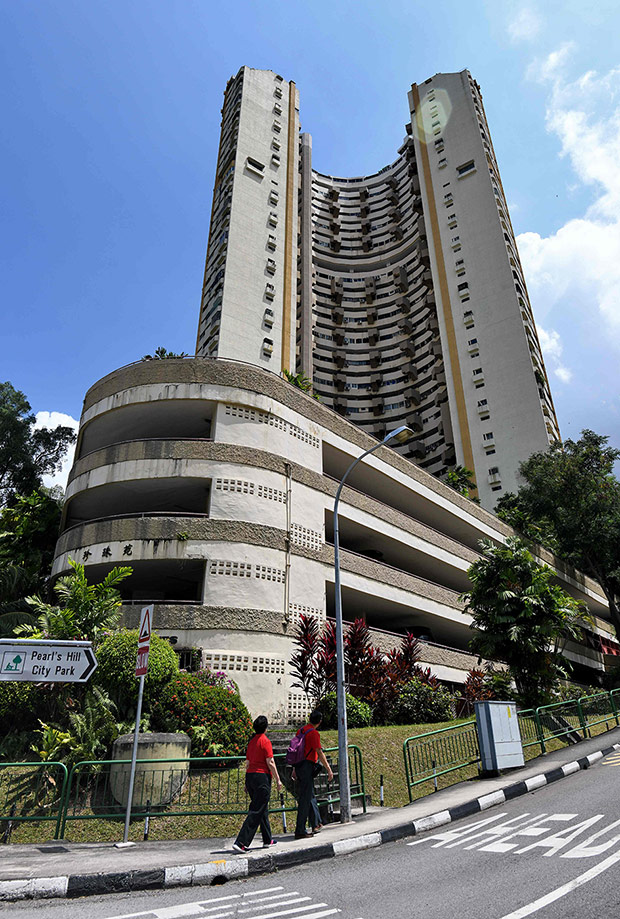
The slightly less well-known and more residential Pearl Bank was among the densest living spaces in the world when it was created with spacious apartments folded into a 3/4 cylinder (horseshoe shaped) 36-story tower.
Now all these buildings are showing signs of age and the rigid, geometric and concrete heavy Brutalist style does make for quite a contrast with the glass-fronted, soft-edged edifices that now dominate our skyline.
Still, is it really time to knock them down? An article on a popular online forum asked the same question — it explored why the buildings were going en bloc (being sold for redevelopment) but I think I might have a more accurate answer;
1. There are just such vast amounts of money to be made from rebuilding on these prime sites.
2. An entrenched position in our city state that the utility of land and space derives principally from how much profit it yields means the priority is rarely conservation.
The authorities have made no moves to list or protect these structures though all three have a distinct visual appearance, striking histories and clear architectural pedigrees.
Again the online commentary attempted to defend the impending demolition by arguing that the buildings’ architectural style was at odds with the present.
I think no more preposterous argument could be made.
Any architectural style from the past will be at odds with the present (that’s how the past works). Should the Istana or the Fullerton hotel be knocked down because they look different from contemporary buildings?
Of course the Brutalist style is a little unusual (even initially jarring to look at) but that’s the key to its appeal.
In a city that’s increasingly uniform; these three icons stand out: glitches in the matrix.
People’s Park looks like it fell out a retro future rendition of 22nd century Hong Kong (think Ghost in the Shell) while Golden Mile’s “pyramid” is pure Blade Runner (really, these buildings are cool).
They are also unique. Brutalism was a movement that took hold in Europe and North America; as tropical examples of the style emblazoned with Chinese characters and bright colours, these buildings don’t resemble much else.
The second argument posited online is that the buildings are halfway through their lease, making resale for the apartment owners difficult and making them keen to sell to developers.
There may be some truth to this but on that basis, every condo in Singapore would be sold off every 40 to 50 years and our skyline would be an apocalyptic mess of cranes and construction sites in no time.
Finally, the case is made that the buildings are old and increasingly difficult and expensive to maintain but that is true of any old building including say the Raffles Hotel but the solution isn’t demolition.
Refurbishment and redesign can solve a great many problems without having to erase these structures from the landscape.
Of course it’s understood that not everything can or should be preserved and Singapore’s essence is its endless modernising.
The willingness to demolish is a characteristic of our unsentimental, pragmatic and competitive city.
However, leaving three structures to record an architectural movement and an era doesn’t seem like conservation overkill.
While the buildings would have to be repurposed, they could certainly be put to use without being levelled. With some creative planning and willingness to provide incentives and support, Golden Mile could be made a creative work and living space for artists, designers and musicians — I suspect a design campus or university faculty could also be housed in there.
People’s Park could surely become a trendy hotel and entertainment complex. Of course doing this sort of conversion will not be as profitable or easy as a simple sale, demolition and rebuilding but with the correct incentives these projects might still make sense for investors.
Brutalist buildings have been successfully redeveloped and preserved across Europe. In England, the gargantuan Commonwealth Institute has emerged as a design museum while the shamelessly brutal Royal Docks building has become a creative work space.
Again a bit of lateral thinking and slightly less focus on profit and we can save a few pieces of our heritage. Something that fosters shared memory, history and identity and something that’s clearly part of our lived-in and visual history.
The reality is Singapore’s skyline, though packed with tall buildings, is pretty conservative. Our skyline is nowhere near as renowned globally as the cityscapes of Hong Kong, Shanghai, New York or even contemporary London or Dubai.
The number of internationally iconic Singaporeans buildings outside of Marina Bay Sands is near nil.
Meanwhile, these three Brutalist beauties are some of the most visually distinctive structures in the country so why flatten them in favour of more uniformity?
*This is the personal opinion of the columnist.


