


JULY 12 — When the month-long football fiesta comes to a close in Rio de Janeiro on Sunday night, I’m hoping and fully expecting Germany to follow up their sensational semi-final victory over hosts Brazil by claiming another South American scalp in the form of Argentina.
Hoping? Because Germany have been, on the whole, the best team in the tournament. Expecting? Because they are a far more effective all-round team than Argentina.
Although much of the attention following Tuesday’s never to be forgotten last four tie in Belo Horizonte understandably focussed on Brazil’s horrific and inexplicable defensive shortcomings, the splendour of Germany’s performance should also be saluted.
As much as Brazil were dreadful, Germany were magnificent, performing with stylish verve and relentless purpose to take full advantage of the generous gifts handed their way by the pliant hosts.
English football fans are particularly reluctant to shower any praise upon German teams, and I’ve seen some begrudging tributes of Joachim Low’s team tempering their admiration by using semi-damning phrases such as “clinical efficiency” and “ruthless accuracy”.
That’s wrong. Germany were far more than just ‘efficient’ or ‘ruthless’, the adjectives which have been most often applied to describe their footballing abilities over the last few years.
For the opening half hour in Belo Horizonte, by which time they were astoundingly 5-0 ahead, Germany were brilliant in every aspect of the game. Organised, disciplined and hard-working in defence, breathtakingly creative in midfield and unerringly confident in attack.
It was partly a display of the traditional German virtues of order and determination. But only partly. It was also a performance of high technical quality, with Sami Khedira, Mesut Ozil, Thomas Muller and Toni Kroos in particular oozing class in their movement and use of the ball.
They were given a considerable helping hand by Brazil’s haphazard lack of defensive structure, of course, but with that kind of performance there was simply no stopping Germany – no matter the identity of the opponent or how well they were playing.
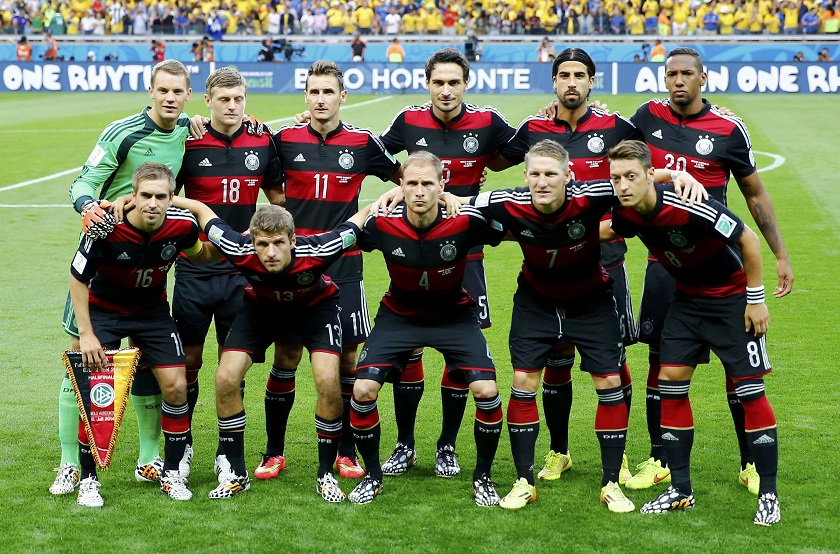
Nevertheless, their work is by no means done and Low, surely, will have immediately attempted to deflate the jubilant post-match atmosphere in his team’s dressing room by reminding his players that their historic victory over Brazil will count for nothing if they don’t also win the final.
Standing in their path is an Argentina team which bored its way to the final with a penalty shoot-out victory over the Netherlands following an utterly uneventful two hours of goalless and virtually chanceless football.
Their performance, disappointingly, was an antithesis of the manner in which Germany disposed of Brazil the previous evening.
Despite the fact that his team boasts arguably the world’s greatest player, Lionel Messi, Argentina boss Alejandro Sabella stuck to the approach he has maintained throughout the tournament by ordering his team to pursue a risk-free strategy which focussed first and foremost on avoiding defeat, with only a passing interest in attempting to win.
The very fact that Argentina are now preparing to play in the World Cup Final suggests their safety-first style of play has been a success, but they have been far from convincing.
Wednesday’s semi-final win over the Netherlands was by no means the first time the Albiceleste have flirted with danger during the course of the last month, starting in the group stage where they were left to hang on nervously for a 2-1 win over Bosnia & Herzegovina and needed an injury time winner Messi against Iran.
In the knockout phase, Argentina were within five minutes of being taken to another penalty shoot-out by Switzerland until Angel Di Maria popped up with an extra time winner, and they stumbled to a quarter-final win over Belgium by scoring early through Gonzalo Higuain and then doing nothing but defend.
After a tournament which has been largely characterised by attacking football, it would be a great shame if such a negative team as Argentina ended up as champions.
I don’t think it will happen. Germany are too experienced, have too much confidence, possess too many high quality players and congeal too well as a coherent team to suffer a particularly damaging dip in performance in the final; they might not be able to reach the same level they did against Brazil, but anything remotely close to those standards should be good enough.
As always, however, there is a caveat…and he goes by the name of Lionel Messi.
Quite simply, this is the biggest game in the Barcelona forward’s career. A World Cup winners’ medal is the only remaining gap in his trophy cabinet and he knows that his legacy will be guaranteed if he can lead his team to success this weekend.
So far, Messi has performed to his potential only in fits and starts during this tournament and has on the whole done little to advance the argument that he is the greatest player in history.
But mixed in with some otherwise anonymous performances, he has managed to produce some moments of sheer magic – the curled strike against Iran, a free-kick against Nigeria, a run and pass to tee up Di Maria’s winner against Switzerland…he remains capable of doing things on a football field that nobody else can.
If he can conjure one or more of those moments on Sunday night, Argentina could be crowned champions. But I won’t be betting on it.
* This is the personal opinion of the columnist.


