


JULY 8 ― The World Cup semi-finals get underway tonight with hosts Brazil still attempting to come to terms with the loss of star man Neymar as they prepare to face Germany in Belo Horizonte.
Neymar, make no mistake, will be a big loss.
The Barcelona winger has been easily Brazil’s most dangerous attacking player throughout the tournament, even though he failed to shine in the quarter-final victory over Colombia before being forced out of the action with the back injury which will keep him on the sidelines for a few weeks, probably extending into the start of the new domestic campaign.
In his absence, it’s difficult to see who will take Neymar’s place as his team’s chief creative force. Oscar is the only other player in the squad with the same kind of game-changing ability, but the Chelsea star is frustratingly inconsistent and has not played particularly well in the World Cup since the opening victory over Croatia.
The door could open for another Chelsea player, Willian, or the impish winger Bernard, but their combined total of three international goals (Neymar has 35) does little to provoke any confidence that they will be able to carry the load.
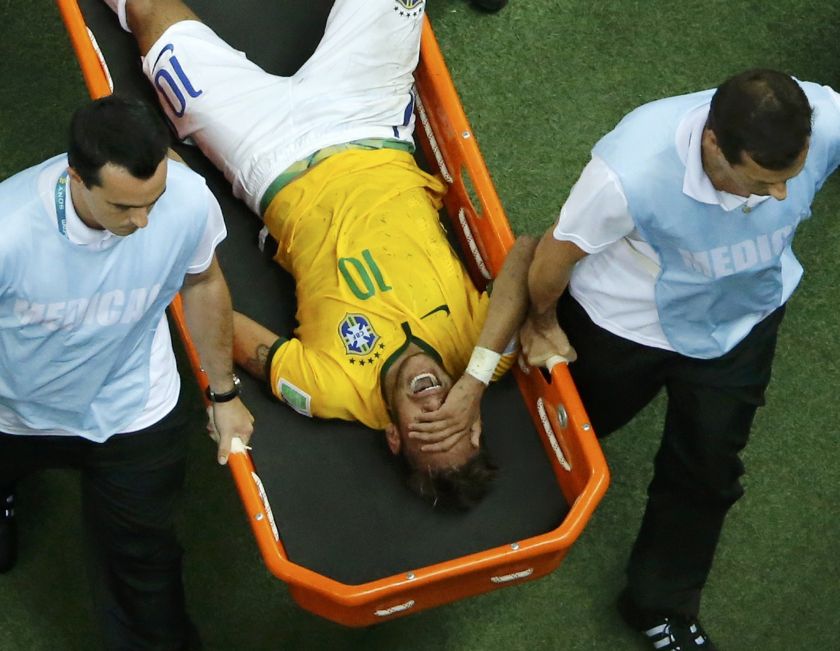
Almost as much as his ability on the ball, Neymar will be missed by Brazil for the infectious mood of optimism he is able to inspire both amongst his teammates and the home support. With him on the pitch, even when Brazil are playing poorly they ― crowd and players alike ― can always be hopeful that their superstar will conjure something to propel them to victory.
That kind of confident positivity may well be conspicuous by its absence tonight, and a nervous reaction from the Brazil fans ― whose near-hysterical presence often threatens to cross the line from encouragement to encumbrance ― could easily exert a significant negative effect upon the players.
To make things worse for Brazil, Neymar is not the only major absentee from their starting line-up with centre back and captain Thiago Silva missing the game through suspension.
Silva’s solid defensive partnership with David Luiz has been an integral part of Brazil’s gameplan over the last couple of years, and although likely replacement Dante is a good enough player, he does not have the same level of familiarity and understanding with Luiz as the captain.
Waiting to exploit Brazil’s frailties, of course, is a Germany team whose performance ― and particularly the manner of their performance ― in the quarter-final was an ominous sign of a team progressing smoothly towards title-winning mode.
Germany were far from sparkling as they defeated France 1-0 thanks to a set-piece header from Mats Hummels, but they were comfortably the better team and were especially effective in subduing the attacking threat of their opponents ― too much of the post-game analysis, I felt, centred on France’s poor attacking performance without giving sufficient credit to Germany’s organised defensive display.
It was notable that Germany boss Joachim Low changed his team’s approach for the game, turning his back on a midfield-heavy pretty passing style and reverting to a more fundamental 4-5-1 formation, with captain Philipp Lahm moved from midfield to right-back, Real Madrid’s Sami Khedira selected in the centre of the field and veteran Miroslav Klose picked as a conventional centre forward.
Until the France game, Low had more or less been attempting to imitate the strategy of Bayern Munich under Pep Guardiola, with a “false nine” striker and a heavy emphasis on dominating possession in midfield ― hence the redeployment of Lahm.
Although Germany were getting results, they weren’t looking particularly convincing and Low chose the quarter-final tie to turn his back on the new methods and go back to what he knows best. Despite the additional of a traditional striker in the form of Klose, it was a conservative, defensive move and could have been perceived as a sign of insecurity and uncertainty.
Instead, it proved to be the exact opposite as the Germans looked much more comfortable in the less adventurous but more commonplace 4-5-1, with their ability to control the spaces of the midfield far greater than they had been in the previous round’s hard-fought meeting with Algeria.
With Neymar absent, Brazil’s greatest chances of scoring in tonight’s game will be through set-pieces and counter-attacks.
If Germany play as they did against France, however, the latter of those two routes will be very difficult for the hosts because Low’s team will not allow themselves to be caught out in the transition from attack to defence ― it happened earlier in the tournament, but against France they appear to have decided enough was enough and that no easy chances would be surrendered.
And if there is ever any team likely to be well organised when defending against set-pieces, it is those old masters of disciplined attention to detail, Germany.
With the creativity of players like Thomas Muller, Mesut Ozil, Toni Kroos and Mario Gotze always likely to provide goalscoring chances to old predator Klose, I know where my money is tonight.
Thanks Brazil, it’s been fun ― but your ride might be over.
*This is the personal opinion of the columnist.


