










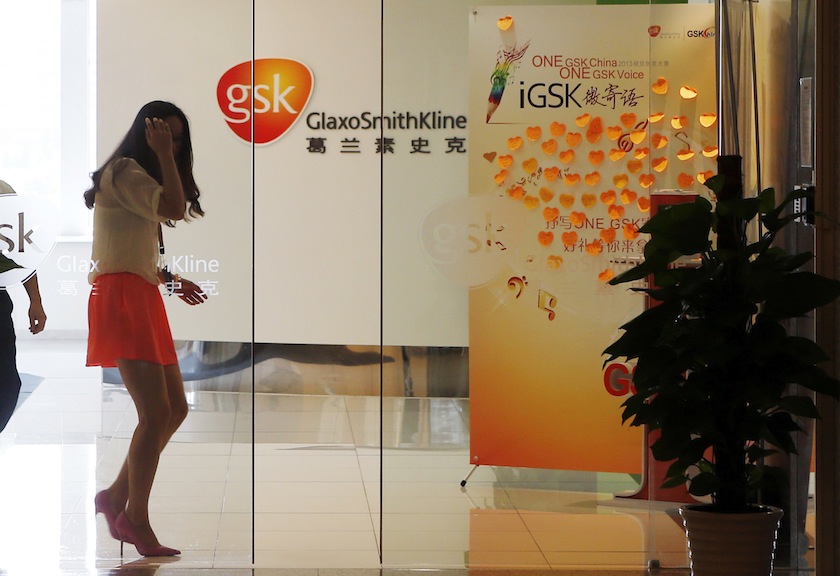


BEIJING, Sept 22 — China’s decision to impose a record fine on GlaxoSmithKline Plc signals that even the largest multinationals may not get off lightly in government investigations in Asia’s largest economy.
China on Sept 19 fined Glaxo almost US$500 million (RM1.6 billion) after a bribery investigation that had lasted almost 15 months and fueled declines in the pharmaceutical company’s local sales.
The Glaxo ruling comes after a spate of Chinese antitrust investigations into global companies have drawn protests from international trade groups, who warned that the scrutiny could undermine the country’s appeal.
The fine is a setback for Glaxo in China and shows the need for multinationals to ensure that business practices conform to the Chinese legal system, said James Roy, associate principal at China Market Research Group in Shanghai.
“Sometimes, foreign businesses become tempted in China, in industries where things like bribery are fairly common, to play by the local rules,” Roy said. “This is a sign that they’re not only on the hook from the laws in their own country, but from authorities in China as well.”
The Intermediate People’s Court in the city of Changsha in Hunan Province imposed the fine on Glaxo for bribing non- government personnel, the U.K. drugmaker said in a statement. It published an apology to China’s government and pledged to reform its practices.
Two calls on Sept 20 to the State Council press office went unanswered and it didn’t immediately respond to a faxed query seeking comments.
Anti-Corruption Drive
China is widening graft investigations after President Xi Jinping warned that corruption threatens the Communist Party’s six-decade hold on power. Xi’s anti-corruption campaign has snared thousands of party officials of all levels.
In July, former security chief and politburo Standing Committee member Zhou Yongkang was taken down and in June the campaign claimed Xu Caihou, a former vice chairman of the Central Military Commission, the country’s highest military body.
Foreign companies are still unlikely to be deterred from investing and will focus on the potential to make profits in China when making their decisions, Roy said.
While the Glaxo case will be a “factor” in how multinationals view China, their decisions to make investments in the country will be driven mainly by the ability to make profits, he said. “You’re still seeing continued investments from foreign companies—it’s dropping but the ones that are successful here are continuing to invest and open up new facilities.”
Industry Pricing
Probes in other industries have included an investigation resulting in a combined 669 million-yuan (RM352.506 million) fine last year of six infant-formula companies, including Mead Johnson Nutrition Co and Danone, for price fixing.
Since July, automakers including Tata Motors Ltd’s Jaguar Land Rover, Daimler AG’s Mercedes-Benz and Bayerische Motoren Werke AG have announced price cuts because of antitrust probes by China’s National Development and Reform Commission.
American and European business groups have issued reports expressing concern that international companies have faced the brunt of antitrust scrutiny. The American Chamber of Commerce in China called China’s antitrust enforcement “selective and subjective.”
Chinese regulators have rebuffed claims that overseas companies are being targeted, by saying only about 10 per cent of anti-monopoly investigations have involved foreign businesses. A call to China’s NDRC wasn’t answered.
Foreign Investment
China last year began an investigation into Glaxo’s sales practices in the country. Police in May 2014 handed a case to prosecutors alleging that Glaxo’s China unit illegally paid doctors and medical associations to boost sales.
As part of last week’s ruling, Mark Reilly, formerly Glaxo’s top executive in the country, was sentenced to three years in prison with a four-year reprieve, meaning he won’t face jail if he doesn’t break the law. Reilly will be deported, the official Xinhua News Agency said, without specifying whether he would be forced to leave immediately. Reilly couldn’t be reached for comment.
Few foreign companies faced corruption probes in China until recently and the government will use Glaxo’s case to show it has “zero tolerance” toward domestic and multinational corruption, said Ren Jianming, a professor at the School of Public Policy and Management at Beihang University in Beijing.
“The verdict set a precedence in China’s commercial corruption cases—the amount of the fine reached an unprecedented level,” he said. “It’s the first time a multinational company was punished with such a stiff sentence.”
Foreign direct investment into China slumped to a four-year low in August. Premier Li Keqiang has sought to counter perceptions that his government is making it tougher for foreign companies to operate in the nation, pledging a wider opening to outside investment.
The government will attract more imports, punish intellectual-property violators and treat foreign and domestic companies equally, Li said earlier this month. — Bloomberg