













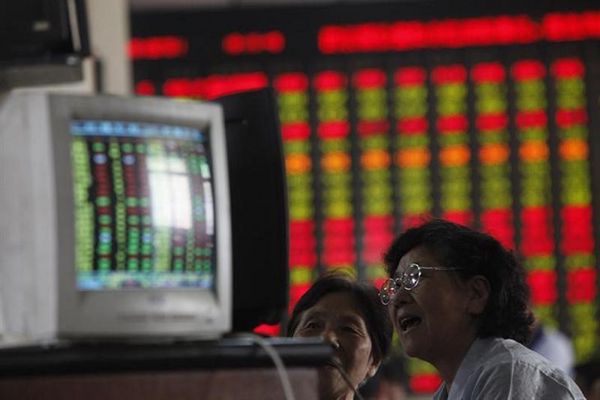


TOKYO, July 8 — Asian shares tumbled today as strong US jobs growth increased the chances of the Federal Reserve rolling back its stimulus in coming months, sending the dollar to a three-year high against a basket of major currencies.
Chinese stocks and regional sentiment were hurt by Beijing’s plan to choke off credit to force consolidation in industries plagued by overcapacity as it seeks to end the economy’s reliance on investment funded by cheap debt.
European shares were expected to open higher, however, with Britain’s FTSE 100 seen trading up as much as one per cent and Germany’s DAX up as much as 0.7 per cent, according to spreadbetters.
US employers added 195,000 new jobs to their payrolls last month, beating expectations of 165,000. Adding to the positive sentiment, the figures for April and May were revised up by a combined 70,000. The unemployment rate held steady at 7.6 per cent as more people entered the workforce.
Friday’s sharp selloff in US Treasuries — with the 10-year yield suffering its biggest one-day rise in nearly two years, Reuters data showed — accelerated losses that started in May over the uncertainty of the Fed’s US$85 billion a month bond-buying programme.
Yields on 10-year US Treasuries, which move opposite to price, were at 2.6924 per cent, turning lower after climbing to a nearly two-year high of 2.755 per cent in Asian trade. They jumped 23.3 basis points to 2.736 per cent on Friday, driving up US dollar borrowing costs.
“The money in the market is very short term right now. Most investors have given up hope for any stimulus from Beijing, but now it seems they could be rolling out stricter ground rules to aid the restructuring of the economy,” said Jackson Wong, vice-president for equity sales at Tanrich Securities in Hong Kong.
Manic Monday
Shares in MSCI’s Asia-Pacific ex-Japan index shed 1.8 per cent to a two-week low, while Chinese equities lost 2.2 per cent and Hong Kong’s Hang Seng Index dropped 2.1 per cent.
China’s resolve to overhaul its economy for long-term improvement will be tested this month if a slew of data shows growth is grinding towards a 23-year low, as expected.
The median forecast of 21 economists surveyed by Reuters show China’s economy likely expanded 7.5 per cent in April-June from a year ago, slowing from the previous three months as weak demand dented factory output and investment growth.
The CSI300 index has lost nearly 14 per cent so far this year, while the MSCI Asian gauge is down 10 per cent.
The weakness in Chinese markets dragged Tokyo’s Nikkei average down 1.4 per cent. Earlier, the Japanese benchmark climbed as much as 1.3 per cent to a six-week high.
“I don’t think it’s negative for Japan,” said a hedge fund manager, who declined to be identified, referring to higher dollar borrowing costs.
“For ASEAN countries, it is more of a concern if rates continue to go up. A lot of the funding for some of these countries is dollar-denominated.”
The selloff in Treasuries also hurt Japanese government bonds today, with the 10-year yield up 2.5 basis points to 0.880 per cent.
Dollar high
The dollar hit a six-week high of ¥101.54 after gaining 1.2 per cent on Friday, its biggest one-day rise in a month.
“The dollar looks likely to gain further. But then again, if Chinese shares face more pressures, we could see a bigger dip in the dollar/yen,” said Koichi Takamatsu, forex manager at Nomura Securities in Tokyo.
Against a basket of major currencies, the dollar advanced 1.6 per cent to a three-year high.
The euro dipped 0.1 per cent to US$1.2820, not far off a seven-week low of US$1.2806. It dropped 1.4 per cent versus the dollar in the previous two sessions on the US jobs data and the European Central Bank’s dovish policy guidance.
Brent crude prices added 0.3 per cent to US$108 a barrel, extending Friday’s 2.1 per cent rise on the strong US data and concerns over Egypt’s unrest increasing instability in the Middle East.
Copper prices eased 0.2 per cent to stay below US$6,800 a ton after shedding 2.3 per cent in the previous session as the dollar firmed, while gold eased 0.2 per cent, extending Friday’s two per cent decline. — Reuters