


KUALA LUMPUR, July 7 — As the race for the 16th Johor State Election enters its critical phase, the primary political contenders have released competing manifestos that detail different economic and social blueprints.
With all 56 state seats contested, these documents outline how each coalition intends to manage Johor’s unique position as a regional economic hub while addressing urgent local concerns regarding the cost of living and infrastructure.
From economic policies and welfare programmes to governance reforms and development plans, each manifesto presents a distinct strategy to address Johor’s economic and social challenges.
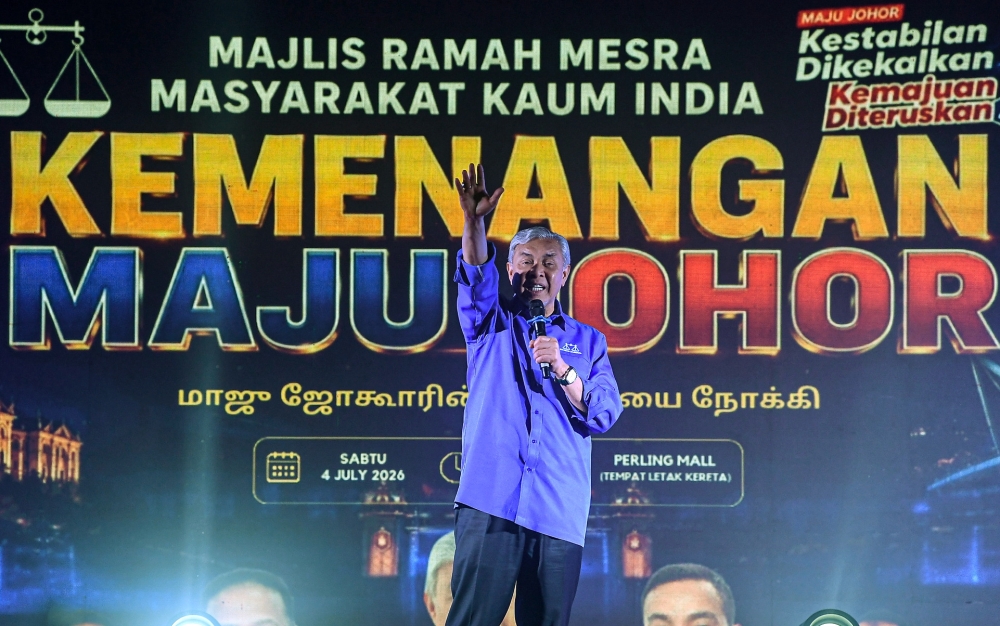
Barisan Nasional (BN) is anchoring its campaign on the manifesto “Maju Johor, Stability Maintained, Progress Continued”. This document outlines 63 pledges across six core pillars: governance, economic development, social safety nets, infrastructure, security and environmental sustainability, and youth development.
Pakatan Harapan (PH) has introduced “Johor Untuk Semua”, a manifesto containing ten pledges built on four pillars: sustainable employment, affordable housing, shared prosperity and a government defined by integrity.
As both coalitions battle for the mandate, here is a comparison of their primary promises to the electorate.
Barisan Nasional: Economic scale and social safety nets
BN focuses heavily on high-value employment and industrial growth. Its flagship goal is to create 200,000 quality jobs for Johor residents, including 100,000 premium-wage positions supported by strategic investments in high-technology sectors.
To assist small businesses, BN proposes an additional RM100 million for interest-free microfinancing. The coalition aims to expand Johor’s economy to RM260 billion by 2030 and increase the gross domestic product (GDP) per capita to RM69,000.
Housing and welfare are central to the BN platform. The coalition commits RM100 million to repair dilapidated homes for low-income households and another RM100 million to help families build subsidised homes on their own land, including second-generation Felda lots. BN also targets the completion of 70,000 affordable homes as part of a broader plan to deliver 100,000 Rumah Mampu Milik Johor units by 2030, prioritising youth, young families and the B40 and M40 groups.
To address poverty, BN will allocate RM500 million to help low-income families increase their earnings through education, skills development and targeted social assistance.
Regarding infrastructure, BN plans to build at least one mini water theme park in each local council and install 10,000 new streetlights statewide to improve safety. To support the low-carbon economy, the coalition aims to expand electric vehicle charging infrastructure to 1,245 units by 2030.
For the younger demographic, BN offers a rental deposit assistance scheme and the construction of 1,000 Rumah Orang Muda Johor using a rent-to-own model for those under 35. Other pledges include a RM200 subsidy for B2 and Class D driving licences for youths from households earning below RM5,000, and a RM100 million boost to the Johor Youth Education Fund for TVET and professional certifications.
Pakatan Harapan: Regional integration and cost of living
On its side, PH highlights the economic relationship between Johor and Singapore. A primary initiative is the goal to bring 20,000 professionals working in Singapore back to Johor by 2031.
To reduce travel times, PH pledges to halve cross-border commuting durations by integrating the Rapid Transit System (RTS) Link, BAS.MY and KTM’s Electric Train Service (ETS).
The PH employment strategy targets 250,000 quality jobs (50,000 annually) and a 30 per cent increase in median wages. This growth is intended to be driven by the Johor-Singapore Special Economic Zone (JS-SEZ), AI, the digital economy and green technology.
PH also proposes RM1 billion in funding for over 50,000 small and medium enterprises (SMEs), including the digitalisation of 20,000 existing businesses.
In healthcare, PH aims to introduce a Johor health scheme providing up to RM100,000 annual coverage for 500,000 Johor residents from the B40 and M40 groups, as well as persons with disabilities.
Housing remains a key battleground. PH promises to build 80,000 affordable homes (16,000 annually), describing this as the largest housing project in the state’s history. First-time homebuyers would receive an RM8,000 incentive, while 50,000 others would benefit from a rent-to-own scheme.
For families, PH pledges a RM1,000 savings incentive for every child born in the state and a RM500 million Johor Youth Fund for 50,000 young families. They also propose a RM50 public transport pass to improve mobility.
Others in the race
Other parties are also presenting their platforms to voters.
Parti Bersama Malaysia, contesting 15 seats, has released a five-point service pledge instead of a full manifesto. The party seeks to act as a “credible opposition” rather than form the government, focusing on housing rights, public transport and state spending oversight.
Within Perikatan Nasional (PN), PAS is contesting 11 seats and will likely provide targeted offers for specific constituencies instead of a formal manifesto. Coalition member Parti Pribumi Bersatu Malaysia is contesting 16 seats, but has not yet released its manifesto.
The Malaysian United Democratic Alliance (Muda) is contesting four seats with its “Kontrak Muda Johor 2026” manifesto. Its 15 pledges focus on political reform, the cost of living and environmental sustainability.
Polling will be held on July 11, with early voting taking place today.


