


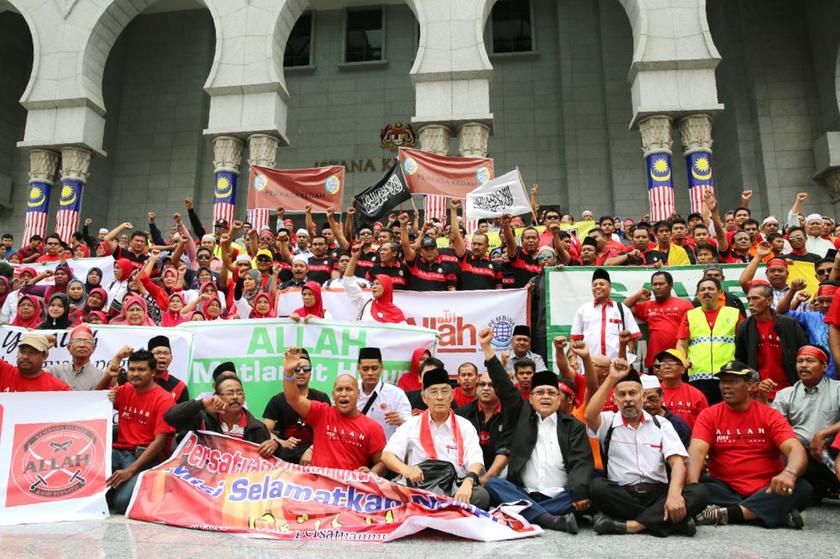
KUALA LUMPUR, March 21 — At its height, Malay rights group Perkasa wielded unlikely influence for what started as a one-man movement to exert pressure over Umno.
Founded by former MP Datuk Ibrahim Ali in 2008 and under the patronage of former prime minister Tun Dr Mahathir Mohamad, such was its clout that it was among those that forced Putrajaya to backtrack on promises to do away with race-based affirmative action for merit-driven reforms.
The source of this influence was that while Perkasa was not officially Umno, it counts among its numbers large swathes who are card-carrying members of the Malay nationalist party, a fact the group regularly touted when it sought to be heard within the corridors of power.
But there is now trouble in that former paradise.
Its affiliation to the increasingly isolated Dr Mahathir and his war against Umno president Datuk Seri Najib Razak meant it no longer held sway with Umno as it once did.
While Najib has gotten most of Umno to rally behind him, the same has not been the case in Perkasa, which is now torn between those loyal to Dr Mahathir and those siding with Umno and the prime minister.
Feeding the polarisation was Ibrahim’s decision to take part in Dr Mahathir’s “Citizens’ Declaration” that counted among its backers former rivals such as DAP, for whom both Umno and Perkasa have little love.
“I just met with some Perkasa members just now, they told me they are quitting. They even cut up their membership cards in front of me,” former Perkasa Youth chief Armand Azha Abu Hanifah told Malay Mail Online several days ago.
“As far as I know, 80 per cent to 90 per cent are all Umno members… A majority will leave I think,” he claimed.
The true extent of the split between Dr Mahathir and Najib loyalists in Perkasa are not immediately known, but it was sufficient that the Malay rights group’s secretary-general Syed Hassan Syed Ali had to call for a truce between the two last week.
Some Najib supporters in the group resigned in protest of the “Citizens’ Declaration” that seeks the prime minister’s resignation, prompting a rival batch of Perkasa members to threaten resignation from Umno in retaliation.
Syed Hassan urged both groups to refrain from further attrition, in a bid to stop an early skirmish from turning into full-blown civil war.
Armand quit as Youth chief over disagreements within Perkasa in 2011, but remains a life member. To illustrate the nexus between Umno and the Malay rights group, he is now an Umno Youth exco member.
“He (Ibrahim) said he went as an individual, but to me as an individual or not, you are still the Perkasa president. He’s been saying since 2009 that he won’t sit down with DAP, but now, because of a personal agenda, he does it,” Arman said of Ibrahim’s participation in the Citizens’ Declaration.
According to Universiti Kebangsaan Malaysia’s Institute of Malaysian and International Studies (IKMAS) associate professor Dr Faisal Hazis, the polarisation in Perkasa mirrored the situation within the Malay community.
He explained that the community has over the last five years become increasingly divided, and that Dr Mahathir’s decision to collaborate with rival parties often painted as the enemies of the Malays only worsened the polarisation in Perkasa.
“Even with Dr Mahathir supporters, with him joining forces with the opposition and the Citizens’ Declaration, it is basically splitting his own supporters to different sides. This is another manifestation of how fragmented the Malays are,” he added.
Ibrahim has acknowledged the rumblings that his role in Dr Mahathir’s campaign has caused, but sought to play down their significance and insisted that the situation remained manageable.
He also insisted that he did not sign the Citizens’ Declaration, and stressed that the former prime minister’s campaign was meant to unite the Malay community, rather than polarise it even further.
"There is lah (those who quit), very small number, not worth mentioning, too small, because I act very fast. I say if you go like this, Najib will also lose out, Dr Mahathir will also lose out,” he told Malay Mail Online in an interview.
He also insisted that Perkasa was not opposing Umno specifically, but was acting as a pressure group that will speak out against whichever party was in power when there is reason to do so.
Whether the split will be enough to break Perkasa remains to be seen, but Arman expressed belief that the group should survive the current tumult.
“Perkasa can go on… They are trying to touch up, but it won’t be as strong as before because Umno members are dissatisfied,” he said.


