


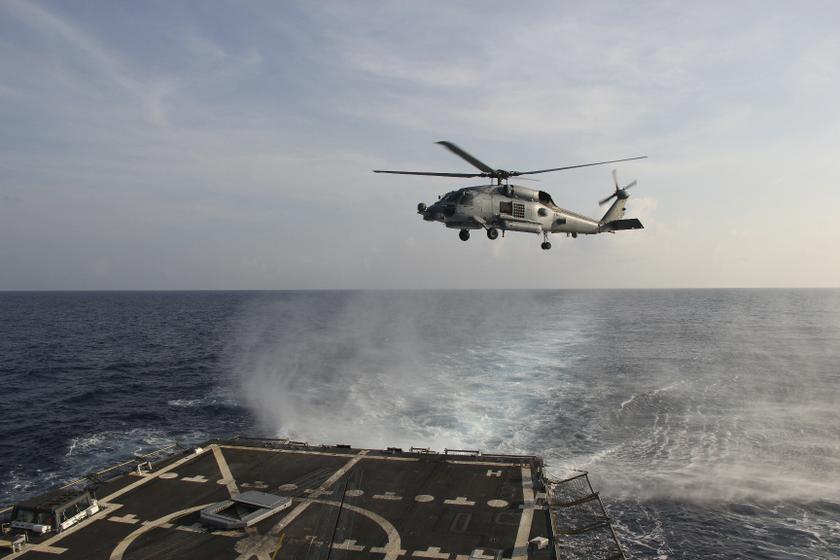


SYDNEY, March 18 — Australia is scouring an area in the southern Indian Ocean that’s about 1 1/2 times the size of California for missing Malaysian Air Flight 370, after the search became the longest in modern commercial aviation.
An AP-3C Orion plane was sent to search 600,000 square kilometres of ocean, according to the Australian Maritime Safety Authority. Five more aircraft, including one from the US and New Zealand, will tomorrow also begin scanning an area that’s about 1,500 nautical miles southwest of Perth in Western Australia.
“A needle in a haystack remains a good analogy,” John Young, the authority’s general manager for emergency response, said at a briefing today. “It’s a large area with aircraft that are towards the end of their operating limits. So they get a short period of time in the search area, and that dictates this is going to take quite a long time.”
Investigators are combing through data after the Beijing- bound Boeing Co. 777-200 aircraft was deliberately steered off its course and disappeared from radar. With little new information coming through, Malaysia’s government is also exploring the possibility of a pilot suicide.
Water movement
The longest period in modern passenger-airline history between a disappearance and initial findings of debris was seven years ago, when Adam Air Flight 574 went missing off the coast of Indonesia’s South Sulawesi. The Boeing 737-400, operated by PT Adam Skyconnection Airlines, lost contact with air traffic control January 1, 2007. Wreckage wasn’t found until the 10th day of the search.
The search area has been adjusted to reflect water movement and weather since March 8, Young said, as well as assumptions about the speed of the aircraft. It will probably take at least a few weeks to search the area thoroughly, he said.
“What we are doing is producing our best estimate of the most likely place to search,” Young said. “But I would hasten to add it is far from very precise.”
Much of the area is within the roaring forties, a region between the 40th and 50th degrees of latitude south known for strong winds and wave conditions, according to charts provided by the Australian Maritime Safety Authority.
A lesser possibility being explored is a northern route over land toward Kazakhstan, though US officials and radar experts said the jetliner probably couldn’t have passed through Indian or Chinese airspace undetected.
Resources needed
The search for the missing airliner faces four obstacles — the absence of fresh clues, the time that’s passed, the distance from the nearest air and naval bases and the size of the area to be searched — said a US intelligence official with search and rescue experience.
Alan Diehl, a former NTSB investigator, said that “adequate resources” weren’t being dedicated to the search in the southern Indian Ocean.
“We’ve got to get out there and find those black boxes,” he said on Bloomberg TV. “We’ve got 20 days and we need 100 of those patrol planes out there. In case it ended up in the Ocean, if we don’t get out there quick, it’s going to be too late.”
China also offered aircraft to help search the area in the southern Indian Ocean, Young said.
Satellite pings that weren’t turned off showed Malaysia Airlines Flight 370 operated for almost seven hours after last making contact on March 8, Malaysia Prime Minister Datuk Seri Najib Razak has said. That may have taken the plane more than 3,000 miles from where it was last tracked and pushed it to the limits of its fuel load, if it was airborne the whole period.
US plane
The US Navy ended its search effort in the Andaman Sea and moved a P-8A Poseidon reconnaissance plane to Western Australia to better support the search effort, Commander William Marks, a spokesman for the Navy’s Seventh Fleet, said yesterday.
Even if floating debris is found, it may be difficult to determine an area to begin searching for the crash site, said Mike Purcell, principal engineer at the Woods Hole Oceanographic Institution, which helped locate the so-called black boxes from Air France Flight 447 after it crashed into the Atlantic Ocean off Brazil in 2009.
“Things will have drifted farther and farther the longer we have to wait,” said Purcell, a leader of the search expedition.
Black boxes
While the black boxes are designed to operate at depths of 20,000 feet (3.8 miles) and may work in even deeper water, the range of the pings is a mile, according to manuals from Honeywell International Inc., the maker of the equipment. That may make the signals difficult to pick up even if an underwater microphone is over the correct location.
It can be difficult to hear the pingers if they are blocked by undersea mountains, said Dave Gallo, director of special projects for the Woods Hole Oceanographic Institution in Massachusetts, in an interview. Layers of water with different temperatures can also block sounds, he said.
Searchers will try to listen for sound-producing pingers attached to the plane’s black boxes that emit signals for 30 days after becoming immersed in water.
The emergency locator transmitters on a 777 are designed for land and don’t work underwater, nor do the satellite transmissions that investigators have used to triangulate the likely last-known location.
In the search for Air France 447 wreckage, authorities were able to narrow down a 5,000 nautical-mile area after finding floating objects five days following the crash. They also had a last known position plus four minutes of signals from the plane’s so-called Acars system, which was turned off on Flight 370.
Police search
Even with those clues, the pings from Flight 447’s recorders weren’t picked up. It took two voyages over almost a two-year period to find the debris field with unmanned underwater vehicles.
Police on March 15 searched the homes of the Malaysian flight’s captain, Zaharie Ahmad Shah, and Fariq Abdul Hamid, the first officer. A flight simulator Zaharie had at his home was taken for examination.
Checking the simulator will take time, police said. “It can’t be done within a day or two,” said Asmawati Ahmad, a spokeswoman.
Initial investigations indicated that the co-pilot had the last contact with air-traffic controllers, Malaysian Air group chief executive officer Ahmad Jauhari Yahya said yesterday.
“Alright, good night” were the last words from the cockpit, which came in at 1:19am as Malaysian air traffic controllers prepared to hand the plane over to Vietnamese counterparts, he said.
Last contact
The jet made its last satellite contact at 8:11am on March 8, according to Najib. Malaysian officials previously said the plane was last tracked by its transponder, a device that helps radar find its location more precisely, at about 1:30am.
Whoever was operating the plane went to great lengths to avoid being detected, shutting off the plane’s transponder beacon and a text-to-ground messaging system before turning the Malaysian Airline System Bhd. aircraft off its course. While not ruling out hijacking or sabotage, Malaysian officials said they had to investigate the pilots.
“Yes, we’re looking at it,” Acting Transport Minister Datuk Seri Hishammuddin Hussein said at a press conference in Kuala Lumpur yesterday, referring to a question about pilot suicide.
Multiple redundancies
The plane’s transponder and the Aircraft Communications Addressing and Reporting System, which transmits text messages and data to and from planes, have multiple redundancies against failure. Yet that’s only if they aren’t turned off from the cockpit, according to a person with knowledge of the plane’s system who wasn’t permitted to speak to the press about an ongoing investigation.
The actions on the flight deck indicate a high level of training in aviation and the 777 specifically, Patrick Veillette, a Park City, Utah, commercial pilot who has taught aviation safety, said in an interview.
There have been at least six airline crashes killing a total of 465 people that were caused by intentional actions by airline employees since 1982, according to AviationSafetyNetwork, which tracks accident data.
The most recent example of suicide came late in 2013, when a pilot steered an Embraer E-Jet into the ground in Namibia, killing 33, according to a preliminary report by the Mozambique Civil Aviation Authority.
EgyptAir, Southwest
In 1999, a co-pilot aboard EgyptAir Flight 990 pulled back the power in a Boeing 767 and dove toward the ocean off Massachusetts after the captain left the cockpit to use the restroom.
The one case not involving a pilot was in 1987, when an employee of Pacific Southwest Airlines who had just been fired smuggled a gun aboard a flight and shot the crew, according to the US National Transportation Safety Board.
In all of those cases, unlike the situation with the Malaysia flight, the end came quickly, usually with a dive into the ground. Also, investigators later found evidence of mental inability or high stress in the pilots’ lives, said John Cox, president of Washington-based aviation consulting company Safety Operating Systems, in an interview.
Suicide is rare even among private pilots, with eight recorded between 2003 and 2012, according to a newly published study by the US Federal Aviation Administration.
“This is completely against every other case that I’m aware of that we have seen,” Cox said. — Bloomberg


