




KUALA LUMPUR, Oct 28 — Putrajaya should not practise two different policies on the Christians’ use of the word “Allah” that would only split up those in Peninsula Malaysia and East Malaysia, Sabah’s second largest church said today.
Sabah Sidang Injil Borneo (SIB) said that it welcomed the prime minister’s recent reassurance that Christians in Sabah and Sarawak could continue to use the word “Allah” and the Alkitab, the Malay-language bible that contains the Arabic word.
But Sabah SIB, or Sabah’s Borneo Evangelical Church, stressed that any decision must be based on the guarantees of freedom of religion in the Federal Constitution.
“We reject any 1 Malaysia, two Alkitab policy that only serves to divide the nation and will not serve our members who are residing in Semenanjung Malaysia,” Sabah SIB’s president Rev Datuk Jerry Dusing wrote in a pastoral communiqué that was made available to the media.
Sabah SIB’s three-page statement comes just a day after the Home Ministry last week withheld the distribution of the Catholic Church’s weekly Herald in Sabah, before releasing it on Sunday after finding that it complied with a Court of Appeal ruling on the publication’s use of the word “Allah”.
The church’s statement also comes ahead of a court mention this Wednesday on a case against the Home Ministry, where it is seeking a few declaratory reliefs on its right to use the word “Allah”.
“We regret that the SIB case which was filed in 2007 even before the Herald case has been subject to long and unnecessary delays while the Herald case is now expected to enter its final stage before the Federal court. SIB’s case has now been scheduled for mention before the Deputy Registrar at the High court on October 30, 20l3,” Dusing said in the statement that was sent out to its leaders and members.
Dusing was referring to the 2007 suit filed by Sabah SIB after the Home Ministry seized three boxes of its Christian educational publications in the Malay-language, which contain the word “Allah”.
SIB had then asked the court to quash the Home Ministry’s decision and order the return of the Christian materials that were solely meant for the church’s internal use, as well as relief through the courts’ declarations on the Christians’ right to use the word “Allah”.
The Home Ministry has since returned the materials to Sabah SIB but the case remains pending in court.
Another case, filed in 2008 by Sarawakian Christian Jill Ireland Lawrence Bill against the Home Ministry for its seizure of her personal compact discs (CDs) containing the word “Allah” was also put on the backburner pending the disposal of the Catholic Church’s case.
Despite the Court of Appeal earlier this month maintaining the Home Ministry’s ban of the word “Allah” in the Catholic Church’s Herald, Dusing said it would not weaken Sabah SIB’s case as the “fact and circumstances” of both cases were “different”.
Dusing, who heads what he said is the second largest Christian denomination in Sabah, told SIB’s largely Bumiputera members that they should not “be misled by the assurance uttered by certain quarters that we can use the word ‘Allah’ to refer to God in Sabah and Sarawak”.
“It is more than just a word; it is about the fundamental right to worship God in the way we have been doing for generations without hindrance. The decision of the Court of Appeal against the Herald puts new restrictions on our human and constitutional right to freedom of religion,” he said.
Dusing also urged his church members to continue their friendship with the Muslims, saying that SIB’s court case was against the allegedly “wrongful conduct” of the federal government, and not against Islam or the Muslim community.
“We have never for one instance undermined the position of Islam as the religion of the federation. By the same token, we expect our constitutional right to profess, practise and propagate our faith to be respected by the courts and the federal government,” he said.
In noting the “contradictory and confusing statements” by Cabinet ministers on the Court of Appeal’s October 14 ruling in the Herald case, Dusing provided a few suggestions from the Sabah SIB to uphold the rights and freedoms of indigenous Christians in both east Malaysia and Peninsular Malaysia.
Dusing said the Home Ministry could withdraw its December 5, 1986 circular on the ban of a few Arabic words in Christian publications here, having earlier cited the former Attorney-General of Malaysia Tan Sri Abu Talib Osman as making this suggestion.
He also said the government could amend the same 1986 letter by removing the word “Allah” from the list of banned words, with the remaining listed words forbidden in Christian publications to only be “Kaabah”, “Baitullah” and “Solat”.
Putrajaya should also “give full effect to the 10 Point Solution by reviewing other administrative and legislative action” that goes against the meaning and intention of the agreement, Dusing said.
Dusing also said the government could “work towards a fair and just resolution” of the Sabah SIB case that will give a “clear formulation” of the Christians’ constitutional rights to use the word “Allah”.
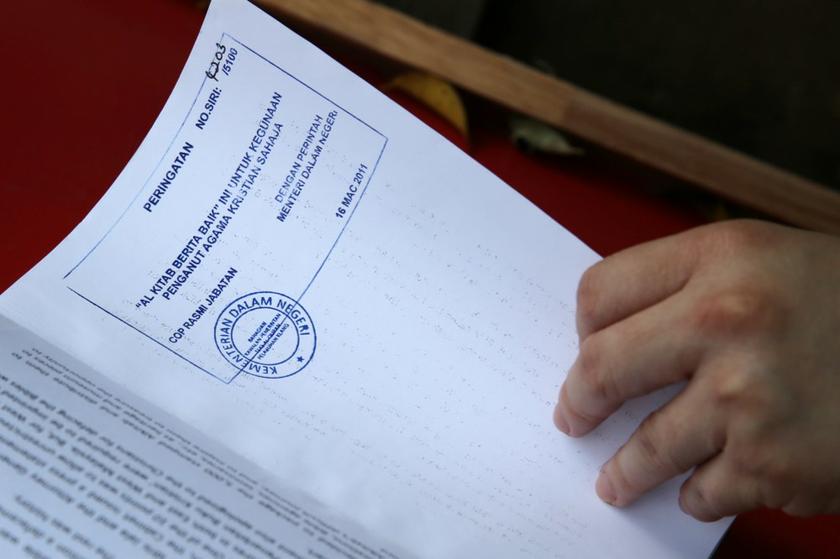
Several ministers recently said that the 10-point solution issued by Putrajaya in 201 — which allows the printing, importation and distribution of the Al-Kitab, the Bahasa Malaysia version of the Christian bible, containing the word “Allah” — should stand, despite the appellate court ruling’s in the Herald case.
The Najib administration issued the 10-point solution shortly before the Sarawak state election in 2011 to end a Home Ministry blockade of shipments of Christian holy scriptures in the Malay language containing the word “Allah”.
Prime Minister Datuk Seri Najib Razak also said recently that the ruling in the Herald case would not affect Christians in Sabah and Sarawak, while separately another Cabinet minister claimed that Christians from the Borneo states could also use the word in peninsula Malaysia.
According to a 2010 census, Muslims are Malaysia’s largest religious group, followed by Buddhists. Christians are the third largest at 2.6 million, which comes up to about 10 per cent of the entire Malaysian population.
Bumiputera Christians, who form about 64 per cent or close to two-thirds of the Christian community in Malaysia, have used the word “Allah” when praying and speaking in the national language and their native tongues for centuries.


