













PARIS, July 8 — Because of their role in global pollution, plastics are hugely controversial.
But the resilient, supple, light and malleable materials play a key role in our lives and, according to experts, will remain crucial for a long time to come.
Here are a few things to know about the world of plastic.
How it’s made
The classic production process involves the distillation and refining of fuel or natural gas, breaking down hydrocarbons.
Various raw materials make up the building blocks of the resulting plastic. Monomers build more complex molecules called polymers — the scientific name for plastics.
There are two families of polymers.
Thermoplastics, accounting for some 80 per cent of global plastics consumption, melt when they are heated and then harden when cooled.
Then there are thermosets, which do not soften after moulding.
How it’s used
Five polymers account for the majority — 71 per cent — of global plastics consumption.
First, there is polyethylene, found above all in single-use packaging, then polypropylene, used in car bumpers, dashboards and drinking straws.
Next up is polystyrene, used for packaging, insulation panels and yoghurt pots.
There is also polyvinyl chloride — better known as PVC — used in windows and drains — and then polyethylene terephthalate (PET), commonly used for synthetic fibres or bottles.
Lighter is better
There is much innovation in conventional plastics, with new properties being added to maximise performance.
Lighter is better, and slimming the volume of plastic is a constant challenge, not least to reduce the amount of plastic clogging the oceans and to wage war on waste.
But lighter plastic also means lighter finished products, including in transport.
“The need for (greater) lightness in auto transport is a massive innovation factor,” Christophe Cabarry, founder and president of SpecialChem, an online platform connecting sellers and buyers of chemicals and materials, told AFP.
A few grams a year are being shaved down, even on products as mundane as plastic bottles.
What about the environment?
The wait is on for the breakthrough of bioplastics — plastics made using biodegradable materials or natural recyclable materials.
“There is much innovation in the sector,” says Cabarry.
But of the 2.05 million tonnes of bioplastics produced worldwide last year less than half was actually biodegradable, according to European Bioplastics, an industry association.
The association put their market penetration at barely 0.75 per cent in 2017, owing to bioplastic’s much higher costs.
But we recycle, right?
Europe managed to re-use around 31 per cent of 26 million tonnes of plastics waste in 2016.
“Europe has initiated a transition from a linear towards a circular and resource efficient society”, says the PlasticsEurope association of manufacturers.
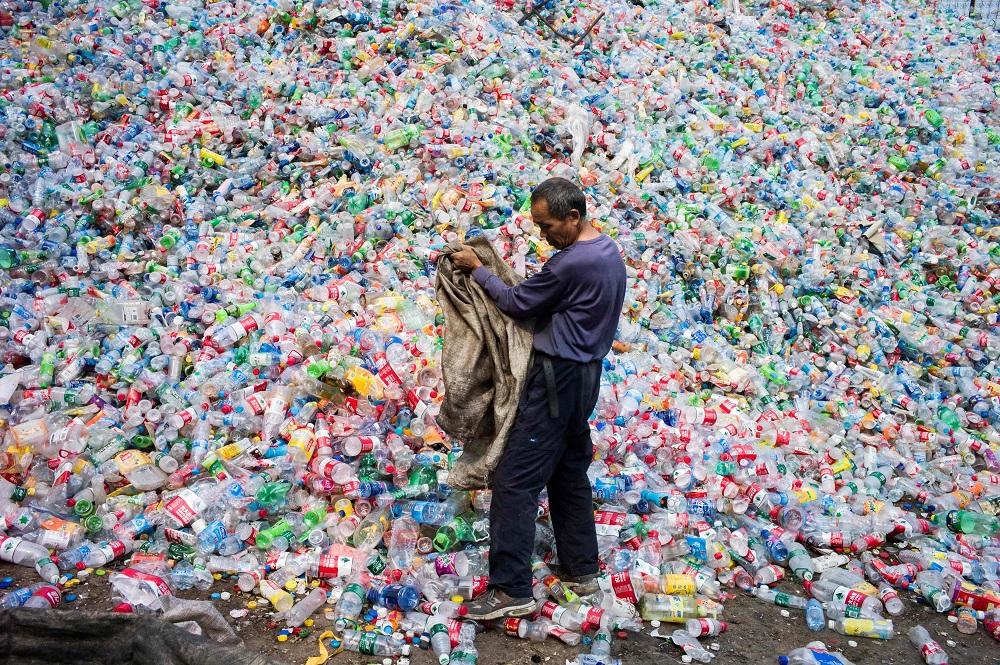
But the rate in the United States is much lower, at 10 per cent, and across the world, only 9 per cent of the nine billion tonnes of plastic produced to date has been recycled, a recent UN report said.
Some 12 million tonnes per year, mostly in the form of single-use packaging, are dumped into the world’s oceans, creating an ecological nightmare, according to Greenpeace. — AFPMOSUL, July 8 — Every day little Mohammed Salem roams the streets of Mosul, left with no choice but to hawk tissues after his father was killed by jihadists who overran Iraq’s second city.
A year on from Iraqi forces announcing the “liberation” of Mosul from the Islamic State group, the scars of the bloody nine-month offensive to oust the militants are still visible in the city.
After losing parents either in the battle or during IS’s brutal three year occupation of Mosul, dozens of children have turned to street peddling or begging to survive.
“I sell tissues... I go out every day from seven in the morning to 10 at night,” 12-year-old Salem tells AFP, wiping sweat from his face as the sun beats down on the Nabi Younis junction in eastern Mosul.
His mother’s only child, Salem hopes to scratch out a living for the two of them. His father was killed by jihadists before the push to retake Mosul began, leaving the family without a breadwinner.
According to the group Orphan’s Joy in Nineveh, encompassing Mosul and the wider province, there is no official data on the number of children who have lost their parents.
But the group’s research has pointed to the “presence of 6,200 orphans in Nineveh, of which 3,283 whose parents were killed in the latest events in Mosul”, the organisation’s head, Kedar Mohammed, told AFP.
‘Our house was destroyed’
Mosul’s two orphanages — one for boys and one for girls — have seen large numbers of children aged six to 18 seeking shelter, according to administrators.
Each day, dozens of children spread out across Mosul’s intersections and traffic signals to ask for money.
Thin and dressed in tattered clothes, they trail pedestrians and extend hands to passing cars. Some wash windows or sell tissues and water.
“My family was killed and our house was destroyed in the bombardment of the Old City,” 10-year-old Ali Bunyan told AFP, unable to hold back his tears.
Fighting destroyed nearly 90 per cent of western Mosul’s Old City, which now lies in ruins and is devoid of any major reconstruction projects.
“I have no relatives now. I have to beg to support myself... I’ve been unable to find work because I’m young,” said Bunyan, who like many of the other children refused to speak about his current place of residence.
Nineveh provincial council member Khalaf al-Hadidi said that “until now, there is no real project or study either from the federal or local government to deal with this phenomenon”.
Finding a solution was becoming increasingly important, he said, “especially as the street children are exposed to various kinds of exploitation”.
A ‘damaged generation’
Residents say gangs are turning the street children into organised groups, or forcing them to pay a fee to beg in public places.
“One day, as I was waiting for my appointment at a medical clinic, I watched an employee at the reception kick out a small girl that was begging,” said 35-year-old Mosul resident Abu Hamid.
“As she left, she told me she had been kicked out for refusing to increase the weekly agreed-upon fee,” he said.
According to social researcher Fatima Khalaf, “conditions in Mosul have left children vulnerable to numerous violations in the street”.
“If they are left out in the streets... they will become useless members of society, and perhaps some of them will become criminals,” she said.
Ghaleb Ahmed, a 20-year-old Mosul municipal employee, thinks it would be better to target the top of the “gangs and systems that manage the begging and exploit the children”.
“This phenomenon counts as a criminal project and terrorism, and it creates a corrupt and psychologically damaged generation,” he said. — AFP