


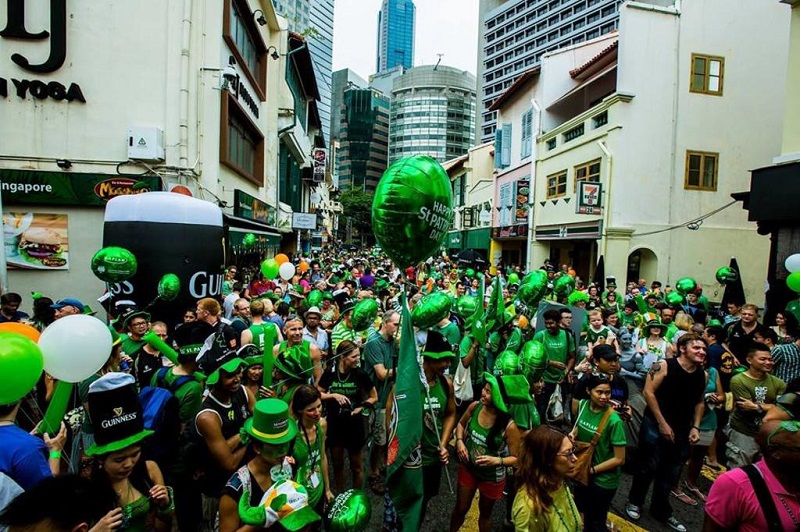


SINGAPORE, March 17 — The police said yesterday it has granted a permit for a St Patrick’s Day procession tomorrow — without any restrictions on the playing of musical instruments — on the basis that the festival is celebrated in Singapore as a “secular, cultural event”.
Organisers also have to comply with the condition that there should be no religious elements or paraphernalia displayed or used at the event, the police reiterated in response to TODAY’s queries after the decision had been questioned by some who noted that the event has religious roots.
The St Patrick’s Day Parade will take place from 3pm to 5pm tomorrow, along a 300m stretch of pedestrian walkways in Boat Quay. There will be no road or lane closures, the police said.
It will be held in conjunction with the St Patrick’s Day Street Festival organised in the vicinity over the weekend. A Public Entertainment Licence has been issued by the police for the festival.
“The St Patrick’s Day Street Festival and Parade are cultural celebrations organised by the Irish community in Singapore and Singapore River One, a not-for-profit organisation, working to increase the vibrancy of the Singapore River precinct,” the police said in a press statement. “As part of the permit conditions, there shall be no display of any foreign national flags or religious elements.”
It added that the parade is a cultural procession with no restrictions on the playing of musical instruments, “similar to the Chingay Parade and Utsav Street Parade”. The biennial Ustav parade is part of the annual Indian New Year celebrations. It was last held in 2017, and featured cultural performances and street floats.
However, some members of the public have pointed out that St Patrick’s Day marks the death of the foremost patron saint of Ireland, Saint Patrick, and commemorates the arrival of Christianity in Ireland.
Said Facebook user Vicknesh Rajamohan: “St Patrick’s Day is in fact a religious celebration. Suggesting otherwise is in fact doing a huge injustice to the Irish Catholic community… while the parade itself has evolved into a cultural parade, the festival itself is religious and that cannot be dictated or decided by the (police) out of regulatory convenience.”
Facebook user Yappilee Yap also felt that the decision to grant the permit was “insensitive” to the Hindu community here, noting that the police statement came a day after the courts sentenced three men for causing a ruckus during the Thaipusam procession in 2015 and clashing with police officers. They were fined, with one of them sent to jail.
The trio were along Serangoon Road on Feb 3, 2015, when the troupe that Ramachandra and Gunasegaran engaged to play the urumi — a traditional Indian drum — were stopped by the police.
The playing of musical instruments during Thaipusam was banned at the time. But the ban, which dated back to 1973 due to fights between competing groups, was relaxed in late-2015 and since 2016, live music was allowed at the festival, via three live music points along the procession route.
Last month, the police had to clarify claims made by a Facebook user alleging that a police officer and a Hindu Endowments Board (HEB) official disrupted a group’s kavadi procession during Thaipusam.
The incident occurred on Jan 31 after some participants in a group of about 16 were “singing, amplified through portable loudspeakers, and playing musical instruments”.
The police said on its Facebook page: “A HEB official advised them to stop, as it was not permitted under the Thaipusam permit conditions. However, one of the participants challenged the HEB official by claiming that what they were playing were not musical instruments.
“The group, however, eventually complied with the HEB official’s advice, and continued with the procession.”
In 2015, Home Affairs and Law Minister K Shanmugam explained that all religious foot processions have been banned since 1964, after riots occurred, but Hindus were given an exemption on three occasions — Thaipusam, Panguni Uthiram and Thimithi — passing through major roads.
He had noted that lion dances and the use of kompangs, for example, often take place during social and community events that are non-religious, just like how musical instruments such as Nathaswaram and Melas are allowed at Hindu community events.
“The truth is that Hindus are not discriminated against. In fact, they have been given a special privilege not enjoyed by others,” Shanmugam had said. — TODAY


